Facts
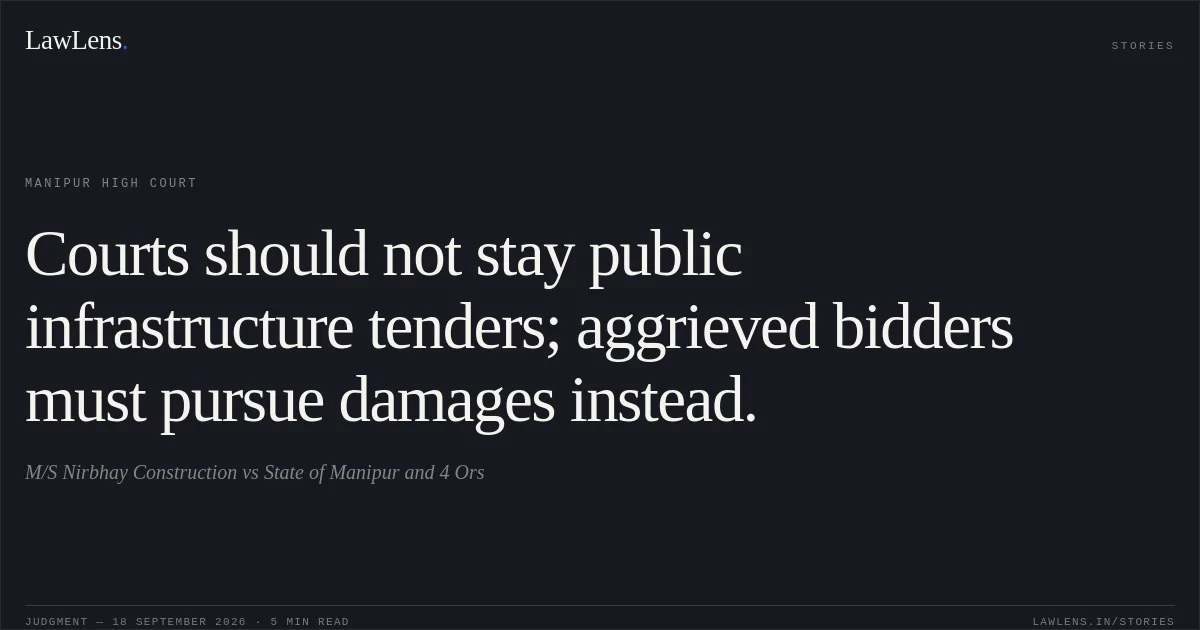
The State authorities issued two Notices Inviting Tenders dated 10 July 2026 for construction of roads under the Pradhan Mantri Gram Sadak Yojana: one covering 55 packages and the other covering 41 packages.
Source reference: pp. 6–8, paras. 3–4The appellant bid for 40 packages under the first NIT and all 41 packages under the second NIT.
Source reference: pp. 6–8, paras. 3–4The technical bids were opened on 27 July 2026 and evaluation reports were prepared on 1 September 2026.
Source reference: p. 8, para. 6On 3 September 2026, the appellant complained that respondent No. 4, M/s Bhartia Infra Projects Limited, was technically non-responsive owing to alleged deficiencies in machinery, personnel, double-counting, suspected falsity of documents, and non-disclosure of CBI proceedings.
Source reference: p. 8, para. 6; pp. 13–14, para. 6Relying on Clause 22.6 of the Instructions to Bidders, the appellant contended that the complaint had to be considered and resolved before opening the financial bids.
Source reference: p. 8, para. 7The appellant filed a writ petition and an interim application seeking to restrain the State authorities from opening or acting upon respondent No. 4’s financial bids and from issuing letters of acceptance or work orders.
Source reference: p. 8, para. 8The Single Judge declined interim relief on 9 September 2026.
Source reference: p. 8, para. 8During the writ appeal, the State produced proceedings dated 10 September 2026 showing consideration of the appellant’s complaint, after which the financial bids were opened on 11 September 2026 and letters of acceptance were issued for 84 packages to respondent No. 4 and for the remaining 12 packages to other bidders.
Source reference: pp. 15–16, para. 7; pp. 28–29, paras. 14–15The State also submitted that the road projects were centrally sponsored, involved approximately ₹638 crores, and were subject to a 30 September 2026 deadline, failing which the funds would lapse.
Source reference: p. 30, para. 17Issues
1. Whether the State authorities complied with Clause 22.6 of the Instructions to Bidders by considering the appellant’s complaint for resolution before opening the financial bids.
Source reference: pp. 28–29, para. 142. Whether the appellant was entitled to receive a copy of the proceedings dated 10 September 2026 or to be issued a show-cause notice before the complaint against respondent No. 4 was considered and the financial bids were opened.
Source reference: pp. 16–17, paras. 8–93. Whether the Court should grant interim relief restraining the award or execution of public road-construction contracts pending disposal of the writ petition.
Source reference: pp. 29–31, para. 154. Whether the appellant’s challenge was maintainable in view of the objection that “Nirbhay Construction” was a sole proprietorship and that the authority relied upon did not expressly authorise filing of the writ appeal.
Source reference: pp. 17–19, para. 9Law Applied
The Court applied the principles governing judicial review in tender matters laid down in Tata Cellular v. Union of India, (1994) 6 SCC 651, including judicial restraint, review of the decision-making process rather than appellate re-evaluation, deference to administrative expertise, freedom of contract subject to non-arbitrariness, absence of bias and mala fides, and consideration of public consequences.
Source reference: pp. 20–22, para. 12It relied on Jagdish Mandal v. State of Orissa, (2007) 14 SCC 517, Michigan Rubber (India) Ltd. v. State of Karnataka, (2012) 8 SCC 216, Central Coalfields Ltd. v. SLL-SML (Joint Venture Consortium), (2016) 8 SCC 622, Afcons Infrastructure Ltd. v. Nagpur Metro Rail Corporation Ltd., (2016) 16 SCC 818, Silppi Constructions Contractors v. Union of India, (2020) 16 SCC 489, Uflex Ltd. v. State of Tamil Nadu, (2022) 1 SCC 165, Galaxy Transport Agencies v. New J.K. Roadways, (2021) 16 SCC 808, and N.G. Projects Ltd. v. Vinod Kumar Jain, (2022) 6 SCC 127, for the propositions that the employer is best placed to interpret its tender conditions, courts should not substitute their decision for that of the tendering authority, and public-service contracts should not be lightly interdicted.
Source reference: pp. 21–24, paras. 12–15The Court also applied Section 41(ha) of the Specific Relief Act, 1963, which bars injunctions that would impede or delay the progress or completion of an infrastructure project, and the principle that road construction constitutes an infrastructure project of public importance.
Source reference: pp. 24–26, para. 15Clause 22.6 required complaints to be “considered for resolution” before opening Part-II financial bids, but the tender documents did not require furnishing the resolution proceedings or issuing a show-cause notice.
Source reference: pp. 16–17, para. 8; pp. 28–29, para. 14Reasoning
The Court held that Clause 22.6 did not prescribe any particular procedure for resolving complaints, require disclosure of the resolution proceedings, or mandate a time gap between resolution and opening of the financial bids.
Source reference: pp. 28–29, para. 14The State’s proceedings dated 10 September 2026 demonstrated that the appellant’s complaint had been considered before the financial bids were opened on 11 September 2026, and all bidders, including the appellant, had been notified of the opening.
Source reference: pp. 28–29, para. 14Consequently, the contractual requirement in Clause 22.6 was satisfied.
Source reference: pp. 28–29, para. 14The Court rejected the contention that a show-cause notice was mandatory because the complaint was directed principally against respondent No. 4 and the NIT contained no such requirement.
Source reference: pp. 16–17, para. 8; p. 31, para. 16It further declined to examine the merits of the allegations concerning machinery, personnel, documents, and alleged non-disclosure as an appellate authority, observing that such matters involved technical evaluation within the employer’s domain.
Source reference: pp. 13–17, paras. 6–8Given the public character of the road projects, the substantial central funding, the imminent lapse of funds, and the statutory policy against delaying infrastructure projects, the Court held that interim restraint would be contrary to public interest and the principles in N.G. Projects.
Source reference: pp. 29–31, paras. 15–17The preliminary objection concerning the appellant’s legal status and authority to institute the appeal was left open for determination by the Single Judge in the pending writ petition.
Source reference: p. 31, para. 19Holding
The Division Bench held that the State had complied with Clause 22.6 by considering the appellant’s complaint before opening the financial bids.
The appellant had no contractual entitlement to receive the complaint-resolution proceedings or to demand a show-cause notice.
Source reference: pp. 28–31, paras. 14–18In view of the restricted scope of judicial review in tender matters and the public importance and time-sensitive nature of the road projects, no interim injunction restraining the award or execution of the contracts was warranted.
Source reference: pp. 28–31, paras. 14–18Finding no error in the Single Judge’s order refusing interim relief, the Court dismissed the writ appeal and the connected miscellaneous application, without costs, while leaving the maintainability objection open for consideration in the pending writ petition.
Source reference: p. 32, paras. 18–20Acts & Sections Cited
2 provisions across 1 statute referred to in this judgment. Each provision opens on LawLens.
Specific Relief Act, 19632
Original Court PDF
M/S Nirbhay ConstructionvsState of Manipur and 4 Ors
Click to open original judgment
Original judgment, available to read, download and summarize on LawLens.in