Facts
The applicants were arrested in connection with Crime No. 64/2025 registered at Police Station Kharsiya, District Raigarh, for offences under Sections 296, 331(6), 324(2), 115(2) and 105 read with Section 3(5) of the Bharatiya Nyaya Sanhita, 2023.
Source reference: para. 3The prosecution alleged that the applicants and other co-accused assaulted the complainant, following which the complainant’s father intervened, fell during the scuffle and subsequently died.
Source reference: para. 3The post-mortem report recorded cardio-respiratory failure as the cause of death and found no external injury on the deceased’s body.
Source reference: para. 3The applicants had previously been granted bail by a Co-ordinate Bench of the High Court in MCRC Nos. 3045/2025 and 3311/2025 by orders dated 4 July 2025 and 30 June 2025, respectively.
Source reference: paras. 2–4, 7They allegedly failed to appear before the trial Court on 1, 3 and 4 August 2026.
Source reference: paras. 2–4, 7Although their counsel appeared and sought exemption from personal appearance under Section 355 of the BNSS, the application was rejected and non-bailable warrants were issued.
Source reference: paras. 2–4, 7The applicants thereafter appeared before the trial Court on 22 August 2026 and were taken into judicial custody.
Source reference: paras. 2–3Their application for cancellation of the warrants and release on bail was dismissed by the trial Court on 24 August 2026, leading to the present second bail application under Section 483 of the BNSS.
Source reference: paras. 2–3Issues
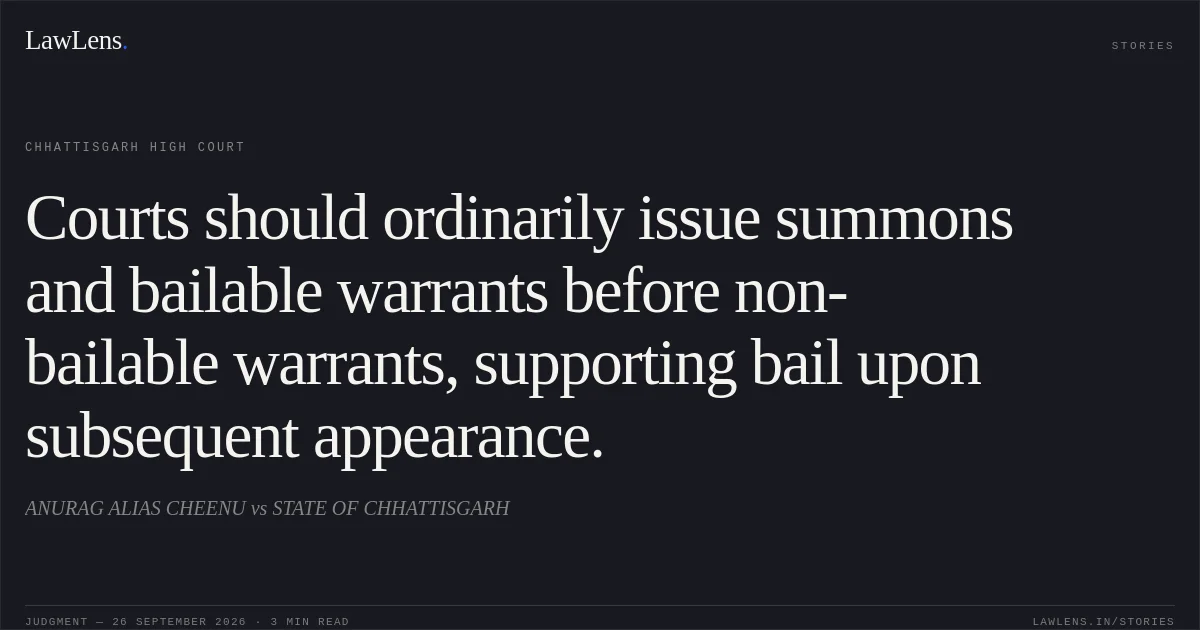
Whether the applicants, who had previously been granted bail but subsequently failed to appear before the trial Court on three dates, were entitled to release on bail after appearing pursuant to non-bailable warrants?
Source reference: paras. 2, 7–8Whether the issuance of non-bailable warrants, without following the ordinarily graduated procedure of summons followed by bailable warrant and then non-bailable warrant, justified reconsideration of the applicants’ custody?
Source reference: para. 7Law Applied
Section 483 of the Bharatiya Nagarik Suraksha Sanhita, 2023 empowers the High Court to grant regular bail. Section 355 of the BNSS concerns exemption from personal appearance before the trial Court, while Section 72(2), read with Section 483, was invoked in relation to cancellation of the non-bailable warrants.
Source reference: paras. 1, 3–4The Court relied on Satender Kumar Antil v. Central Bureau of Investigation, (2022) 10 SCC 51, wherein the Supreme Court observed that courts should ordinarily adopt a graduated process for securing the appearance of an accused—first issuing summons, followed, where necessary, by a bailable warrant and thereafter a non-bailable warrant.
Source reference: para. 7The Court also applied the established principle that prior grant of bail, continued cooperation with the trial and subsequent appearance pursuant to warrants are relevant considerations in determining whether continued custody is warranted.
Source reference: para. 8Reasoning
The Court noted that the applicants had previously been granted bail and had regularly appeared before the trial Court, except on three occasions.
Source reference: para. 7On those dates, their counsel remained present and moved an application seeking exemption from personal appearance, although the application was rejected and non-bailable warrants were immediately issued.
Source reference: para. 7Applying the principle in Satender Kumar Antil, the Court considered that the ordinarily prescribed sequence for securing attendance had not been followed.
Source reference: para. 7The applicants subsequently surrendered before the trial Court on 22 August 2026 and remained in judicial custody thereafter.
Source reference: paras. 2–3, 8Considering their prior compliance with bail conditions, their subsequent appearance, the limited period of custody and the procedural safeguard emphasised by the Supreme Court, the Court held that continued detention was not necessary and that the applicants were entitled to bail.
Source reference: para. 8Holding
The High Court allowed the second bail application.
It directed that the applicants be released on bail upon executing a personal bond of ₹50,000 each with one surety of the like amount, to the satisfaction of the concerned trial Court.
Source reference: para. 9The applicants were required to: (i) refrain from inducing, threatening or promising any person acquainted with the facts of the case; (ii) avoid conduct prejudicial to a fair and expeditious trial; and (iii) appear before the trial Court on every date fixed until conclusion of the trial.
Source reference: para. 9Acts & Sections Cited
9 provisions across 2 statutes referred to in this judgment. Each provision opens on LawLens.
Bharatiya Nagarik Suraksha Sanhita, 20233
Bharatiya Nyaya Sanhita, 20236
Original Court PDF
ANURAG ALIAS CHEENUvsSTATE OF CHHATTISGARH
Click to open original judgment
Original judgment, available to read, download and summarize on LawLens.in