Facts
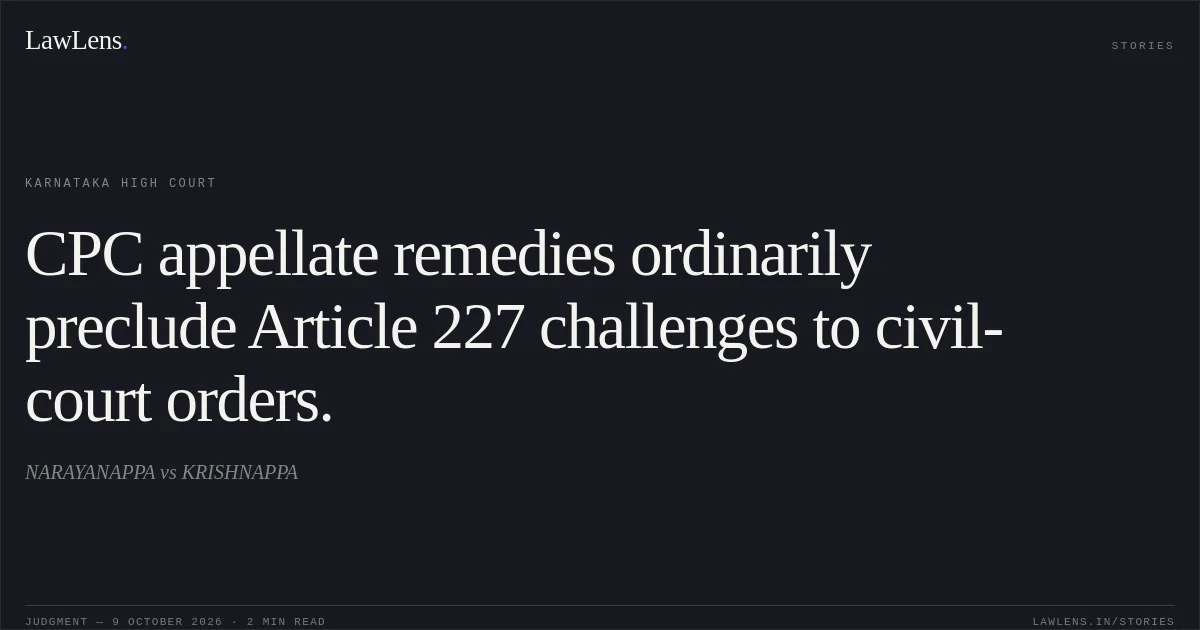
The petitioners challenged the Civil Judge and JMFC, Devanahalli’s order dated 3 January 2024 in O.S. No. 7/2024.
Source reference: p. 3The Trial Court had not considered their application under Order XXXIX Rules 1 and 2 CPC and had issued notice. The High Court had earlier directed the parties to maintain status quo over the suit property; that interim order continued during the writ proceedings.
Source reference: p. 3The petitioners sought permission to withdraw the writ petition and pursue an appropriate remedy before the appellate court.
Source reference: p. 8Issues
1. Whether a challenge under Articles 226 and 227 of the Constitution to the Trial Court’s order concerning an application under Order XXXIX Rules 1 and 2 CPC should be pursued through the appellate remedy provided by the CPC.
Source reference: p. 3, 6–82. Whether the petitioners should be permitted to withdraw the writ petition and take appropriate steps before the appellate court.
Source reference: p. 8Law Applied
Section 104 read with Order XLIII Rule 1(r) CPC provides an appeal from an order under Order XXXIX Rules 1, 2, 2A, 4 or 10.
Source reference: p. 3In A. Venkatasubbaih Naidu v. S. Chellappan, the Supreme Court held that an order under Order XXXIX is appealable and that a party may pursue the CPC appeal remedy; the availability of such a remedy ordinarily weighs against resort to a constitutional remedy.
Source reference: p. 3–6Virudhunagar Hindu Nadargal Dharma Paribalana Sabai v. Tuticorin Educational Society states that, where proceedings are before a civil court and the CPC provides an appellate remedy, the High Court should generally refrain from exercising its supervisory jurisdiction under Article 227.
Source reference: p. 6–7Reasoning
The petitioners’ grievance concerned the Trial Court’s handling of an interlocutory injunction application in a civil suit, and the Court identified an appellate remedy under Order XLIII Rule 1(r) CPC.
Source reference: p. 3, 6Applying the cited Supreme Court authorities on the preference for CPC remedies in civil-court proceedings, the Court considered the writ petition an inappropriate route for the challenge. The petitioners sought leave to withdraw and pursue the appellate remedy; the Court granted that liberty without determining the merits of the injunction dispute.
Source reference: p. 7–9Holding
The writ petition was disposed of, permitting the petitioners to take appropriate steps in accordance with law.
The Court expressly left the merits and the parties’ rights and contentions open for consideration before the Trial Court.
Source reference: p. 9The status quo order dated 5 January 2024 was continued for two weeks to enable the petitioners to pursue the appropriate remedy.
Source reference: p. 9Acts & Sections Cited
1 provisions across 1 statute referred to in this judgment. Each provision opens on LawLens.
Code of Civil Procedure, 19081
Original Court PDF
NARAYANAPPAvsKRISHNAPPA
Click to open original judgment
Original judgment, available to read, download and summarize on LawLens.in