Facts
The petitioner and his business partner allegedly obtained a UCO Bank credit facility using revenue documents that falsely represented the petitioner as the exclusive owner of land offered as collateral.
Source reference: pp. 9–16The investigation alleged that the land was not available as described, that the petitioner was only a co-sharer, and that he had misrepresented a different plot as the collateral property.
Source reference: pp. 9–16The CBI filed a charge sheet alleging offences including criminal conspiracy, cheating, forgery and offences under the J&K Prevention of Corruption Act; the trial court framed charges against the petitioner on 4 September 2013.
Source reference: pp. 9–16The petitioner sought to quash the FIR, charge sheet and charge order, and also challenged the validity of the CBI’s constitution.
Source reference: pp. 1–6Issues
Whether the challenge to the CBI’s constitution and authority to investigate should be decided in this petition while the relevant Gauhati High Court judgment was stayed and the matter remained pending before the Supreme Court.
Source reference: pp. 8–9Whether the allegations and investigation materials disclosed a prima facie case against the petitioner for the charged offences, warranting the trial court’s order framing charges.
Source reference: pp. 10–22Law Applied
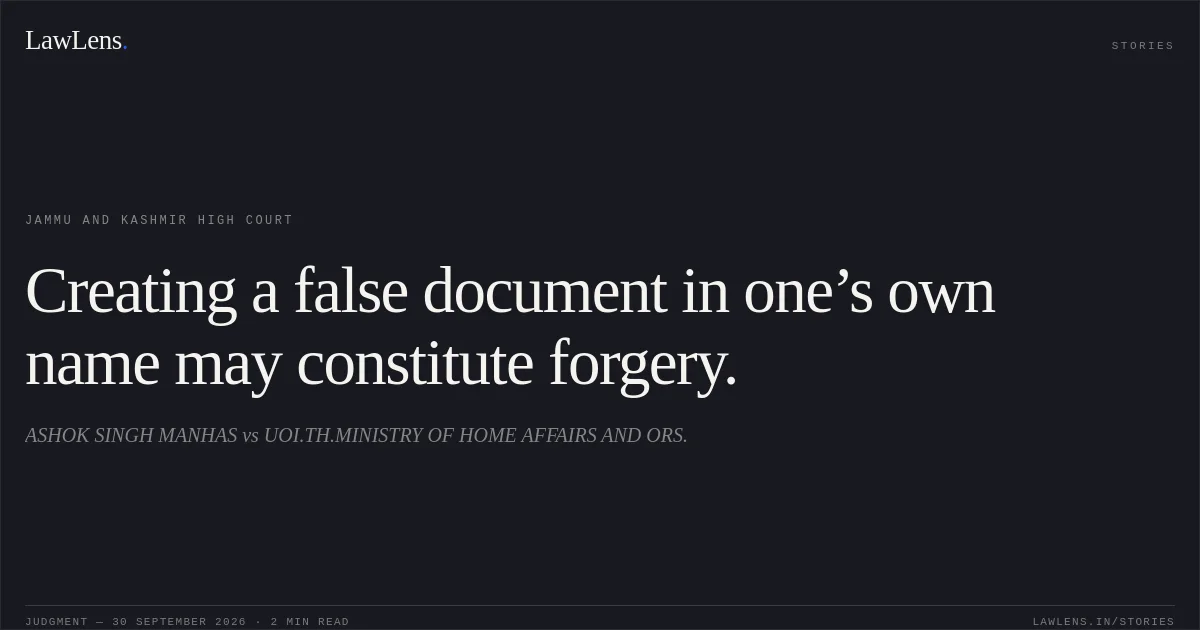
Sections 463 and 464 of the Ranbir Penal Code (RPC) govern forgery and the making of a false document; the court treated the statutory illustrations and Explanation 1 to Section 464 as showing that, in appropriate circumstances, a person may commit forgery by making a document in their own name.
Source reference: pp. 16–19The court also considered the charged provisions—Sections 120-B, 420, 467, 468 and 471 RPC, and Sections 5(1)(d) read with 5(2) of the J&K Prevention of Corruption Act—against the allegations in the charge sheet.
Source reference: pp. 9–11It relied on Bharat Hiralal Sheth v. Jaysin Amarsinh Sampat, 1997 Cri LJ 2509, on the scope of “making a false document,” and held the authorities cited by the petitioner, including Md. Ibrahim v. State of Bihar and Guru Bipin Singh v. Chongtham Manihar Singh, distinguishable on the facts.
Source reference: pp. 17–21The court did not determine the CBI’s constitutional validity; it left that question subject to the Supreme Court’s decision in the pending matter.
Source reference: pp. 8–9, 23Reasoning
The court found that the investigation materials alleged that revenue extracts described the petitioner as exclusive owner of land when he was only a co-sharer, and that the documents were used to obtain the bank facility.
Source reference: pp. 15–22It also noted the allegation that the petitioner presented a different plot as his own property.
Source reference: pp. 15–22Applying Sections 463 and 464 RPC, the court concluded that the alleged preparation and use of false revenue documents could prima facie support forgery and conspiracy, while the alleged property misrepresentation could support cheating; accordingly, it found no basis to quash the charges at this stage.
Source reference: pp. 15–22On the CBI issue, the court considered it appropriate to defer determination pending the Supreme Court proceedings.
Source reference: pp. 8–9Holding
The petition was disposed of without quashing the FIR, charge sheet or order framing charges.
The CBI-constitution issue was left subject to the Supreme Court’s decision, and the trial court was directed to proceed with the trial, avoiding unnecessary adjournments.
Source reference: p. 23Acts & Sections Cited
9 provisions across 2 statutes referred to in this judgment. Linked provisions open on LawLens.
Ranbir Penal Code, 19897
Prevention of Corruption Act, Svt. 2006 [Jammu and Kashmir]2
Original Court PDF
ASHOK SINGH MANHASvsUOI.TH.MINISTRY OF HOME AFFAIRS AND ORS.
Click to open original judgment
Original judgment, available to read, download and summarize on LawLens.in