Facts
On August 27, 2007, a nine-year-old girl was sent by her mother to fetch buttermilk from a neighbor's house
Source reference: p. 2On her return, she was allegedly taken to a cowshed by the respondent (the neighbor’s son) and sexually assaulted
Source reference: p. 2The victim informed her mother and later her father, leading to an FIR being filed the following morning
Source reference: p. 2The Trial Court convicted the respondent under Section 376 of the IPC and the SC/ST Act, relying on the victim's testimony and medical corroboration
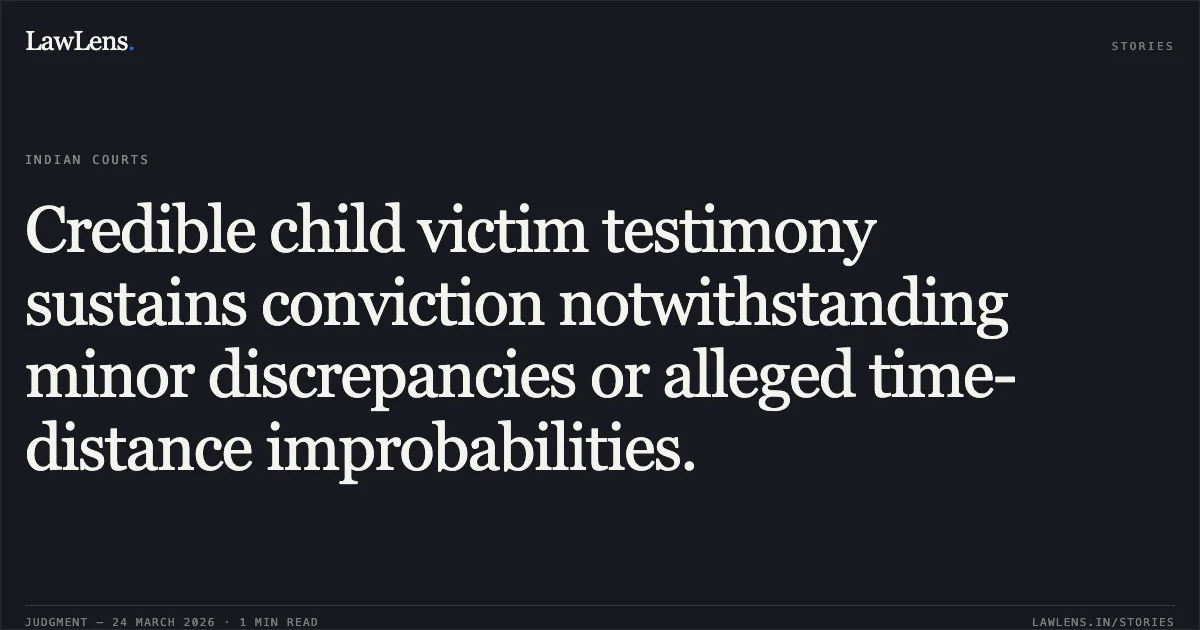
Source reference: p. 3However, the High Court reversed this finding and entered an acquittal, citing "major contradictions," a pre-existing family feud over land, a delay in filing the FIR, and the "improbability" of the victim traveling 16 kilometers to fetch buttermilk within two hours
Source reference: p. 4-5The State appealed this acquittal to the Supreme Court.
Source reference: no citationIssues
1. Whether the High Court erred in reversing the conviction by overemphasizing minor inconsistencies and the "improbability" of the travel timeline
Source reference: p. 10-112. Whether the uncorroborated testimony of a child prosecutrix is sufficient to sustain a conviction if it inspires the confidence of the court
Source reference: p. 8-103. Whether the courts failed to comply with the statutory mandate under Section 228-A IPC regarding the non-disclosure of the victim's identity
Source reference: p. 5-7Law Applied
The Court applied Section 376 of the IPC regarding rape and the SC/ST (Prevention of Atrocities) Act
Source reference: p. 2-3It relied on State of U.P. v. Ajmal Beg to define the narrow scope of interference in acquittals under Article 136, limited to cases of perversity or errors of law
Source reference: p. 7-8Regarding child witnesses, the Court applied principles from State of Rajasthan v. Chatra and State of M.P. v. Balveer Singh, holding that while corroboration is a rule of prudence, a conviction can be based solely on a child's testimony if they understand the distinction between truth and falsehood
Source reference: p. 8-9It further cited State of U.P. v. M. K. Anthony to establish that minor discrepancies or "normal lapses of memory" should not lead to the rejection of otherwise credible testimony
Source reference: p. 10-12Finally, it emphasized the mandatory protection of victim identity under Section 228-A IPC and Nipun Saxena v. Union of India
Source reference: p. 18Reasoning
The Supreme Court observed that the High Court adopted a hyper-technical approach by "picking holes" in a case that survived rigorous cross-examination
Source reference: p. 15The Court held that mathematical precision regarding the 16-kilometer travel time was unnecessary; even if the timeframe was slightly off, the factum of sexual assault remained "uncontroverted"
Source reference: p. 16The Court reasoned that the medical evidence, which showed lacerated wounds and a torn hymen, squarely corroborated the victim’s ocular testimony
Source reference: p. 14, 16It found that the victim had positively identified the accused and her core narrative remained unshaken despite the alleged family animosity
Source reference: p. 15-17The Court determined that the High Court's focus on "minor discrepancies" regarding how the incident was reported to the maternal uncle did not undermine the backbone of the prosecution's narrative
Source reference: p. 11, 16Holding
The Supreme Court set aside the High Court’s judgment of acquittal and restored the conviction of the respondent
The Court held that the testimony of the child prosecutrix was sufficient and inspired confidence
Source reference: p. 17The respondent was directed to surrender immediately to serve the remainder of his ten-year sentence
Source reference: p. 18Additionally, the Court issued a stern deprecation of the disclosure of the victim’s name in the records and directed all High Court Registrars General to ensure strict compliance with Section 228-A IPC and the anonymity mandates of Nipun Saxena
Source reference: p. 18Acts & Sections Cited
3 provisions across 2 statutes referred to in this judgment. Each provision opens on LawLens.
Indian Penal Code, 18602
Scheduled Castes and the Scheduled Tribes (Prevention of Atrocities) Act, 19891
Original Court PDF
The State Of Himachal PradeshvsHukam Chand Alias Monu
Click to open original judgment
Original judgment, available to read, download and summarize on LawLens.in