Facts
On September 10, 2001, the prosecutrix was waylaid by the Appellant while returning from fields with fodder
Source reference: p. 1The Appellant sought sexual favors and, upon refusal, forcibly dragged her into a "Jowar" field, assaulted her with tooth bites and slaps, and attempted rape
Source reference: p. 1The victim was saved by the sudden appearance of a neighbor/labourer, causing the Appellant to flee
Source reference: p. 1The victim narrated the incident to her mother-in-law and cousin-in-law (PW-5), leading to FIR No. 330/2001 at PS Narela Industrial Area
Source reference: p. 2The Trial Court, vide judgment dated August 11, 2008, convicted the Appellant under Sections 324, 354, and 506 IPC, but acquitted him of charges under Sections 376/511 IPC
Source reference: p. 2, 13The Appellant challenged the conviction on grounds of property disputes, delayed FIR, and alleged improvements in the victim’s testimony regarding her torn clothing
Source reference: p. 3Issues
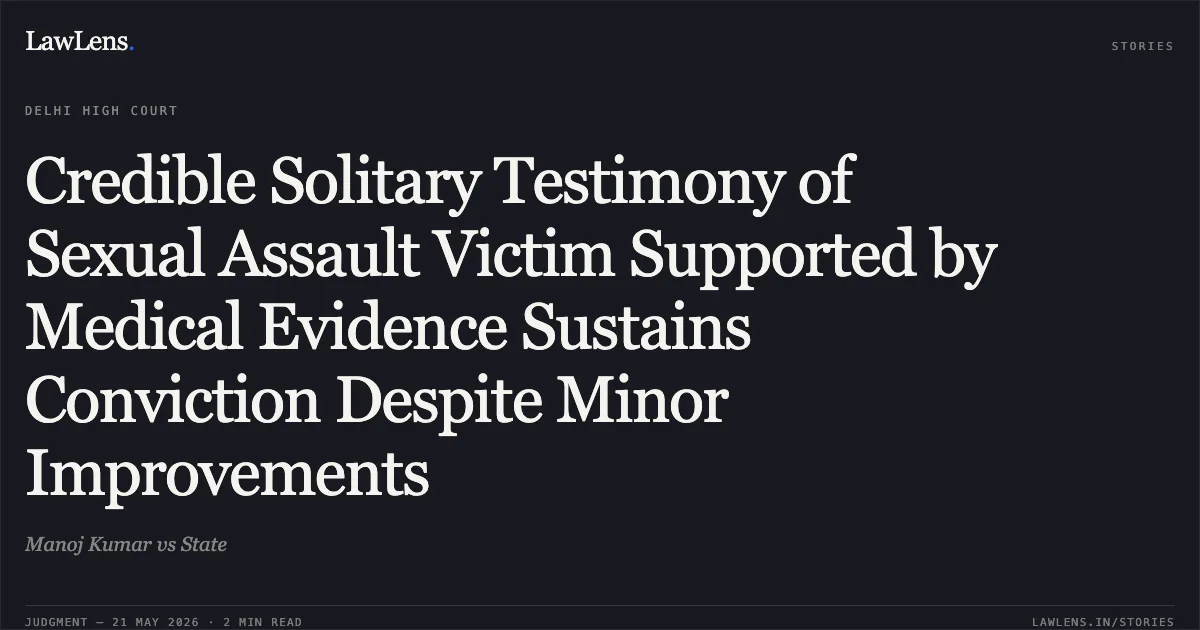
1. Whether the sole testimony of the prosecutrix is sufficient for conviction in a sexual offence case despite minor improvements
Source reference: p. 8 / para. 152. Whether the medical evidence (MLC) sufficiently corroborates the victim's narrative of being dragged and assaulted
Source reference: p. 4 / para. 73. Whether the defense of alibi and property dispute raised by the Appellant was legally sustainable
Source reference: p. 6-7 / para. 12-13Law Applied
The court applied the Indian Penal Code, 1860, specifically Sections 324 (voluntarily causing hurt by dangerous weapons/means), 354 (assault or criminal force to woman with intent to outrage her modesty), and 506 (criminal intimidation)
Source reference: p. 2It relied on the Supreme Court precedent in Ganesan v. State (2020) and State of Punjab v. Gurmit Singh (1996), which establish that the testimony of a sexual assault victim is of "sterling quality" and does not require corroboration if it inspires confidence
Source reference: p. 8-11The court also applied Section 118 of the Evidence Act regarding the competency of witnesses and the principle of "Plea of Alibi" under the Indian Evidence Act
Source reference: p. 8, p. 6Reasoning
The Court found the victim’s testimony credible, noting that her failure to initially mention her torn "salwar" string was a justifiable result of "shame" and social stigma
Source reference: p. 5 / para. 9The discrepancies between the words "labourer" and "neighbour" were dismissed as minor phonetic variations
Source reference: p. 6 / para. 10Crucially, the Court mapped the victim's narrative to the MLC (Ex.PW 1/A), which recorded six distinct injuries, including swelling, contusions, and multiple abrasions consistent with being dragged on a rough surface
Source reference: p. 4-5 / para. 7Regarding the defense, the Court rejected the plea of alibi as DW-1 (Appellant’s father) failed to produce documentary proof of the alleged property dispute and did not submit to cross-examination, rendering his testimony legally ineffective
Source reference: p. 7 / para. 13The Court concluded that the Appellant’s actions—dragging the victim and expressing intent to rape—clearly established the offences under Sections 354 and 324 IPC
Source reference: p. 7-8Holding
The High Court upheld the conviction, holding that the victim's testimony was of sterling quality and corroborated by medical evidence
The appeal was partially allowed only regarding the sentence: the Rigorous Imprisonment for offences under Sections 324, 354, and 506 IPC was reduced to six months each, to run concurrently, while the fine amounts remained unaltered
Source reference: p. 14-15Acts & Sections Cited
7 provisions across 2 statutes referred to in this judgment. Each provision opens on LawLens.
Indian Penal Code, 18606
Code of Criminal Procedure, 19731
Original Court PDF
Manoj KumarvsState
Click to open original judgment
Original judgment, available to read, download and summarize on LawLens.in