Facts
The appellant was prosecuted for allegedly committing rape and penetrative sexual assault upon Ruby Kumari, a minor girl, at approximately 3:00 a.m. on the night intervening 1–2 May 2017.
Source reference: pp. 2–4The victim alleged that the appellant entered her house, pressed her mouth, forcibly removed her salwar and raped her, causing profuse bleeding; her aunt thereafter arrived and the appellant fled.
Source reference: pp. 2–4The victim’s fardbeyan was recorded at Darbhanga Medical College and Hospital on 2 May 2017, following which the FIR was registered under Section 376 IPC and Sections 4/6 of the POCSO Act.
Source reference: pp. 2–4The prosecution examined six witnesses, including the victim, her relatives, the Investigating Officer and the examining doctor, and relied on the victim’s fardbeyan, Section 164 CrPC statement, medical report and seizure documents.
Source reference: p. 4The trial court convicted the appellant under Section 376(2)(i) IPC and Section 6 of the POCSO Act and sentenced him to imprisonment for the remainder of his natural life, with a fine of ₹30,000; it also directed payment of ₹6,00,000 compensation to the victim.
Source reference: p. 5The appellant challenged the conviction, relying principally on contradictions in the witnesses’ accounts, the possibility that the injuries were caused by a fall, defective investigation, doubtful identification and alleged false implication.
Source reference: pp. 10–13Issues
Whether the prosecution proved beyond reasonable doubt that the appellant committed rape or penetrative sexual assault upon the victim on the night intervening 1–2 May 2017.
Source reference: p. 5; paras 8(A)–(E), 9Whether the prosecution proved that the victim was below twelve years of age, thereby attracting Section 376(2)(i) IPC and Section 6 of the POCSO Act.
Source reference: p. 5; para 9Whether the victim’s testimony, read with the medical evidence and surrounding circumstances, was sufficiently reliable despite the alleged contradictions, improvements and investigative lapses.
Source reference: p. 5; paras 8(A)–(D), 9Whether the conviction and sentence imposed by the trial court warranted interference in appeal.
Source reference: paras 8(xxiii)–(xxiv), 9Law Applied
The Court applied Section 376(2)(i) IPC, which prescribes enhanced punishment for rape of a woman under twelve years, and Sections 6 and 42 of the POCSO Act, under which aggravated penetrative sexual assault upon a child attracts severe punishment and the applicable punishment is determined in accordance with the provision imposing the greater punishment.
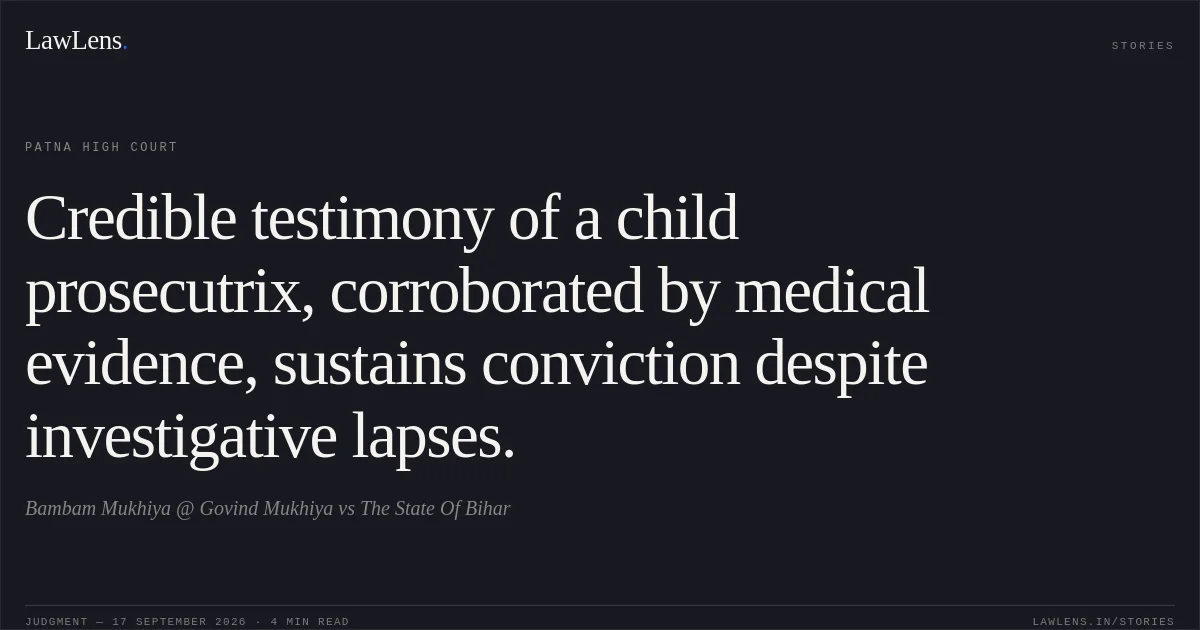
Source reference: pp. 2–4It relied on State of Punjab v. Gurmit Singh, (1996) 2 SCC 384, and State of Himachal Pradesh v. Asha Ram, (2005) 13 SCC 766, for the principle that the credible testimony of a prosecutrix can by itself sustain a conviction and that absence of spermatozoa is not fatal where penetration is otherwise proved.
Source reference: pp. 16–17, 23–25Rameshwar v. State of Rajasthan, 1951 SCC 1213, was applied for the principle that corroboration of a child victim’s testimony is a rule of prudence, not an inflexible requirement of law.
Source reference: pp. 17–19The Court also relied on C. Muniappan v. State of Tamil Nadu, (2010) 9 SCC 567, for the rule that defective investigation does not automatically entitle an accused to acquittal if the substantive evidence independently inspires confidence.
Source reference: pp. 27–29Penetration, rather than ejaculation or detection of semen, was treated as sufficient to constitute rape.
Source reference: pp. 22–25Reasoning
The Court found that the victim consistently named the appellant and attributed the assault to him in her fardbeyan, Section 164 CrPC statement and trial testimony; the variations concerning whether she became unconscious, the exact time of the aunt’s arrival and who took her to hospital were treated as peripheral discrepancies attributable to trauma and the limitations of a child witness.
Source reference: pp. 19–22The medical evidence—blood-stained clothing and genital area, multiple abrasions, torn hymen and active bleeding—was held to corroborate recent penetrative genital injury, notwithstanding the doctor’s admission that injury by a fall was theoretically possible and that no spermatozoa were detected.
Source reference: pp. 22–25The Court considered the latter possibility insufficient to displace the direct testimony and medical corroboration.
Source reference: pp. 22–25The victim’s radiological age of 10–12 years, together with the prosecution’s evidence describing her as approximately eight years old, was accepted as establishing that she was below twelve.
Source reference: p. 25; para 9The absence of independent witnesses, non-examination of the appellant, failure to send biological material for forensic examination and other investigative omissions were held not to undermine the prosecution case because the core evidence was reliable.
Source reference: pp. 27–30The defence theories concerning the neighbouring marriage, false implication and the involvement of Shanti Devi were rejected as either speculative or unsupported by defence evidence.
Source reference: pp. 29–31Holding
The Court answered all material issues in favour of the prosecution. It held that the appellant’s guilt for rape and penetrative sexual assault upon a child below twelve years was proved beyond reasonable doubt and that the victim’s testimony, supported by the medical evidence, was sufficient to sustain the conviction.
The appeal was dismissed, and the conviction under Section 376(2)(i) IPC and Section 6 of the POCSO Act was affirmed.
Source reference: p. 34The sentence of imprisonment for the remainder of the appellant’s natural life, the fine of ₹30,000 and the default sentence of six months’ simple imprisonment were maintained; no separate sentence under Section 6 POCSO was imposed in view of Section 42 POCSO.
Source reference: p. 34The direction to pay ₹6,00,000 compensation to the victim was also affirmed, with payment to be ensured by the District Legal Services Authority within thirty days if unpaid.
Source reference: p. 35The Court further directed the Senior Superintendent of Police, Darbhanga, to examine the investigative lapses and take appropriate departmental action against the Investigating Officer after providing an opportunity of hearing, with a compliance report to be submitted within three months.
Source reference: pp. 35–36Acts & Sections Cited
8 provisions across 3 statutes referred to in this judgment. Each provision opens on LawLens.
Indian Penal Code, 18602
Protection of Children from Sexual Offences Act, 20124
Code of Criminal Procedure, 19732
Original Court PDF
Bambam Mukhiya @ Govind MukhiyavsThe State Of Bihar
Click to open original judgment
Original judgment, available to read, download and summarize on LawLens.in