Facts
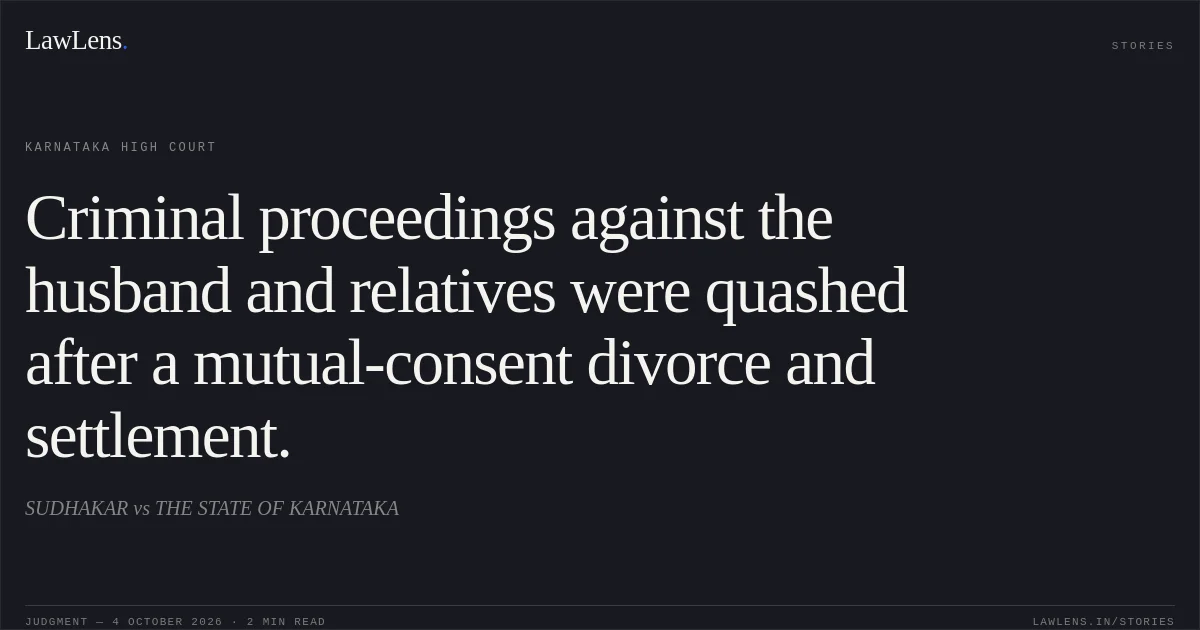
Respondent No. 2, the wife of petitioner No. 1, lodged a complaint alleging offences against him, his parents (petitioners Nos. 2 and 3), and his married sisters (petitioners Nos. 4 and 5).
Source reference: para. 3The resulting charge sheet led to C.C. No. 26/2026, alleging offences under Sections 85, 115(2), 127(2), 74, 351, 352 and 49 read with Section 3(5) of the Bharatiya Nyaya Sanhita, 2023, and Sections 3 and 4 of the Dowry Prohibition Act, 1961.
Source reference: para. 3–4The spouses subsequently petitioned for divorce by mutual consent; their settlement provided that the wife would withdraw the criminal case.
Source reference: para. 5–6The Family Court granted a decree of divorce on 9 February 2026 after recording their joint memo, which also recorded payment of ₹7,51,000 as permanent alimony.
Source reference: para. 6–7The wife did not withdraw the criminal case and, although served with notice of this petition, did not appear to contest it.
Source reference: para. 8–9The accused petitioned under Section 528 of the Bharatiya Nagarik Suraksha Sanhita, 2023, to quash the proceedings.
Source reference: para. 3Issues
Whether the High Court should exercise its power under Section 528 of the BNSS to quash the criminal proceedings following the spouses’ mutual-consent divorce and settlement.
Source reference: para. 3, 7–10Whether the proceedings should also be quashed against the husband’s parents and married sisters in light of the resolution of the matrimonial dispute.
Source reference: para. 10Law Applied
The Court considered its power under Section 528 of the BNSS to quash criminal proceedings.
Source reference: para. 3It also considered the charged offences under Sections 85, 115(2), 127(2), 74, 351, 352 and 49 read with Section 3(5) of the BNS, and Sections 3 and 4 of the Dowry Prohibition Act.
Source reference: para. 3, 11No precedents or more detailed legal test for exercising the quashing power were cited; the Court’s stated basis was the settlement and conclusion of the matrimonial dispute.
Source reference: para. 10Reasoning
The Court relied on the mutual-consent divorce decree and the joint memo recording the settlement, including the alimony payment and the wife’s undertaking to withdraw the criminal case.
Source reference: para. 5–7It noted that the wife had not withdrawn the case and had not contested the quashing petition despite service.
Source reference: para. 8–9On those facts, the Court concluded that the matrimonial dispute had ended and that no case should continue against the husband’s parents and sisters; it found sufficient grounds to quash the proceedings against all petitioners.
Source reference: para. 10Holding
The Court allowed the petition and quashed the entire proceedings in C.C. No. 26/2026, arising from Crime No. 114/2025, against petitioners Nos. 1–5 for the offences charged under the BNS and the Dowry Prohibition Act.
Acts & Sections Cited
11 provisions across 3 statutes referred to in this judgment. Each provision opens on LawLens.
Bharatiya Nagarik Suraksha Sanhita, 20231
Bharatiya Nyaya Sanhita, 20238
Original Court PDF
SUDHAKARvsTHE STATE OF KARNATAKA
Click to open original judgment
Original judgment, available to read, download and summarize on LawLens.in