Facts
The de facto complainant alleged that he was a tenant in portions of Gaganchal Commercial Complex, Howrah, and that the petitioner, with the assistance of police personnel and others, forcibly broke open the locks, dispossessed him, and removed various articles from the premises.
Source reference: paras. 2–4On this basis, Golabari P.S. Case No. 37 of 1999 was registered and, after investigation, Charge-sheet No. 129 dated 13 July 2001 was submitted against six accused persons under Sections 120B/448/379/461/417/109 IPC.
Source reference: paras. 2–4The petitioner denied the allegations, asserted that the complainant relied on forged tenancy documents, and contended that the criminal case was a counterblast to his own complaint alleging forgery and cheating against the complainant.
Source reference: paras. 7–9Three accused had died, while proceedings against two co-accused were quashed by the High Court, including on the grounds that there was no prima facie material establishing abetment or a specific role in the alleged dispossession.
Source reference: paras. 17, 21–22The petitioner’s application for discharge under Section 239 Cr.P.C. was rejected by the Magistrate on 9 January 2024, leading to the present revision and petition for quashing.
Source reference: paras. 1, 15Issues
Whether the materials collected during investigation disclosed sufficient prima facie involvement of the petitioner in the offences under Sections 120B/448/379/461/417/109 IPC so as to justify continuation of the criminal proceedings after rejection of his discharge application.
Source reference: paras. 20, 23–25Whether continuation of G.R. Case No. 249 of 1999, pending for nearly 27 years, constituted an abuse of the process of law warranting exercise of the High Court’s inherent jurisdiction under Section 482 Cr.P.C.
Source reference: paras. 24–29Whether the proceedings against the petitioner were liable to be quashed in view of the absence of a specific overt act, the essentially civil nature of the dispute, and the earlier quashing of proceedings against co-accused on substantially similar allegations.
Source reference: paras. 21–25Law Applied
The Court exercised jurisdiction under Sections 397, 401 and 482 Cr.P.C., read with Article 227 of the Constitution, to examine the legality of the order refusing discharge and to prevent abuse of process.
Source reference: para. 1At the quashing stage, the Court may interfere where the uncontroverted allegations and materials collected during investigation do not disclose the commission of an offence or make out a case against the accused, or where the proceeding is manifestly attended with mala fides or instituted for an ulterior purpose.
Source reference: paras. 27–29These principles were drawn from State of Haryana v. Bhajan Lal, particularly Categories (3) and (7) of the illustrative cases permitting quashing under Section 482 Cr.P.C.
Source reference: paras. 27–29The Court also applied the principle that vague allegations, mere presence at the place of occurrence, or circumstances not demonstrating a specific role cannot, by themselves, establish criminal liability.
Source reference: paras. 21–24Reasoning
On examining the case diary and the statements under Sections 161 and 164 Cr.P.C., the Court found that the principal allegation against the petitioner was that he arrived at the market complex in a car, made a telephone call, and was present when security personnel allegedly broke open the locks and removed articles.
Source reference: para. 23No direct evidence or specific overt act connected him with the breaking open of the premises, theft, conspiracy, abetment, or other alleged offences; his arrival at the spot and the subsequent arrival of another accused did not ipso facto constitute an offence.
Source reference: para. 24The Court further relied on the earlier quashing of proceedings against co-accused, including the finding that there was no prima facie material establishing abetment or conspiracy, and on the Supreme Court’s observations casting doubt on the alleged dispossession.
Source reference: para. 21Given the absence of specific incriminating material, the civil character of the underlying possession and tenancy dispute, the prolonged pendency of the case, and the remote possibility of conviction, the Court held that continuation of the prosecution would fall within Categories (3) and (7) of Bhajan Lal and amount to abuse of process.
Source reference: paras. 25–29Holding
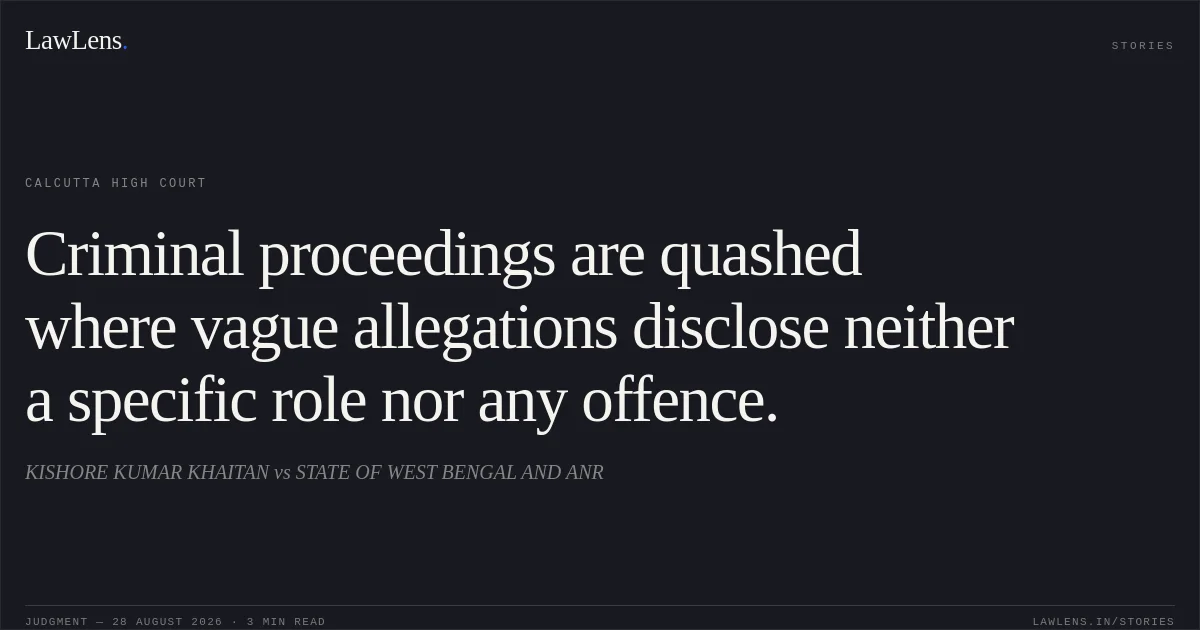
The Court allowed the criminal revision and held that no sufficient prima facie case was made out against the petitioner.
It quashed G.R. Case No. 249 of 1999 and Charge-sheet No. 129 dated 13 July 2001, arising from Golabari P.S. Case No. 37 of 1999, insofar as the petitioner was concerned, and set aside the Magistrate’s order dated 9 January 2024.
Source reference: paras. 30–31Connected applications were disposed of, the case diary was directed to be returned to the State, and any interim order was vacated.
Source reference: paras. 30, 32–34Acts & Sections Cited
17 provisions across 3 statutes referred to in this judgment. Each provision opens on LawLens.
Code of Criminal Procedure, 19738
Indian Penal Code, 18607
Bharatiya Nagarik Suraksha Sanhita, 20232
Original Court PDF
KISHORE KUMAR KHAITANvsSTATE OF WEST BENGAL AND ANR
Click to open original judgment
Original judgment, available to read, download and summarize on LawLens.in
![Courts will not interfere with transfers absent mala fides or violation of statutory rules.. M Ramya vs EMPLOYEES STATE INSURANCE CORPORATION (ESIC). CAT - ['Chennai']. LawLens](/stories/thumbnails/courts-will-not-interfere-with-transfers-absent-mala-fides-or-violation-of-statutory-rules-a6845e9ca6f548fca284c51c8351957f.webp)
![Courts cannot direct one-time recruitment age relaxation absent authority in the governing rules or advertisement.. UT OF PUDUCHERRY vs M ANDAL. CAT - ['Chennai']. LawLens](/stories/thumbnails/courts-cannot-direct-one-time-recruitment-age-relaxation-absent-authority-in-the-governing-895d78fde47143e2a8ed0207c4b6a44f.webp)
![A review cannot correct an allegedly erroneous decision absent an error apparent on the record.. Ajit Kumar Jha vs RAILWAY BOARD. CAT - ['Delhi']. LawLens](/stories/thumbnails/a-review-cannot-correct-an-allegedly-erroneous-decision-absent-an-error-apparent-on-the-re-8ac952fd4eba470c92f7da20af72a220.webp)