Facts
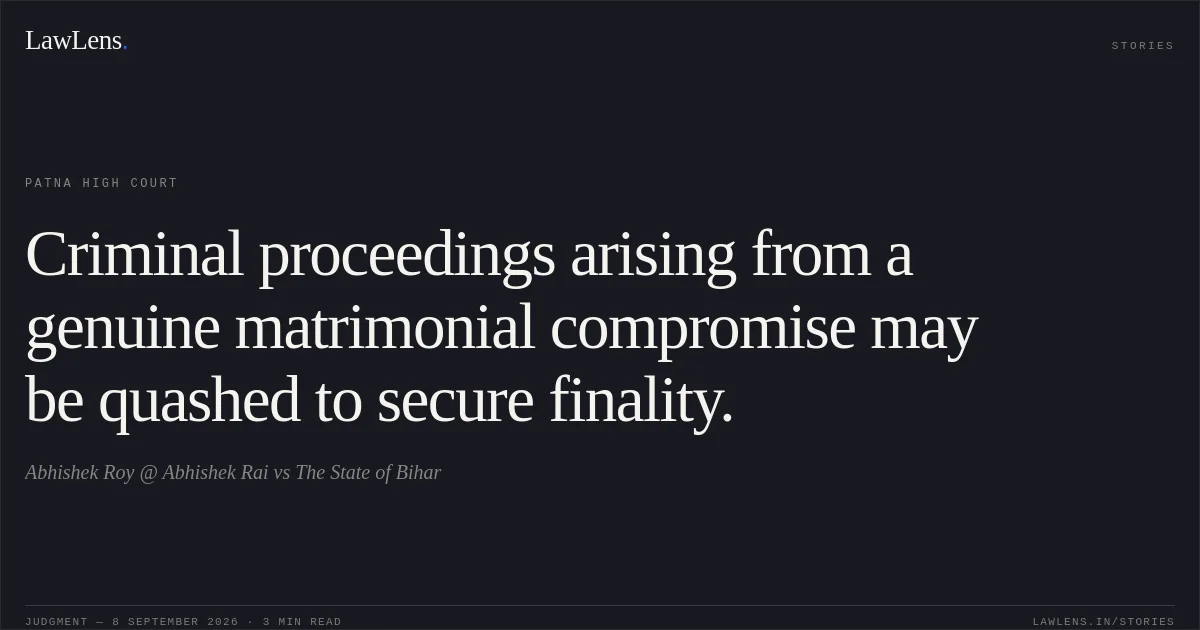
The petitioner faced criminal proceedings arising from Mahila P.S. Case No. 138 of 2017, registered in connection with a matrimonial dispute.
Source reference: no citationHe had been granted provisional bail by the court below pursuant to a compromise between the parties, but the compromise subsequently failed due to continuing marital disputes.
Source reference: no citationThe Sub-Divisional Judicial Magistrate, Arrah, thereafter cancelled the petitioner’s provisional bail by order dated 17 February 2024 in G.R. No. 4837 of 2017.
Source reference: p.1, para. 2Subsequently, the parties entered into a settlement under which the petitioner agreed to pay ₹17 lakhs to opposite party no. 2 and both parties agreed to cooperate in obtaining a divorce by mutual consent under Section 13B of the Hindu Marriage Act, 1955.
Source reference: p.2, para. 3A mutual-consent divorce proceeding was accordingly instituted before the Family Court, Arrah, as Matrimonial Divorce Case No. 366 of 2025.
Source reference: p.2, para. 3A dispute arose regarding a ₹15 lakh demand draft, which had initially become invalid due to a defect.
Source reference: p.2–3, para. 4The petitioner later validated the draft, and the amount was released to opposite party no. 2; this fact was admitted by her counsel.
Source reference: p.2–3, para. 4The petitioner thereafter sought quashing of the entire criminal proceeding, and opposite party no. 2 expressed no objection.
Source reference: p.3, paras. 5–6Issues
Whether the order dated 17 February 2024 cancelling the petitioner’s provisional bail could be interfered with in view of the subsequent settlement and compliance with the parties’ agreed terms?
Source reference: p.1, para. 2; p.2, paras. 3–4Whether the entire criminal proceeding arising out of Mahila P.S. Case No. 138 of 2017 could be quashed on the basis of a genuine compromise and settlement in a matrimonial dispute?
Source reference: p.3–4, paras. 5–8Law Applied
The Court applied the principles governing exercise of its inherent jurisdiction to quash criminal proceedings where continuation would amount to an abuse of the process of court and where the dispute is essentially private in nature.
Source reference: p.3–4, paras. 6–8It relied on the principle that matrimonial and other predominantly personal disputes may be quashed after a genuine, voluntary, and complete settlement between the parties, particularly where the victim or complainant has no objection and no overriding public interest is involved.
Source reference: p.3–4, paras. 6–8The Court relied on Naushey Ali v. State of Uttar Pradesh, (2025) 4 SCC 78, and Mange Ram v. State of Madhya Pradesh, 2025 SCC OnLine SC 1681, for the proposition that criminal proceedings arising from matrimonial disputes may be quashed pursuant to a compromise to bring the litigation to a peaceful conclusion.
Source reference: p.3, para. 7The settlement also involved divorce by mutual consent under Section 13B of the Hindu Marriage Act, 1955.
Source reference: p.2, para. 3Reasoning
The Court treated the dispute as a private matrimonial conflict rather than an offence implicating overriding public policy.
Source reference: no citationIt noted that the parties had entered into a subsequent settlement, the agreed payment had been substantially complied with, and the disputed ₹15 lakh draft had ultimately been validated and released to opposite party no. 2.
Source reference: p.2–3, para. 4The parties had also proceeded with divorce by mutual consent under Section 13B of the Hindu Marriage Act, and opposite party no. 2 did not oppose closure of the criminal case.
Source reference: p.3, paras. 5–6In these circumstances, applying the principles in Naushey Ali and Mange Ram, the Court held that sending the matter back to the subordinate court or requiring a fresh application would serve no legitimate purpose.
Source reference: p.3–4, paras. 6–8The absence of coercion, threat, or force, coupled with the genuinely settled nature of the dispute, meant that continuation of the criminal proceeding would constitute an abuse of the process of court and unnecessarily consume judicial time.
Source reference: p.3–4, paras. 6–8Holding
The Court held that the parties’ dispute had been validly and genuinely settled, that the settlement obligations had been fulfilled, and that no useful purpose would be served by continuing the criminal prosecution.
It therefore quashed the entire criminal proceeding arising out of Mahila P.S. Case No. 138 of 2017, including the proceeding in G.R. No. 4837 of 2017, and allowed the criminal miscellaneous application along with I.A. No. 1 of 2026.
Source reference: p.4, paras. 8–9Acts & Sections Cited
1 provisions across 1 statute referred to in this judgment. Linked provisions open on LawLens.
Hindu Marriage Act, 19551
Original Court PDF
Abhishek Roy @ Abhishek RaivsThe State of Bihar
Click to open original judgment
Original judgment, available to read, download and summarize on LawLens.in