Facts
The petitioner sought quashing under Section 528 of the Bharatiya Nagarik Suraksha Sanhita, 2023, of an FIR registered for offences under Sections 420, 384 and 386 of the Indian Penal Code, 1860, and Sections 3/4 of the M.P. Protection of Debtors Act, 1937.
Source reference: para. 1–2The allegations arose from a loan transaction, alleged threats concerning security cheques, and withdrawal of money from the complainant’s bank account.
Source reference: para. 1–2During the proceedings, the petitioner and complainant settled their dispute; the complainant did not oppose quashing.
Source reference: para. 3, 8A Registrar’s report found the compromise voluntary and free from coercion or undue influence.
Source reference: para. 3, 8The State opposed quashing, arguing that the alleged offences were not merely private in nature.
Source reference: para. 4Issues
Whether the High Court could exercise its inherent jurisdiction under Section 528 of the BNSS to quash the FIR and consequential proceedings for non-compoundable offences on the basis of a settlement between the parties.
Source reference: para. 6–7Whether, in light of the nature of the allegations and the voluntary settlement, continuation of the proceedings would serve the ends of justice.
Source reference: para. 8–10Law Applied
Section 528 of the BNSS preserves the High Court’s inherent power to prevent abuse of the process of law and secure the ends of justice.
Source reference: para. 6–7That power is distinct from statutory compounding under Section 320 of the Code of Criminal Procedure; accordingly, the High Court may quash non-compoundable offences on settlement in an appropriate case, while considering the nature and gravity of the offence and its impact on society.
Source reference: para. 6–7In Gian Singh v. State of Punjab, (2012) 10 SCC 303, the Supreme Court recognized this power where quashing would prevent abuse of process or secure justice.
Source reference: para. 6–7Narinder Singh v. State of Punjab, (2014) 6 SCC 466, reiterated that the decision is fact-specific and turns on whether continuation of proceedings would serve the ends of justice.
Source reference: para. 6–7Reasoning
The Court treated the allegations as arising essentially from monetary dealings between the petitioner and the complainant, who had settled the dispute and no longer wished to pursue it.
Source reference: para. 8The Registrar’s report confirmed that the compromise was voluntary and untainted by pressure.
Source reference: para. 8Although the offences were not being compounded under statutory compounding provisions, the Court considered quashing under its inherent jurisdiction.
Source reference: para. 8–10It concluded that, given the settlement and the complainant’s position, the likelihood of a fruitful prosecution was diminished and continuation of the proceedings would serve no meaningful purpose.
Source reference: para. 8–10Holding
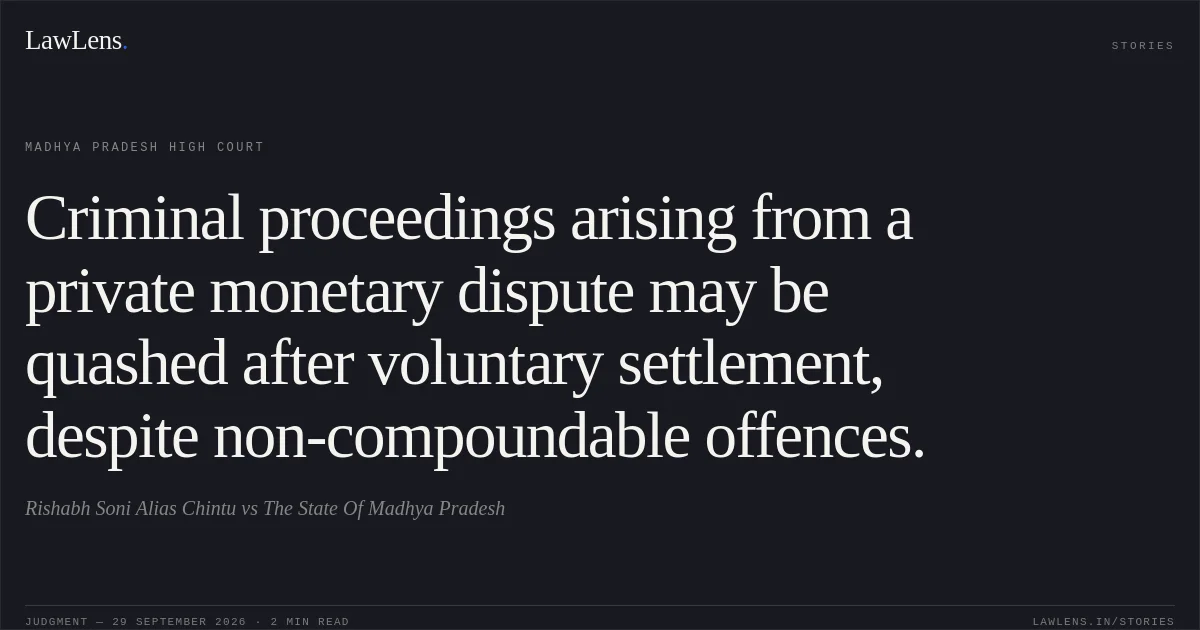
The Court allowed the petition, took the compromise on record, and quashed the FIR and all consequential criminal proceedings against the petitioner for the specified offences.
The order was confined to proceedings arising from that FIR and did not affect any independent civil or other statutory remedy available to either party.
Source reference: para. 13–14Acts & Sections Cited
5 provisions across 3 statutes referred to in this judgment. Each provision opens on LawLens.
Bharatiya Nagarik Suraksha Sanhita, 20231
Indian Penal Code, 18603
Code of Criminal Procedure, 19731
Original Court PDF
Rishabh Soni Alias ChintuvsThe State Of Madhya Pradesh
Click to open original judgment
Original judgment, available to read, download and summarize on LawLens.in