Facts
The petitioner, who was posted as District Sub-Registrar, Katihar, challenged the order dated 23.05.2018 passed by the Additional Chief Judicial Magistrate-V, Katihar, in Complaint Case No. 68 of 2013, whereby cognizance was taken against him for offences under Sections 500, 506 and 120B of the Indian Penal Code and summons were directed to be issued.
Source reference: p.1, paras. 2, 4The complainant, an Advocate, alleged that he had visited the Sub-Registrar’s office with clients for registration of documents; that the petitioner abused him, directed him to leave the office, threatened him, and instructed office staff not to register documents presented through him.
Source reference: p.2, para. 3The complainant examined himself and four inquiry witnesses in support of the complaint.
Source reference: p.2, para. 4The petitioner contended that the complaint was motivated by a dispute concerning registration fees and that none of the persons whose documents were allegedly presented had complained of any illegal refusal, abuse or threat.
Source reference: pp.2–3, paras. 5–6Issues
Whether the order taking cognizance under Sections 500, 506 and 120B IPC was liable to be quashed where the allegations arose from an official dispute in the Sub-Registrar’s office and were not supported by the persons directly concerned with the proposed registrations?
Source reference: pp.3–6, paras. 7–16Whether the materials disclosed the essential basis of a criminal conspiracy under Section 120B IPC, namely, an agreement to commit an illegal act or to commit a legal act by illegal means?
Source reference: p.6, para. 14Whether continuation of the complaint proceeding would amount to an abuse of the process of the Court under the principles stated in State of Haryana v. Bhajan Lal?
Source reference: pp.4–6, paras. 11–16Law Applied
The Court applied the principles governing quashing of criminal proceedings where continuation would constitute an abuse of process.
Source reference: no citationIt relied on Pepsi Foods Ltd. v. Special Judicial Magistrate, (1998) 5 SCC 749, which holds that summoning an accused is a serious matter and that the Magistrate must apply judicial mind to the allegations and supporting material rather than issue process mechanically.
Source reference: p.3, para. 8It also relied on State of Haryana v. Bhajan Lal, 1992 Supp (1) SCC 335, particularly Guideline No. 7, under which proceedings may be quashed where they are manifestly attended with mala fides or maliciously instituted with an ulterior motive for wreaking vengeance.
Source reference: pp.4–5, para. 11For Section 120B IPC, the Court stated that conspiracy requires material indicating an agreement to commit an illegal act or to commit a legal act by illegal means; mere official interaction or presence is insufficient.
Source reference: p.6, para. 14The Court further recognised that, at the cognizance stage, it should not conduct a meticulous appreciation of evidence, but must nevertheless examine whether the allegations and materials disclose a prima facie basis for proceeding.
Source reference: p.3, para. 7Reasoning
The Court found that the prosecution principally rested on the alleged incident between the complainant and the petitioner in the registration office, while the persons whose documents were allegedly presented had themselves made no complaint against the petitioner.
Source reference: p.5, para. 9This omission was treated as a relevant circumstance affecting the genuineness and context of the prosecution case, particularly because the dispute arose during the petitioner’s discharge of official duties concerning registration and payment of proper registration fees.
Source reference: pp.2–3, 5, paras. 5–6, 9–10Applying Pepsi Foods, the Court held that the Magistrate was required to assess the allegations and materials judicially before summoning the petitioner.
Source reference: p.3, para. 8Applying Guideline No. 7 of Bhajan Lal, it concluded that the complaint appeared to have been instituted because of the dispute between the complainant and the petitioner, rather than to redress a genuine grievance of the persons concerned with the documents.
Source reference: pp.5–6, paras. 12–13, 16The materials also lacked any specific indication of an agreement constituting conspiracy under Section 120B IPC.
Source reference: p.6, para. 14Holding
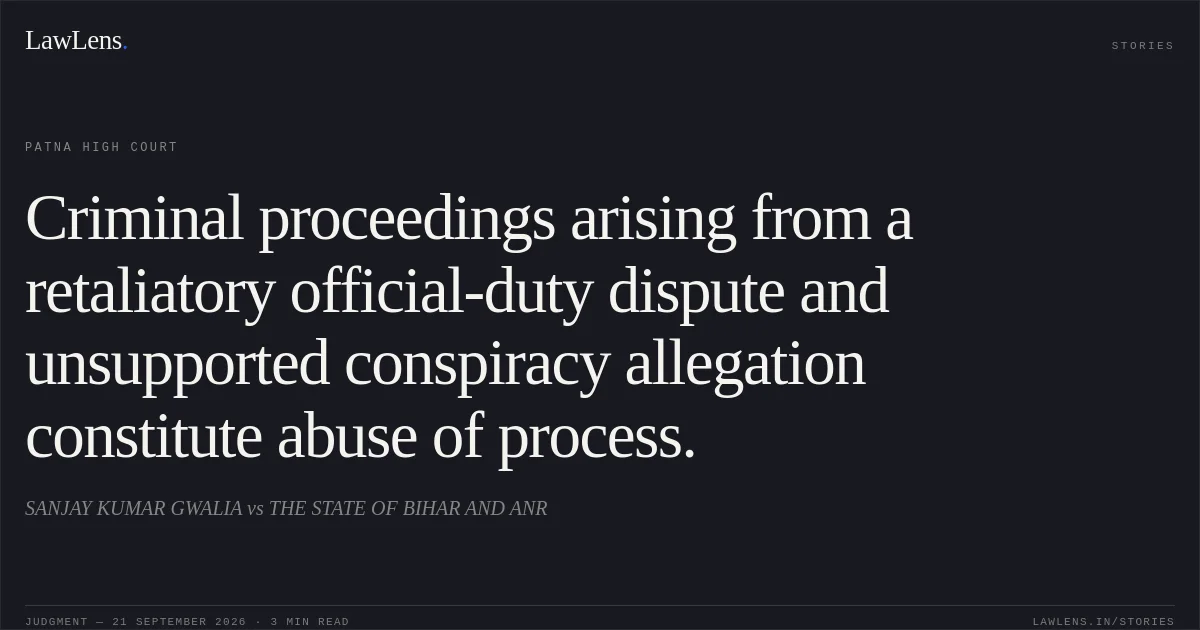
The Court held that continuation of the criminal proceeding against the petitioner would amount to an abuse of the process of the Court, particularly in view of the apparent ulterior motive, the official context of the dispute, the absence of complaints by the persons directly concerned with the documents, and the lack of material supporting the conspiracy allegation.
Accordingly, the order dated 23.05.2018 taking cognizance in Complaint Case No. 68 of 2013 was quashed and set aside qua the petitioner, and the quashing petition was allowed.
Source reference: p.7, paras. 17–18Acts & Sections Cited
2 provisions across 1 statute referred to in this judgment. Each provision opens on LawLens.
Indian Penal Code, 18602
Original Court PDF
SANJAY KUMAR GWALIAvsTHE STATE OF BIHAR AND ANR
Click to open original judgment
Original judgment, available to read, download and summarize on LawLens.in