Facts
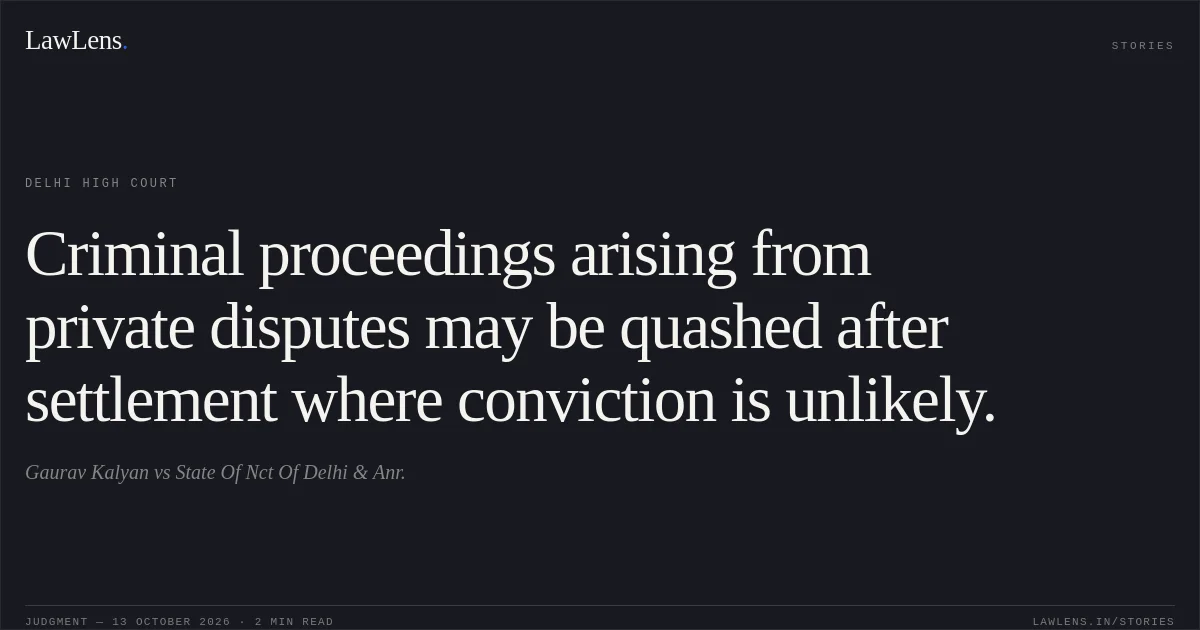
The petitioner, a director of a travel agency, was named in an FIR alleging criminal breach of trust and conspiracy after respondent no. 2’s family’s Dubai trip was cancelled during the COVID-19 pandemic and the payments were not refunded.
Source reference: pp. 2–3, paras. 6.1–6.5The FIR was registered under Sections 406/120B/34 IPC, and a chargesheet was later filed against the petitioner and two others.
Source reference: p. 3, paras. 6.6–6.7The petitioner sought quashing under Section 528 BNSS. The petitioner, respondent no. 2, and the family members who had made the payments entered into a settlement; the agreed amounts were paid, and respondent no. 2 confirmed the settlement was voluntary and that he did not wish to pursue the case.
Source reference: pp. 3–4, paras. 7–11Issues
Whether the FIR and consequential proceedings under Sections 406/120B/34 IPC should be quashed qua the petitioner in light of the parties’ settlement.
Source reference: pp. 1, 6, paras. 1, 15–17Whether the nature of the dispute and the settlement justified exercising the High Court’s inherent jurisdiction under Section 528 BNSS.
Source reference: pp. 4–6, paras. 13–16Law Applied
Section 528 BNSS preserves the High Court’s inherent power to prevent abuse of process and secure the ends of justice.
Source reference: p. 4, para. 13Applying the principles in Gian Singh v. State of Punjab, (2012) 10 SCC 303, the Court may quash even non-compoundable offences after settlement where continuation of proceedings would be futile and justice warrants their termination.
Source reference: p. 4, para. 13Under Parbatbhai Aahir v. State of Gujarat, (2017) 9 SCC 641, the Court must assess the nature and gravity of the offence, whether the dispute is predominantly civil or private, the likelihood of conviction, and whether continuation would cause oppression or prejudice; serious offences with substantial public impact are generally not to be quashed on settlement alone.
Source reference: pp. 4–6, para. 14Reasoning
The Court treated the dispute as private in nature and noted that the settlement had been reached voluntarily, the agreed payments had been received, and respondent no. 2 did not wish to continue the matter.
Source reference: pp. 3–4, paras. 9–12In those circumstances, it considered the likelihood of conviction remote and concluded that continuing the proceedings would be an empty formality that would needlessly consume judicial and public resources.
Source reference: p. 6, paras. 15–16The State had no serious objection to quashing.
Source reference: p. 4, para. 12Holding
The Court answered the issues in favour of quashing and allowed the petition.
FIR No. 35/2021 and all proceedings arising from it were quashed qua the petitioner, Gaurav Kalyan; the parties remained bound by the settlement memorandum.
Source reference: p. 6, paras. 17–19Acts & Sections Cited
5 provisions across 3 statutes referred to in this judgment. Each provision opens on LawLens.
Bharatiya Nagarik Suraksha Sanhita, 20231
Indian Penal Code, 18602
Code of Criminal Procedure, 19732
Original Court PDF
Gaurav KalyanvsState Of Nct Of Delhi & Anr.
Click to open original judgment
Original judgment, available to read, download and summarize on LawLens.in