Facts
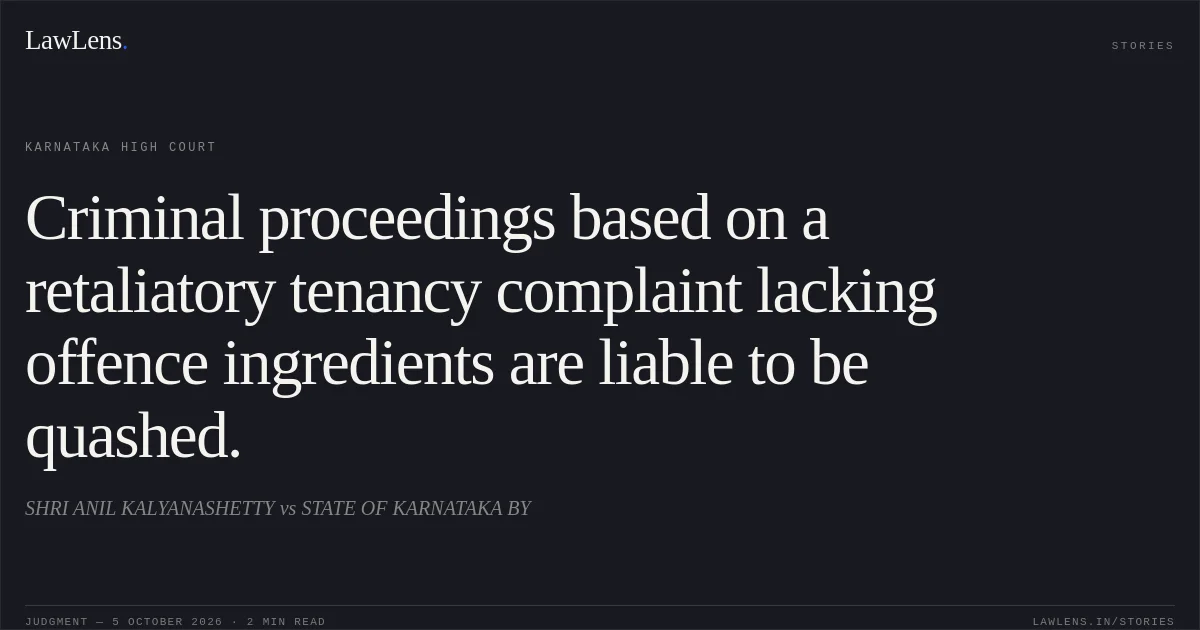
Respondent No. 2, a tenant operating a saloon in premises associated with the petitioner’s family, alleged that the petitioner trespassed into the saloon on 1 October 2018, outraged her modesty and damaged property.
Source reference: para. 2, 4, 7She lodged a complaint on 26 October 2018, leading to registration of a case and, after investigation, a charge sheet for offences under Sections 354A, 427 and 506 of the IPC.
Source reference: para. 2, 4, 7The Magistrate took cognizance and issued process.
Source reference: para. 2, 4, 7The petitioner sought to quash the proceedings under Section 482 of the Cr.P.C., arguing, among other things, that the complaint followed a landlord–tenant dispute, was delayed, and lacked specific allegations.
Source reference: para. 2, 4, 7Respondent No. 2’s civil suit for permanent injunction was dismissed, while the petitioner’s family’s counterclaim for eviction was decreed.
Source reference: para. 2, 4, 7Issues
1. Whether the complaint and accompanying material disclosed the ingredients of the alleged offences under Sections 354A, 427 and 506 of the IPC against the petitioner
Source reference: para. 2, 7, 92. Whether, in light of the circumstances surrounding the landlord–tenant dispute, continuing the criminal proceedings would amount to an abuse of process warranting relief under Section 482 of the Cr.P.C.
Source reference: para. 4, 7–9Law Applied
Section 482 of the Cr.P.C. empowers the High Court to quash criminal proceedings to prevent abuse of process and secure the ends of justice.
Source reference: para. 8–9Under the categories identified in State of Haryana v. Bhajan Lal, proceedings may be quashed where the allegations, even accepted in full, do not constitute an offence, or where they are manifestly mala fide and instituted to wreak vengeance.
Source reference: para. 8–9The Court also relied on Mohammed Ali v. State of U.P., (2023) 15 SCC 488, concerning careful scrutiny of the surrounding circumstances in cases alleging vexatious proceedings, and on the principles in State of A.P. v. Golconda Linga Swamy, (2004) 6 SCC 522, and R.P. Kapur v. State of Punjab, AIR 1960 SC 866, regarding the permissible scope of quashing proceedings.
Source reference: para. 8–9In assessing Section 354A of the IPC, the Court considered whether the complaint alleged the requisite conduct and a positive act by the petitioner.
Source reference: para. 7Reasoning
The Court noted that the complaint was lodged 25 days after the alleged incident and that, on its reading, it contained no allegation that the petitioner had outraged respondent No. 2’s modesty or otherwise committed a positive act sufficient to attract Section 354A.
Source reference: para. 7It considered these deficiencies alongside the parties’ landlord–tenant dispute, the related civil proceedings and their outcome.
Source reference: para. 4, 7The Court inferred that the complaint had been lodged in retaliation for the petitioner’s father’s insistence that respondent No. 2 vacate the premises and clear rent arrears.
Source reference: para. 4, 7Applying the Bhajan Lal categories and the cited quashing principles, it concluded that the allegations did not constitute the offences alleged and that continuation of the prosecution would be an abuse of process.
Source reference: para. 8–9Holding
The High Court allowed the petition under Section 482 of the Cr.P.C. and quashed the proceedings in C.C. No. 53587/2020, arising from Crime No. 272/2018, against the petitioner for offences under Sections 354A, 427 and 506 of the IPC.
Acts & Sections Cited
5 provisions across 2 statutes referred to in this judgment. Each provision opens on LawLens.
Code of Criminal Procedure, 19733
Indian Penal Code, 18602
Original Court PDF
SHRI ANIL KALYANASHETTYvsSTATE OF KARNATAKA BY
Click to open original judgment
Original judgment, available to read, download and summarize on LawLens.in