Facts
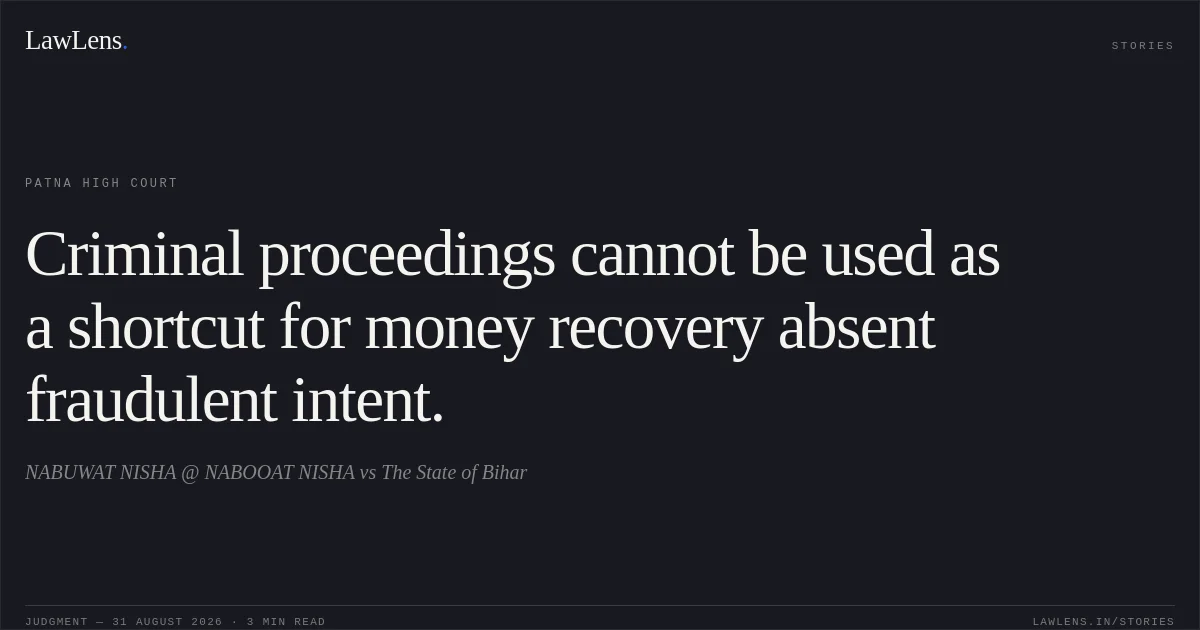
The petitioner-complainant and her husband allegedly paid ₹12 lakhs to the accused persons for purchasing land at Allahabad and Bengaluru. The land was allegedly purchased in the names of Opposite Parties Nos. 2 and 3 and was not registered in the petitioner’s name. Upon demand, ₹9,30,000 was returned, but ₹2,70,000 remained unpaid.
Source reference: p.2, para. 3On the basis of the complaint, the Magistrate took cognizance of offences under Sections 406 and 34 of the Indian Penal Code by order dated 4 January 2021.
Source reference: p.2, para. 4Opposite Party No. 2 and another accused challenged that order in Criminal Revision No. 85 of 2021. The Additional District and Sessions Judge allowed the revision on 22 July 2022 and set aside the cognizance order against all accused persons, although Opposite Party No. 3 had not preferred the revision.
Source reference: p.2–3, paras. 2 and 5The petitioner consequently approached the High Court seeking quashing of the revisional order.
Source reference: no citationIssues
Whether the revisional court was justified in setting aside the order taking cognizance under Sections 406 and 34 IPC when the complaint, the complainant’s statement, and the inquiry-witness depositions allegedly disclosed a prima facie case.
Source reference: p.2–3, paras. 4–5Whether the alleged non-payment of ₹2,70,000, after repayment of ₹9,30,000, constituted a criminal offence or was essentially a civil dispute concerning recovery of money.
Source reference: p.3–5, paras. 7–12Whether the criminal process could be used as a means of recovering the outstanding amount.
Source reference: p.4, paras. 9–10Law Applied
The Court considered the alleged offences under Sections 406 and 34 IPC, requiring material indicating criminal breach of trust and common intention, rather than a mere unpaid contractual or monetary obligation.
Source reference: no citationIt relied on Bimla Tiwari v. State of Bihar, (2023) 1 SCC 506, for the principle that criminal proceedings cannot be used for arm-twisting or recovery of money.
Source reference: p.4, para. 9It further relied on Indian Oil Corporation v. NEPC India Ltd., (2006) 6 SCC 736, which deprecated the use of criminal proceedings as a shortcut for pursuing civil remedies.
Source reference: p.4, para. 10Under Satish Chandra v. State of Gujarat, (2019) 9 SCC 148, mere inability to repay a loan or amount does not constitute cheating or criminal breach of trust unless fraudulent intention is clearly established.
Source reference: p.4, para. 10The Court also referred to Urmila Devi v. Balram, 2025 SCC OnLine SC 1574, regarding the abuse of complaint proceedings as a circuitous tool when appropriate civil remedies are available.
Source reference: p.4, para. 11Reasoning
The Court examined the complaint, the complainant’s solemn affirmation, the inquiry-witness depositions, the cognizance order, and the revisional order.
Source reference: p.3, para. 7It found that ₹9,30,000 had admittedly been returned and that the complainant and inquiry witnesses stated, in response to the court’s queries, that they primarily wanted their money refunded.
Source reference: p.3, paras. 7–8The materials did not establish fraudulent intention, entrustment followed by dishonest misappropriation, or any other distinct criminal element; they showed only that ₹2,70,000 remained unpaid.
Source reference: p.3–4, para. 8Applying the principles against converting civil money-recovery claims into criminal prosecutions, the Court held that the dispute was predominantly civil and that the complaint appeared to have been instituted to secure repayment from the accused.
Source reference: p.4, paras. 9–12The availability of civil remedies further militated against permitting the criminal prosecution to continue.
Source reference: p.4–5, para. 12Holding
The High Court held that the allegations and supporting materials did not disclose a criminal offence under Sections 406 and 34 IPC and that the dispute essentially concerned recovery of an outstanding monetary amount.
It found no illegality in the revisional order dated 22 July 2022 setting aside the order taking cognizance dated 4 January 2021.
Source reference: p.5, para. 12The application was accordingly dismissed.
Source reference: p.5, para. 13Acts & Sections Cited
2 provisions across 1 statute referred to in this judgment. Each provision opens on LawLens.
Indian Penal Code, 18602
Original Court PDF
NABUWAT NISHA @ NABOOAT NISHAvsThe State of Bihar
Click to open original judgment
Original judgment, available to read, download and summarize on LawLens.in