Facts
The petitions challenged cross-FIRs registered as Crime Nos. 92 and 93 of 2025, arising from an alleged altercation between the parties and their family members on 23 May 2025.
Source reference: para. 1, 4, 10–10.1The complaints alleged, among other things, assault, threats and unlawful assembly; the FIRs invoked various offences under the Bharatiya Nyaya Sanhita, 2023.
Source reference: para. 1, 4, 10–10.1The dispute arose against the background of partnership businesses established by the parties and their spouses, and subsequent disagreements concerning the partnerships and monetary transactions.
Source reference: para. 4Petitioner No. 2 in W.P. No. 17916 of 2025 had also instituted a commercial arbitration application.
Source reference: para. 4Interim stays of the proceedings had been granted in both petitions.
Source reference: para. 5Issues
1. Whether the allegations in the two FIRs, viewed in the context of the parties’ admitted partnership and monetary disputes, disclosed a basis for continuing the criminal proceedings.
Source reference: para. 9–102. Whether the FIRs and proceedings in Crime Nos. 92 and 93 of 2025 should be quashed as an abuse of the criminal process.
Source reference: para. 11.2–12Law Applied
The petitions invoked Articles 226 and 227 of the Constitution and Section 528 of the Bharatiya Nagarik Suraksha Sanhita, 2023, as the basis for seeking quashing.
Source reference: case caption; para. 1The Court relied on State of Haryana v. Bhajan Lal, which identifies categories of cases in which proceedings may be quashed, including where the allegations do not prima facie disclose an offence or where proceedings are maliciously instituted for an ulterior purpose.
Source reference: para. 11.2It also referred to V. Ganesan v. State, Paliniswamy Veeraraja v. State of Karnataka and G. Saminathan v. State for the principles that criminal proceedings should not be used to give a criminal colour to essentially civil or business disputes, and that cheating requires dishonest or fraudulent intention at the inception of the transaction.
Source reference: para. 11–11.2Reasoning
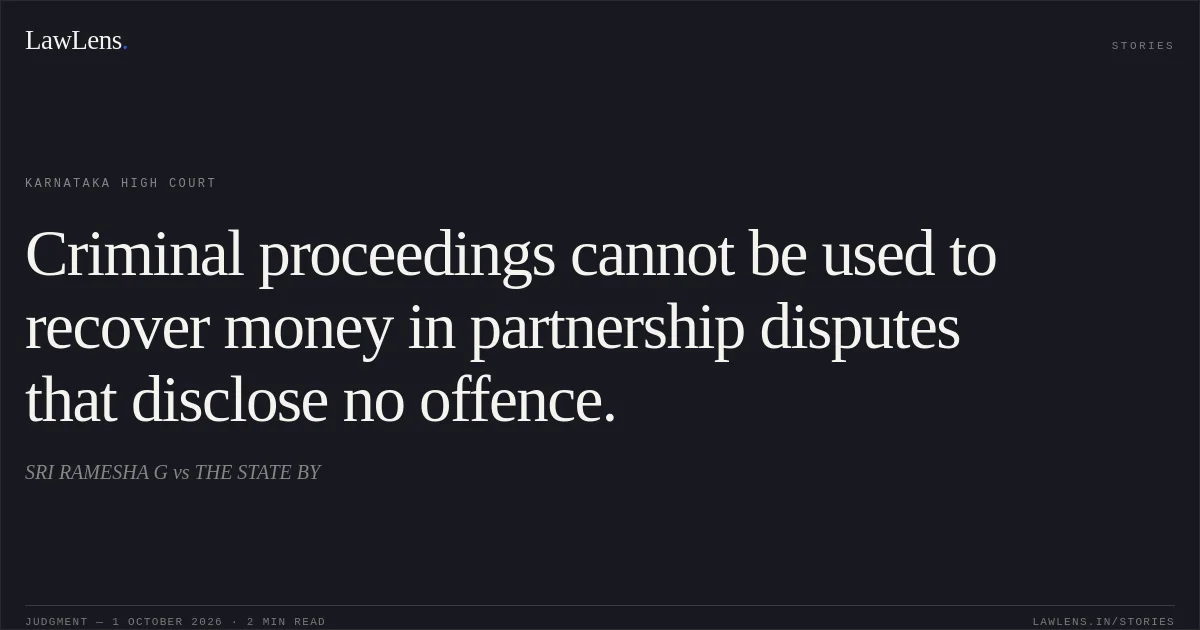
The Court treated the parties’ partnership and monetary disputes as the context for both the complaints and the counter-complaint, noting that the parties accepted that the petitions arose from those disputes.
Source reference: para. 8–10It concluded that the criminal law had been set in motion in furtherance of a civil dispute and applied the Bhajan Lal categories concerning allegations that do not disclose offences and proceedings allegedly brought with an ulterior motive.
Source reference: para. 10, 11.2On that basis, it found continuation of the two criminal proceedings unwarranted.
Source reference: para. 11.2Holding
The Court allowed both petitions and quashed Crime Nos. 92 and 93 of 2025, pending before the 2nd Additional Civil Judge and JMFC, Nelamangala.
It clarified that its observations were confined to the petitions under Section 528 of the BNSS and would not govern disputes between the parties pending before other fora.
Source reference: para. 12Acts & Sections Cited
20 provisions across 6 statutes referred to in this judgment. Each provision opens on LawLens.
Bharatiya Nagarik Suraksha Sanhita, 20231
Bharatiya Nyaya Sanhita, 2023
Indian Penal Code, 18604
Negotiable Instruments Act, 18811
Code of Criminal Procedure, 19734
Arbitration and Conciliation Act, 19961
Original Court PDF
SRI RAMESHA GvsTHE STATE BY
Click to open original judgment
Original judgment, available to read, download and summarize on LawLens.in