Facts
The petitioner, Sanjeev Kumar, was implicated in Complaint Case No. 1086 of 2022 arising from an alleged dispute concerning the sale of ancestral land.
Source reference: p. 2The complainant alleged that the petitioner and co-accused persons sold land belonging to the complainant’s share and, when questioned, abused, assaulted, and threatened the complainant and his family members.
Source reference: p. 2The alleged occurrence was stated to have taken place in December 2019, whereas the complaint was instituted in 2022, without a specific explanation for the delay.
Source reference: pp. 2–3A civil title dispute between the parties, who were agnates, was admittedly pending.
Source reference: pp. 3–4On 14 April 2024, the Judicial Magistrate took cognizance only under Sections 323 and 504 of the Indian Penal Code and issued summons to the petitioner.
Source reference: p. 1The petitioner invoked the High Court’s inherent jurisdiction under Section 482 of the Code of Criminal Procedure seeking quashing of the cognizance order and the consequential proceedings.
Source reference: no citationIssues
Whether the allegations in the complaint, sworn statement, and inquiry-witness statements disclosed the essential ingredients of offences under Sections 323 and 504 IPC.
Source reference: pp. 4–5, para. 7Whether the criminal complaint was an abuse of process, having been instituted in the context of a pending civil land dispute, after substantial delay, and with vague allegations of assault and abuse.
Source reference: pp. 5–7, paras. 8–9Whether the High Court should exercise its inherent jurisdiction under Section 482 CrPC to quash the cognizance order and criminal proceedings against the petitioner.
Source reference: pp. 7–9, paras. 10–12Law Applied
The Court applied Section 482 CrPC, which preserves the High Court’s inherent power to prevent abuse of the process of any court and to secure the ends of justice.
Source reference: pp. 5–9It considered the ingredients of Sections 323 and 504 IPC, observing that Section 323 requires the allegation of voluntarily causing hurt, while Section 504 requires conduct amounting to intentional insult of the legally relevant nature.
Source reference: p. 5, para. 7The Court relied on State of Haryana v. Ch. Bhajan Lal, 1992 Supp (1) SCC 335, particularly the principle that proceedings manifestly attended with mala fides or instituted maliciously may be quashed.
Source reference: p. 7, para. 9It also relied on Amit Kapoor v. Ramesh Chander, (2012) 9 SCC 460, for the principle that proceedings may be quashed where the allegations predominantly disclose a civil wrong, contain no element of criminality, or continuing the prosecution would amount to abuse of process.
Source reference: pp. 7–8, para. 10The Court further referred to Urmila Devi v. Balram, 2025 SCC OnLine SC 1574, and the decisions cited therein, emphasising that criminal proceedings cannot be used as a circuitous tool or a weapon of harassment in matters essentially civil in nature.
Source reference: pp. 5–7, para. 8Reasoning
The Court found that the central dispute concerned the alleged sale of land said to belong to the complainant’s share and that the parties were already litigating the matter in civil proceedings.
Source reference: pp. 4–5, 7The allegations of assault and abuse were vague and did not identify any specific date, particular incident, or concrete act; the complainant’s own statement placed the occurrence generally in 2019.
Source reference: pp. 4–5, para. 7The Court also noted that there was no assertion that anyone suffered hurt, which it treated as necessary for constituting an offence under Section 323 IPC.
Source reference: p. 5, para. 7In the context of the pending title dispute, the generalized allegation of abuse was insufficient to establish an offence under Section 504 IPC.
Source reference: p. 5, para. 7The unexplained delay of approximately three years, the civil nature of the underlying dispute, and the absence of specific allegations indicated that the criminal case had been given a criminal colour to harass the petitioner.
Source reference: pp. 5–7, paras. 8–9Applying the principles in Bhajan Lal and Amit Kapoor, the Court concluded that continuation of the prosecution would amount to abuse of process and that the allegations, even if accepted at face value, did not disclose the alleged offences.
Source reference: pp. 7–9, paras. 9–11Holding
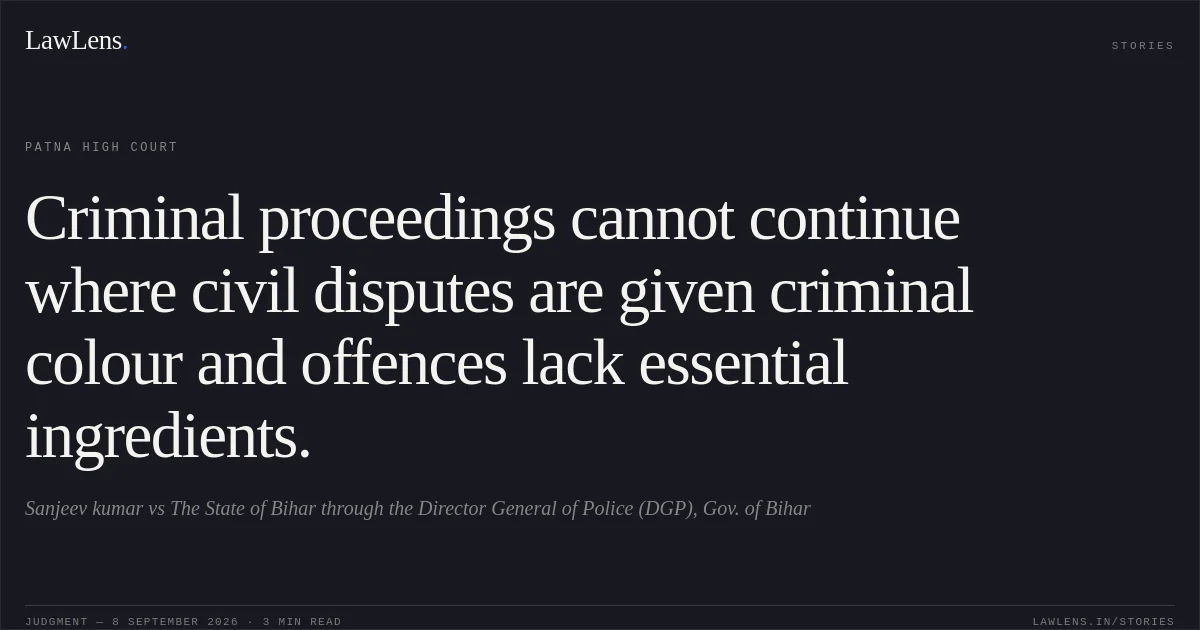
The High Court held that the complaint and supporting materials did not disclose the essential ingredients of Sections 323 or 504 IPC and that the proceedings were manifestly attended by mala fides in the setting of an essentially civil land dispute.
Exercising jurisdiction under Section 482 CrPC, the Court quashed the order dated 14 April 2024 passed in Complaint Case No. 1086 of 2022 and the consequential criminal proceedings insofar as they related to the petitioner, Sanjeev Kumar.
Source reference: p. 9, para. 12The application was accordingly allowed.
Source reference: p. 9, para. 13Acts & Sections Cited
12 provisions across 2 statutes referred to in this judgment. Each provision opens on LawLens.
Indian Penal Code, 1860
Code of Criminal Procedure, 19732
Original Court PDF
Sanjeev kumarvsThe State of Bihar through the Director General of Police (DGP), Gov. of Bihar
Click to open original judgment
Original judgment, available to read, download and summarize on LawLens.in