Facts
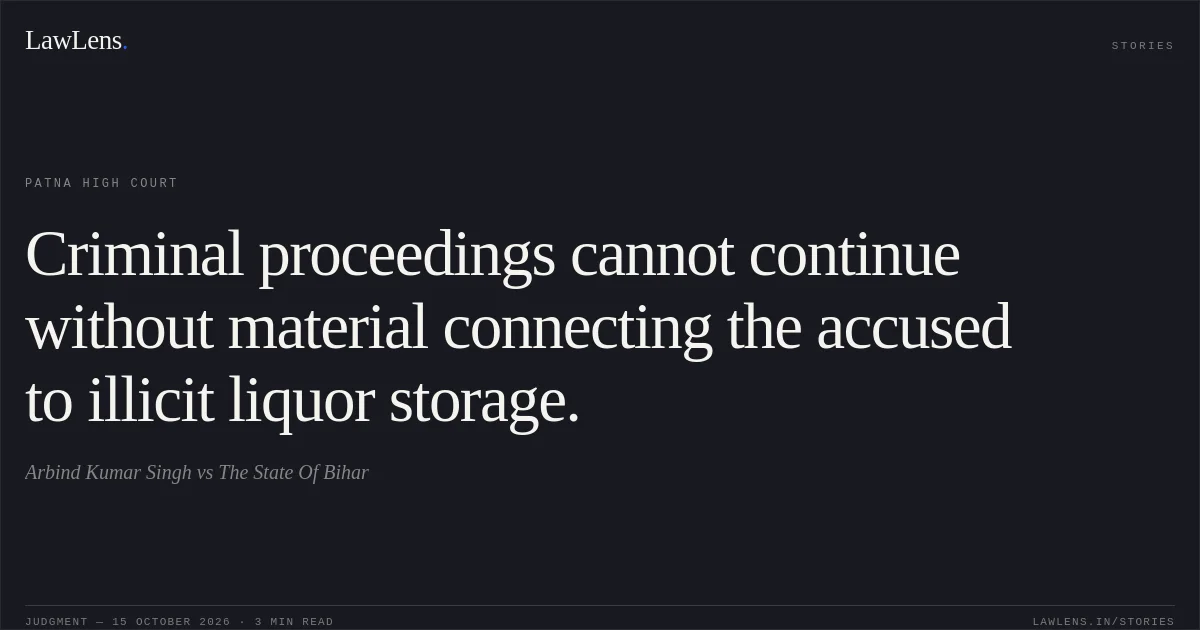
On 18 May 2005, police searched a house belonging to Ramashish Yadav and allegedly seized 105 gunny bags containing more than 4,000 litres of illicit liquor. The prosecution alleged that Arbind Kumar Singh had stored the liquor there, although it was not recovered from his person and he was not present during the raid.
Source reference: paras. 2–7, pp. 1–3During investigation, Shanti Devi, Ramashish Yadav’s wife, stated that the premises had been let to Sunil Kumar Sinha, who claimed to hold a liquor licence. The petitioner maintained that the record disclosed no evidence connecting him to the premises, liquor, or alleged offence.
Source reference: paras. 16–17, 29, pp. 5–6, 10–11After the Magistrate rejected his discharge application under Section 239 CrPC, the Sessions Judge dismissed his revision. The petitioner then sought relief under Section 482 CrPC.
Source reference: paras. 10–12, pp. 4–5Issues
1. Whether, in the absence of sufficient material prima facie connecting the petitioner with the alleged offence, continuation of the criminal proceedings would amount to an abuse of process warranting interference under Section 482 CrPC.
Source reference: para. 23, p. 72. Whether the prosecution materials disclosed a sufficient basis to proceed against the petitioner for the alleged offence under Section 47(A) of the Bihar Excise Act.
Source reference: paras. 49–51, pp. 21–22Law Applied
Section 239 CrPC requires discharge where, after considering the police report and accompanying documents and hearing the parties, the Magistrate finds the charge groundless; at this stage the court must assess whether the prosecution materials provide a basis to proceed, not determine guilt or conduct a detailed evaluation of evidence.
Source reference: paras. 25–28, 33–40, pp. 8–9, 13–17Under Section 482 CrPC, the High Court may quash proceedings to prevent abuse of process where the allegations and materials, taken at face value, fail to disclose the essential ingredients of an offence; this power must be exercised sparingly and without assessing the reliability of disputed evidence.
Source reference: paras. 24, 41–45, pp. 8, 17–20The Court relied, among other authorities, on State of Haryana v. Bhajan Lal, 1992 Supp (1) SCC 335, Amit Kapoor v. Ramesh Chander, (2012) 9 SCC 460, and Neeharika Infrastructure Pvt. Ltd. v. State of Maharashtra, (2021) 19 SCC 401, alongside decisions concerning the threshold for framing charges.
Source reference: paras. 31–44, pp. 11–20Reasoning
The Court accepted that absence of personal recovery or the petitioner’s signature on the seizure list would not, by itself, establish innocence. However, it found that the liquor was recovered from another person’s house and that the investigation disclosed no material showing the petitioner stored it, knew of its presence, or was otherwise connected to the alleged offence. The statement concerning the tenancy to Sunil Kumar Sinha further formed part of the circumstances considered by the Court.
Source reference: paras. 29, 46–49, pp. 10–11, 20–21On the prosecution materials as described, the Court concluded that no prima facie basis existed to attribute the alleged storage or offence to the petitioner; the charge-sheet alone could not justify continuing the prosecution.
Source reference: paras. 50–54, pp. 21–23Holding
The High Court allowed the application under Section 482 CrPC, quashed the Sessions Judge’s order dated 2 August 2016 and the Magistrate’s order dated 14 March 2016, and discharged the petitioner.
It also quashed the criminal proceedings against him arising from Nawada Muffasil P.S. Case No. 46 of 2005, while clarifying that the order did not affect proceedings against any other accused.
Source reference: paras. 55–60, pp. 23–25Acts & Sections Cited
9 provisions across 1 statute referred to in this judgment. Each provision opens on LawLens.
Code of Criminal Procedure, 1973
Original Court PDF
Arbind Kumar SinghvsThe State Of Bihar
Click to open original judgment
Original judgment, available to read, download and summarize on LawLens.in