Facts
The petitioners were accused Nos. 1–8 in Crime No. 90 of 2025 registered by Jigani Police Station for offences under Sections 3(1)(r), 3(1)(s), 3(1)(t), 3(1)(a) and 3(1)(za) of the Scheduled Castes and Scheduled Tribes (Prevention of Atrocities) Act, 1989 (“SC/ST Act”) and Sections 329, 351 and 45 of the Bharatiya Nyaya Sanhita, 2023 (“BNS”).
Source reference: para. 1Respondent No. 2 claimed to belong to the Bhovi community and asserted hereditary occupancy and ownership rights over portions of land bearing Sy. No. 21 at Mahanthalingapura Village.
Source reference: paras. 3–3.1The petitioners claimed possession under a registered sale deed and revenue entries.
Source reference: paras. 3–3.1The parties were already litigating their title and possession claims in O.S. No. 1094 of 2016 and O.S. No. 1052 of 2023, both pending before the civil court.
Source reference: para. 8The complainant alleged that, on 1 January 2025, the petitioners removed stones allegedly marking the samadhis of her ancestors, cut eucalyptus trees, installed cameras and attempted to construct a compound wall.
Source reference: para. 3.2She further alleged that on 3 January 2025 the accused removed two samadhis with JCB machinery, threatened and abused her and others, and used caste-based expressions.
Source reference: para. 10Jigani Police initially treated the matter as civil and issued a non-cognizable report.
Source reference: para. 3.3Thereafter, the complainant filed a private complaint under Section 223 of the BNSS, pursuant to which the Magistrate referred the matter for investigation and Crime No. 90 of 2025 was registered.
Source reference: para. 3.3; para. 11The petitioners invoked Section 528 of the BNSS seeking quashing of the FIR and the direction referring the private complaint for investigation.
Source reference: no citationIssues
Whether the allegations in the complaint, arising from a pending dispute regarding title and possession of land, prima facie constituted criminal trespass, criminal intimidation and abetment under Sections 329, 351 and 45 of the BNS.
Source reference: paras. 12–15Whether the allegations satisfied the statutory ingredients of Sections 3(1)(a), 3(1)(r), 3(1)(s), 3(1)(t) and 3(1)(za) of the SC/ST Act.
Source reference: paras. 16–22Whether continuation of the criminal proceedings amounted to an abuse of process where the criminal complaint was allegedly being used as a pressure tactic or counterblast in pending civil litigation.
Source reference: paras. 23–33Law Applied
The Court exercised its inherent jurisdiction under Section 528 of the BNSS, corresponding to Section 482 of the CrPC, to prevent abuse of process and secure the ends of justice.
Source reference: paras. 30–33Section 329 of the BNS requires entry upon property in the possession of another accompanied by the prescribed criminal intent; a disputed claim of title or possession does not, by itself, establish criminal trespass.
Source reference: paras. 12–15The Court applied Sections 3(1)(a), 3(1)(r), 3(1)(s), 3(1)(t) and 3(1)(za) of the SC/ST Act, holding that penal ingredients must be specifically pleaded and cannot be supplied by inference.
Source reference: para. 16Sections 3(1)(r) and 3(1)(s) additionally require intentional insult, intimidation or caste-based abuse in a place “within public view.”
Source reference: no citationRelying on Hitesh Verma v. State of Uttarakhand, (2020) 10 SCC 710, and Swaran Singh v. State, (2008) 8 SCC 435, the Court held that a property dispute does not become an atrocity merely because one party belongs to a Scheduled Caste or Scheduled Tribe, absent the requisite caste-based intent and public-view requirement.
Source reference: paras. 26–27It also relied on Gunjan v. State (NCT of Delhi), 2026 SCC OnLine SC 834, for the necessity of a specific allegation that the incident occurred within public view and for the requirement of intent to cause alarm in criminal intimidation.
Source reference: para. 28The principles in Mahmood Ali v. State of Uttar Pradesh, 2023 SCC OnLine SC 950, and State of Haryana v. Bhajan Lal, 1992 Supp (1) SCC 335, permit the Court to examine the surrounding circumstances and quash proceedings where allegations do not disclose an offence or are manifestly malicious.
Source reference: paras. 30–32Reasoning
The Court found that the petitioners were prima facie in possession under a registered sale deed and that the complainant’s title and possession remained unresolved in the pending civil suits.
Source reference: paras. 8–9, 13In that context, the allegation that the petitioners had trespassed into property which they themselves claimed and possessed could not establish Section 329 of the BNS; the related allegations of intimidation and abetment could not survive independently once the foundational trespass allegation failed.
Source reference: paras. 12–15Section 3(1)(a) of the SC/ST Act was wholly unsupported because the complaint contained no allegation that any inedible or obnoxious substance was put into, or forced into, the complainant’s mouth.
Source reference: para. 17The allegations under Sections 3(1)(r) and 3(1)(s) failed to state that the alleged caste-based abuse occurred in a place within public view, while the caste nexus appeared to arise from the property dispute rather than an intention to humiliate the complainant because of her caste.
Source reference: paras. 18–19, 26–28The alleged stones were not established, even on the complainant’s material, to be objects generally known to be sacred or held in high esteem so as to attract Section 3(1)(t).
Source reference: paras. 20–21Section 3(1)(za) also depended upon the unresolved assumption that the complainant had the legal right to use or possess the disputed land.
Source reference: para. 22Considering the chronology, the prior civil litigation, the non-cognizable report and the subsequent private complaint, the Court concluded that the criminal process was being used to exert pressure in a civil dispute, attracting the Bhajan Lal and Mahmood Ali principles.
Source reference: paras. 29–33Holding
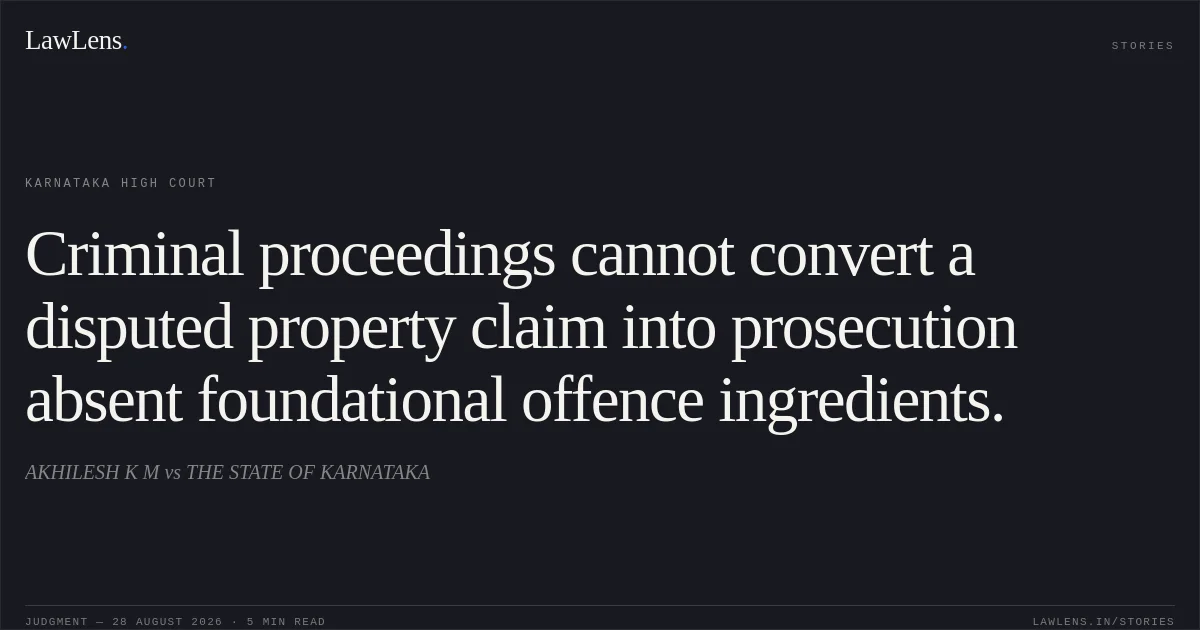
The Court held that the allegations did not disclose the essential ingredients of the offences under either the BNS or the SC/ST Act and that continuation of the proceedings would constitute an abuse of the process of law.
Both criminal petitions were allowed.
Source reference: no citationFIR No. 90 of 2025 registered by Jigani Police Station, together with the criminal proceedings pending before the II Additional District and Sessions Court, Bengaluru Rural District, was quashed.
Source reference: para. 34(i)–(ii)The Court clarified that its observations were confined to the exercise of jurisdiction under Section 528 of the BNSS and would not prejudice or influence the parties’ other pending civil proceedings.
Source reference: para. 34(iii)Acts & Sections Cited
15 provisions across 6 statutes referred to in this judgment. Each provision opens on LawLens.
Bharatiya Nagarik Suraksha Sanhita, 20232
Scheduled Castes and the Scheduled Tribes (Prevention of Atrocities) Act, 19891
Bharatiya Nyaya Sanhita, 20233
Code of Civil Procedure, 19081
Indian Penal Code, 18605
Code of Criminal Procedure, 19733
Original Court PDF
AKHILESH K MvsTHE STATE OF KARNATAKA
Click to open original judgment
Original judgment, available to read, download and summarize on LawLens.in
![Courts will not interfere with transfers absent mala fides or violation of statutory rules.. M Ramya vs EMPLOYEES STATE INSURANCE CORPORATION (ESIC). CAT - ['Chennai']. LawLens](/stories/thumbnails/courts-will-not-interfere-with-transfers-absent-mala-fides-or-violation-of-statutory-rules-a6845e9ca6f548fca284c51c8351957f.webp)
![Courts cannot direct one-time recruitment age relaxation absent authority in the governing rules or advertisement.. UT OF PUDUCHERRY vs M ANDAL. CAT - ['Chennai']. LawLens](/stories/thumbnails/courts-cannot-direct-one-time-recruitment-age-relaxation-absent-authority-in-the-governing-895d78fde47143e2a8ed0207c4b6a44f.webp)
![A review cannot correct an allegedly erroneous decision absent an error apparent on the record.. Ajit Kumar Jha vs RAILWAY BOARD. CAT - ['Delhi']. LawLens](/stories/thumbnails/a-review-cannot-correct-an-allegedly-erroneous-decision-absent-an-error-apparent-on-the-re-8ac952fd4eba470c92f7da20af72a220.webp)