Facts
The petitioner had contested the 2011 election for Member, Panchayat Samiti, Rakiya, in the name of Khushboo Kumari, wife of Amit Kumar Singh. In 2016, she contested for Mukhiya of Rakiya Gram Panchayat in the name of Nikki Devi. It was alleged that she concealed her earlier name and furnished false information in her nomination papers and affidavit.
Source reference: para. 3; p. 2Following complaints by Chanda Devi and Rajesh Kumar, an inquiry was conducted by the Sub-Divisional Officer, Saharsa. On the basis of the inquiry report, the Block Development Officer lodged a written report on 13 April 2018, resulting in registration of Bihra P.S. Case No. 66 of 2018 for offences under Section 171H IPC and Sections 125-A(1) and 125-A(3) of the Bihar Panchayat Raj Act, 2006.
Source reference: para. 4; p. 2Criminal Case No. 1054 of 2018 was thereafter pending before the Judicial Magistrate-III, Saharsa.
Source reference: para. 2; p. 1The petitioner sought quashing of the FIR and consequential proceedings under Section 482 CrPC, contending that the offences were non-cognizable and that no order under Section 155(2) CrPC had been obtained. She further asserted that Khushboo Kumari was her nickname and that she had subsequently changed or corrected her name before the competent authority. The same issue had also been considered in an earlier election proceeding, where the allegation of deliberate use of two identities was not accepted.
Source reference: paras. 5–8; pp. 2–4Issues
Whether the police could register the FIR and investigate the alleged non-cognizable offences without obtaining an order from the competent Magistrate under Section 155(2) CrPC?
Source reference: paras. 11–15; pp. 4–6Whether the allegations, even if accepted in their entirety, disclosed the essential ingredients of offences relating to furnishing false information or filing a false affidavit under Section 171H IPC and Sections 125-A(1) and 125-A(3) of the Bihar Panchayat Raj Act?
Source reference: paras. 16–20, 22–24; pp. 6–10Whether continuation of the criminal proceedings would amount to an abuse of the process of the court warranting exercise of inherent jurisdiction under Section 482 CrPC?
Source reference: paras. 24–27; pp. 10–11Law Applied
The Court applied Section 155(2) CrPC, which prohibits police investigation of a non-cognizable case without an order of a Magistrate competent to try or commit the case.
Source reference: para. 11; p. 5It relied on Manager Singh v. State of Bihar, 2014 SCC OnLine Pat 2570, for the principle that the statutory procedure under Section 155 CrPC must be followed before investigating a non-cognizable offence.
Source reference: para. 13; p. 5The Court also applied Section 482 CrPC, under which criminal proceedings may be quashed to prevent abuse of process or to secure the ends of justice.
Source reference: paras. 18, 24–25; pp. 7, 10–11Under Sections 125-A(1) and 125-A(3) of the Bihar Panchayat Raj Act, 2006, criminal liability requires failure to furnish required information, furnishing information known or believed to be false, or concealment of information, with the requisite intent to be elected.
Source reference: para. 23; pp. 9–10The Court treated the materially similar provision in Section 447 of the Bihar Municipal Act, 2007 in the same manner.
Source reference: para. 23; pp. 9–10It also referred to Nikki Devi v. The State Election Commission (Panchayat) & Ors., 2019 SCC OnLine Pat 1068, concerning the prior election dispute and the issue of the petitioner’s change or use of names.
Source reference: paras. 8, 17; pp. 3–4, 6–7Reasoning
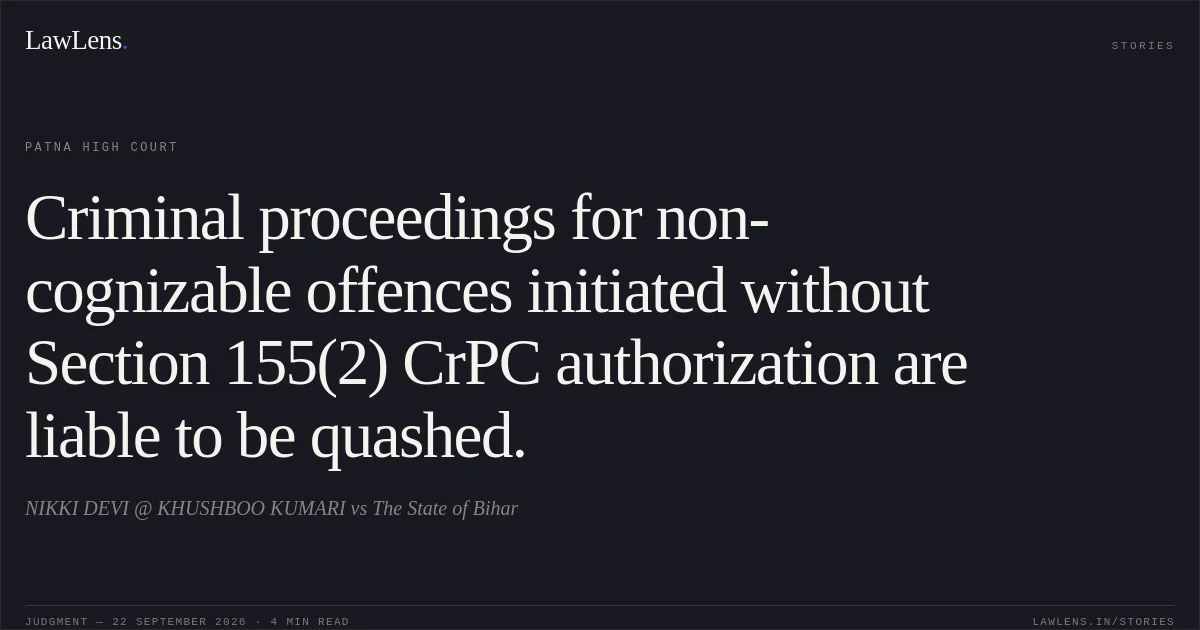
The Court found that the alleged offences were non-cognizable and that the State could not demonstrate that any order under Section 155(2) CrPC had been obtained before registration of the FIR or commencement of investigation. The investigation was therefore undertaken contrary to the mandatory statutory procedure.
Source reference: paras. 11–15; pp. 5–6Independently, the Court held that the prosecution was substantially founded only on the fact that the petitioner used the names Khushboo Kumari and Nikki Devi in two elections. The petitioner’s explanation that Khushboo Kumari was her nickname and that her name had subsequently been changed or corrected was consistent with the findings in the earlier election proceeding.
Source reference: paras. 16–17; pp. 6–7Mere difference in names did not establish that she was a different person, deliberately assumed a false identity, knowingly furnished false information, or intentionally concealed information from the election authorities.
Source reference: paras. 18–20; pp. 7–8Consequently, the essential ingredients of the alleged statutory offences were not disclosed even on accepting the FIR allegations at face value.
Source reference: paras. 18–20; pp. 7–8The delay between the 2016 inquiry and the 13 April 2018 FIR further supported the conclusion that continuation of the prosecution would be oppressive, although delay alone was not treated as determinative.
Source reference: para. 21; p. 8Holding
The Court answered the first issue in the negative, holding that the police could not investigate the alleged non-cognizable offences without a prior order under Section 155(2) CrPC.
It further held that the allegations did not disclose the essential ingredients of the offences under Section 171H IPC or Sections 125-A(1) and 125-A(3) of the Bihar Panchayat Raj Act.
Source reference: para. 24; p. 10Exercising its inherent jurisdiction under Section 482 CrPC, the Court quashed Bihra P.S. Case No. 66 of 2018 dated 13 April 2018 and the consequential proceedings in Criminal Case No. 1054 of 2018, insofar as they concerned the petitioner.
Source reference: paras. 25–27; pp. 10–11Acts & Sections Cited
2 provisions across 1 statute referred to in this judgment. Each provision opens on LawLens.
Code of Criminal Procedure, 19732
Original Court PDF
NIKKI DEVI @ KHUSHBOO KUMARIvsThe State of Bihar
Click to open original judgment
Original judgment, available to read, download and summarize on LawLens.in