Facts
The applicant, a village temple priest, was accused of taking the complainant’s daughter away at night in a car with two other persons.
Source reference: para. 1; p. 1The complainant alleged that they had taken her by force, and an FIR was registered under Sections 366, 506(2) and 114 of the Indian Penal Code, 1860.
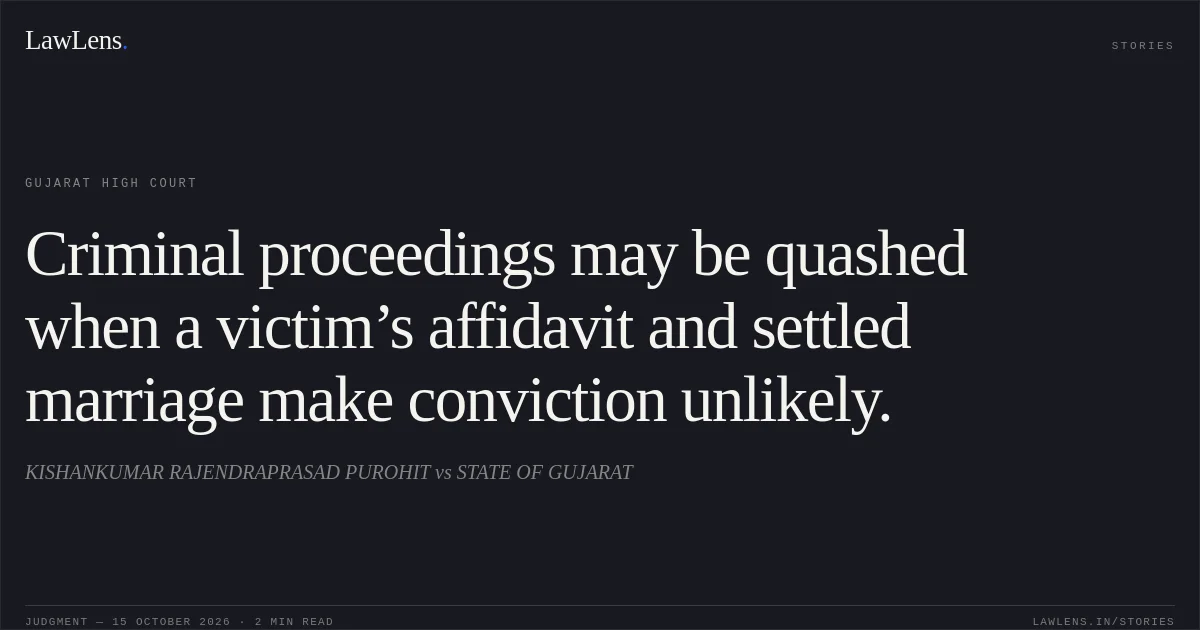
Source reference: para. 1; p. 1Seeking quashing under Section 482 of the Code of Criminal Procedure, 1973, the applicant contended that he and the daughter had been in a love relationship, that she left voluntarily after attaining majority, and that they had married and had children.
Source reference: paras. 3–3.1; pp. 2–3The daughter’s affidavit supported that account.
Source reference: paras. 3–3.1; pp. 2–3The State opposed quashing, arguing that the subsequent marriage did not establish that no offence had been committed.
Source reference: para. 5; p. 3The original complainant did not appear despite service.
Source reference: para. 4; p. 3Issues
1. Whether the FIR and consequential proceedings should be quashed under Section 482 CrPC where the victim’s affidavit stated that she had left voluntarily, married the applicant, and had children with him.
Source reference: paras. 3–3.1, 6–7; pp. 2–42. Whether, in the circumstances, the likelihood of conviction and the utility of continuing the prosecution justified quashing the proceedings.
Source reference: para. 6; p. 4Law Applied
Section 482 CrPC preserves the High Court’s inherent power to quash criminal proceedings.
Source reference: no citationThe FIR alleged offences under Sections 366, 506(2) and 114 IPC.
Source reference: para. 1; p. 1Relying on Madhavrao Jiwaji Rao Scindia & Another v. Sambhajirao Chandrojirao Angre & Others, AIR 1988 SC 709, para. 7, the Court applied the principle that proceedings may be quashed where the chances of conviction are bleak and continuing them would serve no useful purpose.
Source reference: para. 6; p. 4Reasoning
The Court considered the victim’s affidavit, which stated that she and the applicant had been in a love relationship and were happily married with children.
Source reference: para. 6; p. 4It accepted that she had left with the applicant against her father’s wishes, in the context of her father seeking to arrange her engagement against her wishes.
Source reference: para. 6; p. 4Applying the Madhavrao principle, the Court concluded that the victim’s account made the prospects of conviction bleak and that continuing the prosecution would serve no useful purpose.
Source reference: para. 6; p. 4The Court did not separately analyze the elements of each alleged IPC offence.
Source reference: para. 6; p. 4Holding
The Court allowed the application and quashed the FIR registered as C.R. No. I-11188007210260 of 2021 at Meghraj Police Station, Aravalli District, and the consequential proceedings, qua the applicant.
The rule was made absolute to that extent.
Source reference: paras. 7–8; p. 4Acts & Sections Cited
4 provisions across 2 statutes referred to in this judgment. Each provision opens on LawLens.
Code of Criminal Procedure, 19731
Indian Penal Code, 18603
Original Court PDF
KISHANKUMAR RAJENDRAPRASAD PUROHITvsSTATE OF GUJARAT
Click to open original judgment
Original judgment, available to read, download and summarize on LawLens.in