Facts
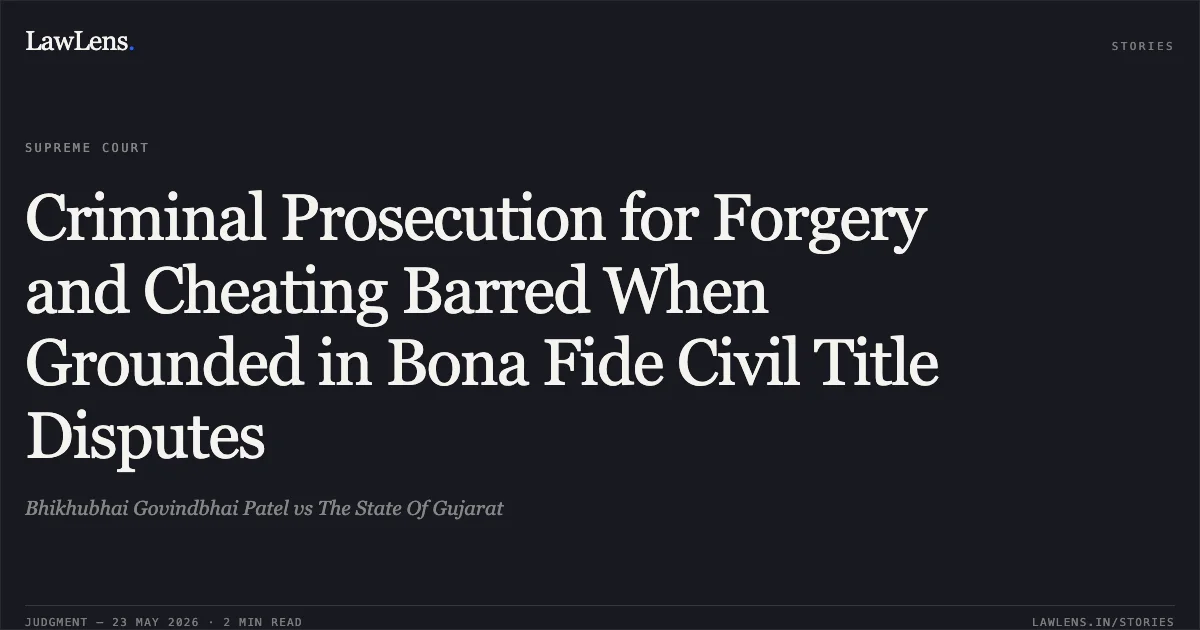
The dispute concerns ancestral land (Survey No. 157) in Village Panas, Surat, where the appellants claim a 2/3rd share based on 1988 ULC Act proceedings, while Respondent No. 2 claims exclusive ownership via a 1987 settlement decree.
Source reference: p. 2, 3, 12, 18Civil litigation regarding the property has been pending since 2000.
Source reference: p. 4, 18In 2009, Respondent No. 2 lodged an FIR alleging forgery of a 2001 Power of Attorney, cheating, and extortion involving a demand for ₹1.5 crores.
Source reference: p. 5, 19The High Court of Gujarat refused to quash the FIR, citing the "modus operandi" and criminal antecedents of Accused No. 6.
Source reference: p. 6, 17, 26Issues
1. Whether the High Court was justified in refusing to exercise jurisdiction under Section 482 CrPC to quash an FIR arising from a long-standing civil property dispute.
Source reference: para. 362. Whether the allegations of forgery (Section 463/464 IPC) and cheating (Section 420 IPC) are legally sustainable when the documents in question were executed by the parties themselves under a bona fide claim of title.
Source reference: para. 44-463. Whether criminal antecedents can serve as the primary basis for refusing to quash a criminal proceeding.
Source reference: para. 50Law Applied
Section 482 of the CrPC regarding the inherent powers of High Courts to prevent abuse of process.
Source reference: p. 2The categories for quashing FIRs established in State of Haryana v. Bhajan Lal, specifically targeting cases where disputes are predominantly civil.
Source reference: para. 54The principle from Mohd. Ibrahim v. State of Bihar holding that executing a document claiming property as one's own does not constitute a "false document" under Section 464 IPC even if the title is disputed.
Source reference: para. 45The ruling in Mohd. Wajid v. State of U.P. that criminal antecedents cannot replace the requirement of proving the ingredients of an offence and should not be the sole basis to deny quashing.
Source reference: para. 42, 50Reasoning
The court observed that the dispute was essentially civil, with litigation pending since 2000 without any prior allegations of criminality; it further noted an improvement in the complainant's case where extortion was introduced seven months after the initial 2009 complaint.
Source reference: para. 37-38, 39-40The Court found the nine-year delay in filing the FIR was not sufficiently explained by a government circular and indicated that since the signatures on the Power of Attorney were genuine and represented a claim of title, no "false document" was created under Section 464 IPC.
Source reference: para. 41, 44-45Charges of cheating and extortion were dismissed because no property was delivered due to deception and the allegations were vague, lacking essential legal ingredients.
Source reference: para. 46, 47-48The Court criticized the High Court for conducting a "mini-trial" on title and over-relying on the accused’s criminal history instead of evaluating the legal ingredients of the FIR.
Source reference: para. 50-51Holding
The Supreme Court held that the criminal proceedings were an abuse of process intended to coerce the appellants in a civil dispute and allowed the appeals, setting aside the High Court's judgment.
The Court quashed FIR No. I-CR No. 504/2009 and all consequential proceedings, including the charge-sheet, qua the appellants, clarifying that findings are limited to the Section 482 proceedings.
Source reference: para. 58, 59Acts & Sections Cited
18 provisions across 3 statutes referred to in this judgment. Each provision opens on LawLens.
Code of Criminal Procedure, 19734
Indian Penal Code, 1860
Limitation Act, 19631
Original Court PDF
Bhikhubhai Govindbhai PatelvsThe State Of Gujarat
Click to open original judgment
Original judgment, available to read, download and summarize on LawLens.in