Facts
Omega Hospital & Blood Bank, Jabalpur was constituted as a partnership firm in 2008 and reconstituted on 1 July 2018.
Source reference: paras. 2–4; pp. 1–2, 5–7Disputes subsequently arose among the partners concerning management, accounts, utilisation of funds and continuation of the hospital business.
Source reference: paras. 2–4; pp. 1–2, 5–7The complainant and certain partners alleged that the petitioners, without their consent, transferred the original firm’s assets, machinery, medical equipment, furniture, goodwill, stock, licences and business to a newly constituted firm named Omega Children Hospital & Critical Care, which continued operating from the same premises under a similar name.
Source reference: paras. 2–4; pp. 1–2, 5–7The petitioners relied on Clause 29 of the partnership deed, which contained an arbitration agreement, and contended that arbitration had been invoked through notices dated 28 November 2022 and 5 December 2022, prior to registration of the FIR on 9 January 2023.
Source reference: paras. 6–7, 17; pp. 3–4, 9Arbitration Case No. 4/2023 was pending between the parties.
Source reference: paras. 6–7, 17; pp. 3–4, 9The FIR, initially registered under Sections 406 and 120-B of the Indian Penal Code, was followed by a charge-sheet under Sections 406, 409, 420, 467, 468, 471 and 120-B IPC.
Source reference: para. 5; p. 2The petitioners sought quashing of the FIR and consequential proceedings under Section 482 of the Code of Criminal Procedure, arguing that the dispute was essentially civil and commercial, that there was no entrustment or dishonest misappropriation, and that the criminal proceedings had been initiated to exert pressure in the partnership dispute.
Source reference: paras. 6–7; pp. 3–4Issues
Whether the FIR, charge-sheet and consequential criminal proceedings disclosed the essential ingredients of offences under Sections 406, 409, 420, 467, 468, 471 and 120-B IPC, or whether the allegations essentially concerned a civil and commercial partnership dispute?
Source reference: paras. 15–21, 26–28; pp. 8–14Whether the existence and prior invocation of an arbitration clause, and the pendency of arbitration proceedings, justified quashing the criminal proceedings under Section 482 CrPC?
Source reference: paras. 15–18, 23, 28; pp. 8–10, 13–14Whether continuation of the prosecution would amount to an abuse of the process of law where the alleged criminal acts arose from disputes regarding partnership assets, accounts, goodwill, management and business operations?
Source reference: paras. 16, 22–28; pp. 8–14Law Applied
The Court applied Section 482 CrPC, which empowers the High Court to prevent abuse of the process of any court and secure the ends of justice.
Source reference: paras. 16, 22, 27; pp. 8, 11–14It held that criminal proceedings may be quashed where, even if the allegations are accepted in their entirety, the essential ingredients of the alleged offences are absent and the dispute is predominantly civil or commercial.
Source reference: paras. 16, 22, 27; pp. 8, 11–14Section 406 IPC requires entrustment of property followed by dishonest misappropriation or conversion; partnership disputes involving property of the firm do not, by themselves, establish entrustment or criminal breach of trust.
Source reference: para. 19; p. 10The Court relied on State of Haryana v. Bhajan Lal, 1992 Supp (1) SCC 335, particularly the categories permitting quashing where the allegations do not prima facie constitute an offence or where proceedings are instituted for an ulterior purpose.
Source reference: para. 27; p. 13It also relied on G. Sagar Suri v. State of U.P., (2000) 2 SCC 636, and V.Y. Jose v. State of Gujarat, (2009) 3 SCC 78, for the principles that criminal law cannot be used as a shortcut for enforcing civil rights and that a contractual dispute cannot be converted into cheating or another criminal offence absent the requisite criminal ingredients.
Source reference: paras. 24–25; pp. 12–13Although civil and criminal proceedings may proceed simultaneously where distinct criminal offences are disclosed, the mere existence of an arbitration agreement does not bar prosecution; however, criminal proceedings cannot continue where the allegations are merely a civil dispute dressed in criminal language.
Source reference: paras. 23, 26; pp. 13–14Reasoning
The Court found that the substance of the allegations concerned ownership and use of partnership assets, transfer of goodwill and stock, validity of the alleged partners’ resolution, exclusion of certain partners, settlement of accounts and continuation of the hospital business through another partnership.
Source reference: paras. 18, 20–21; pp. 9–11These matters required determination of the partners’ contractual rights and obligations and were within the scope of the arbitration clause.
Source reference: paras. 18, 20–21; pp. 9–11The FIR did not identify any property specifically entrusted to the petitioners in their individual capacity; the disputed assets belonged to the partnership, in which the partners had a joint interest and managerial dominion by virtue of their status as partners.
Source reference: para. 19; p. 10The allegations of forgery, cheating and conspiracy were also founded on the same internal partnership dispute and did not disclose independent criminal ingredients beyond the alleged breach of the partnership arrangement.
Source reference: para. 21; p. 11The prior invocation of arbitration reinforced the Court’s conclusion that the criminal prosecution was being used in relation to a pre-existing commercial dispute, although the Court clarified that arbitration proceedings alone would not automatically justify quashing.
Source reference: paras. 17, 23, 26; pp. 9, 13–14Since the charge-sheet did not cure the foundational deficiencies in the FIR and collected material, continuation of the prosecution was held to constitute an abuse of process.
Source reference: paras. 22, 27–28; pp. 11, 13–14Holding
The petition was allowed.
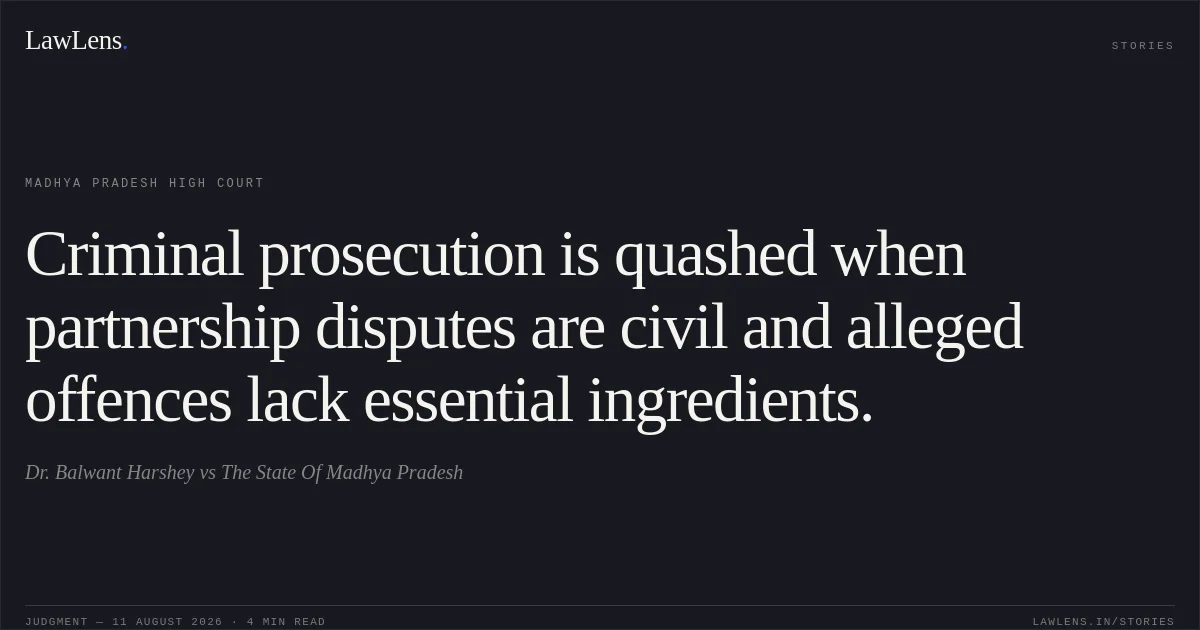
The Court held that the dispute was predominantly civil and commercial, arising from the partnership deed and partnership affairs, and that the essential ingredients of the alleged offences were not disclosed.
Source reference: para. 28; p. 14The Court quashed FIR Crime No. 33/2023 dated 9 January 2023 registered at Police Station Lordganj, Jabalpur, the charge-sheet for offences under Sections 406, 409, 420, 467, 468, 471 and 120-B IPC, and all consequential criminal proceedings.
Source reference: para. 29; p. 14It expressly clarified that its observations were confined to the Section 482 proceedings and would not prejudice the parties’ rights or contentions in the pending arbitration or other civil proceedings.
Source reference: para. 30; p. 14Pending interlocutory applications, if any, were disposed of.
Source reference: para. 31; p. 15Acts & Sections Cited
7 provisions across 2 statutes referred to in this judgment. Each provision opens on LawLens.
Code of Criminal Procedure, 19731
Indian Penal Code, 18606
Original Court PDF
Dr. Balwant HarsheyvsThe State Of Madhya Pradesh
Click to open original judgment
Original judgment, available to read, download and summarize on LawLens.in