Facts
The applicant, Sriram, was appointed as an Assistant Teacher in 2005.
Source reference: p.3, para 3In 2016, his services were terminated following allegations that he obtained his appointment using a fraudulent Permanent Resident Certificate.
Source reference: p.3, para 3Consequently, an F.I.R. was lodged against Sriram, his father-in-law (Natthulal), and a Revenue Inspector (Abdul Wajid) for facilitating the alleged forgery.
Source reference: p.3, para 4Sriram challenged the cancellation of his certificate and termination through a Writ Petition and a Special Appeal, both of which were dismissed.
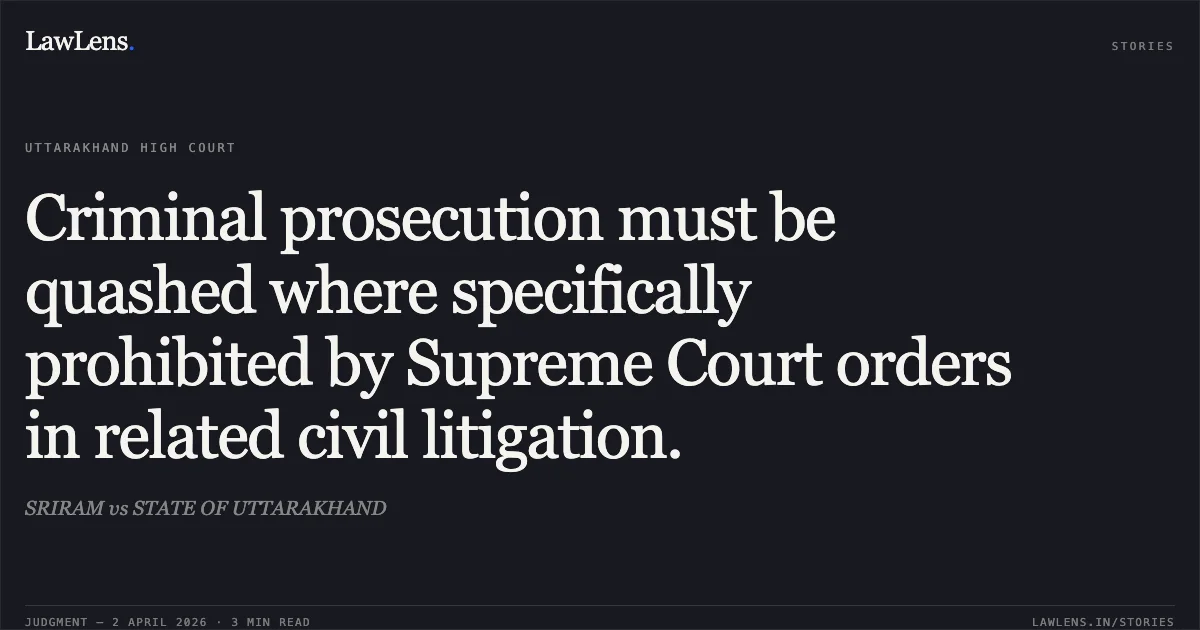
Source reference: p.4, para 4Upon approaching the Hon’ble Supreme Court via Special Leave Petition (Civil) Nos. 23150-23151 of 2018, the Court dismissed the petitions but specifically clarified that Sriram "shall not be subjected to any criminal proceedings" resulting from the impugned orders.
Source reference: p.4, para 4Despite this clarification, the trial court issued summoning and cognizance orders against the applicants in 2018 and 2021.
Source reference: p.2, para 1The applicants subsequently filed the present applications under Section 482 Cr.P.C. to quash these proceedings.
Source reference: p.2, para 1Issues
1. Whether the continuation of criminal proceedings against the applicants is legally sustainable in view of the specific restraining clarification issued by the Hon’ble Supreme Court.
Source reference: p.5, para 5; p.6, para 92. Whether the High Court should exercise its inherent power under Section 482 of the Cr.P.C. to quash the proceedings to prevent an abuse of the process of the court.
Source reference: p.6, para 9-10Law Applied
Section 482 of the Code of Criminal Procedure, which grants the High Court inherent powers to quash proceedings to prevent abuse of the process of law or to secure the ends of justice.
Source reference: p.6, para 9Article 141 of the Constitution of India, which mandates that the law declared by the Supreme Court is binding on all courts within the territory of India.
Source reference: p.6, para 9The principles established in State of Haryana v. Bhajan Lal regarding the quashing of proceedings that amount to an abuse of process.
Source reference: p.6, para 10Pepsi Foods Ltd. v. Special Judicial Magistrate regarding the requirement for Magistrates to apply judicial mind before summoning an accused.
Source reference: p.7, para 10Amit Kapoor v. Ramesh Chander regarding the prevention of miscarriage of justice.
Source reference: p.7, para 10Reasoning
The Court observed that the Supreme Court, while dismissing the applicant's SLP, had explicitly clarified that the applicant should not face criminal proceedings arising from the cause of action related to his certificate and termination.
Source reference: p.6, para 9The Court reasoned that under Article 141 of the Constitution, this clarification is a binding direction that must be strictly complied with by all subordinate courts and authorities.
Source reference: p.6, para 9By issuing summoning orders and taking cognizance despite the Apex Court’s order, the trial court acted mechanically and failed to apply its judicial mind to the legal bar on such proceedings.
Source reference: p.7, para 10The High Court determined that allowing the criminal cases to continue would not only constitute a miscarriage of justice but would also be a direct violation of the Supreme Court's mandate.
Source reference: p.7, para 10Holding
The High Court allowed the applications and quashed the chargesheets, the cognizance/summoning orders dated 17.02.2018, 19.06.2018, and 06.12.2021, and the entire criminal proceedings in Criminal Case Nos. 1416 of 2018 and 6191 of 2021.
The Court held that the specific clarification by the Supreme Court effectively barred any criminal prosecution of the applicants for the alleged acts, and thus the continuation of such proceedings was an abuse of process.
Source reference: p.7, para 10Acts & Sections Cited
1 provisions across 1 statute referred to in this judgment. Each provision opens on LawLens.
Code of Criminal Procedure, 19731
Original Court PDF
SRIRAMvsSTATE OF UTTARAKHAND
Click to open original judgment
Original judgment, available to read, download and summarize on LawLens.in