Facts
The informant’s marriage with Vineet Kumar was solemnised on 18 April 2016. She alleged that dowry comprising cash, jewellery and other articles was given at the time of marriage, and that, after approximately three months, the accused persons subjected her to cruelty, assaulted her and demanded an additional ₹5 lakhs. She further alleged that she was ousted from her matrimonial home on 7 June 2016 and that her belongings were retained.
Source reference: para. 3Following investigation into Lakhisarai Mahila P.S. Case No. 19 of 2017, a charge-sheet was submitted against the petitioners and other accused persons for offences under Sections 498-A, 406 and 34 of the IPC and Sections 3/4 of the Dowry Prohibition Act. The Sub-Divisional Judicial Magistrate, Lakhisarai, took cognizance on 3 October 2018 in Trial No. 1573 of 2018.
Source reference: para. 2–3Petitioner no. 1 was the married sister of the informant’s husband, and petitioner no. 2 was her husband. The petitioners contended that they were government school librarians residing separately in District Khagaria and that the allegations against them were general and lacked any specific overt act.
Source reference: para. 4They also relied on prior matrimonial proceedings and the informant’s proceedings under the Domestic Violence Act, in which the petitioners had not been impleaded.
Source reference: para. 5Issues
Whether the order taking cognizance and the consequential criminal proceedings against the petitioners should be quashed where the allegations of cruelty, assault and dowry demand are general and omnibus, without attribution of any specific role or incident to either petitioner.
Source reference: paras. 6, 9–10Whether continuation of the prosecution against the petitioners, who were married relatives allegedly residing separately from the matrimonial home, would amount to an abuse of the process of law warranting exercise of the High Court’s inherent jurisdiction.
Source reference: paras. 7, 10Law Applied
The Court considered the offences alleged under Sections 498-A, 406 and 34 of the Indian Penal Code and Sections 3/4 of the Dowry Prohibition Act.
Source reference: para. 2It applied the inherent jurisdiction of the High Court to prevent abuse of the process of court where, even accepting the allegations at face value, the ingredients of the alleged offences are not disclosed or continuation of proceedings would not serve the ends of justice.
Source reference: para. 10Relying on State of Haryana v. Bhajan Lal, 1992 Supp (1) SCC 335, particularly guidelines 1 and 5, the Court held that proceedings may be quashed where the allegations do not disclose an offence or are so vague, general and inherently insufficient that continuation would constitute abuse of process.
Source reference: para. 10The Court also relied on Abhishek v. State of Madhya Pradesh, 2023 SCC OnLine SC 1083, which cautions that allegations against the husband’s relatives in Section 498-A cases must be examined carefully and that general or omnibus allegations, without attribution of a specific role, should not ordinarily result in their being subjected to criminal trial.
Source reference: para. 8Reasoning
The Court found that the allegations against both petitioners merely stated that “all the accused persons” had subjected the informant to cruelty, assaulted her and demanded dowry, without identifying any particular act, date, incident or manner of participation attributable to either petitioner.
Source reference: paras. 6, 9Their status as the husband’s married sister and her husband, their employment in government schools in District Khagaria, and the absence of material showing their continuous presence in the matrimonial home further weakened the prosecution case against them.
Source reference: para. 7The Court also noted that the petitioners had not been impleaded in the subsequent Domestic Violence Act proceedings, which supported the conclusion that the criminal allegations against them were general and omnibus.
Source reference: para. 9Applying the principles in Abhishek and Bhajan Lal, the Court held that continuation of the proceedings, in the absence of specific allegations constituting the offences, would amount to an abuse of the process of law.
Source reference: paras. 8–10Holding
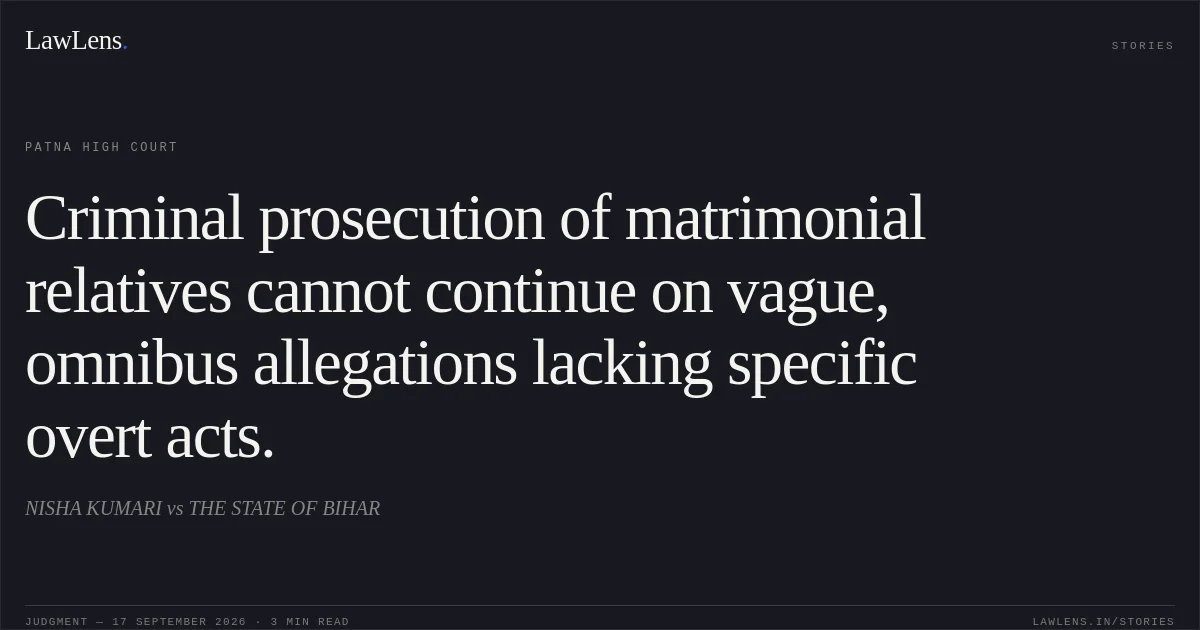
The Court answered the issues in favour of the petitioners. It held that the general and omnibus allegations did not disclose specific criminal conduct by either petitioner and that their prosecution would amount to an abuse of the process of law.
Accordingly, the order dated 3 October 2018 taking cognizance in Trial No. 1573 of 2018, along with all consequential proceedings against both petitioners, was quashed and set aside.
Source reference: paras. 11–13The criminal miscellaneous petition was allowed, and the judgment was directed to be communicated to the trial court with the trial court record, if any.
Source reference: paras. 11–13Acts & Sections Cited
6 provisions across 3 statutes referred to in this judgment. Each provision opens on LawLens.
Indian Penal Code, 18602
Hindu Marriage Act, 19552
Original Court PDF
NISHA KUMARIvsTHE STATE OF BIHAR
Click to open original judgment
Original judgment, available to read, download and summarize on LawLens.in