Facts
The petitioner-complainant initiated proceedings under Section 145 Cr.P.C., alleging that respondent Vandana Sharma had forcibly entered her house after breaking the locks and dispossessed her from a ground-floor room.
Source reference: paras. 2–3The complainant claimed ownership and possession of the property and sought restoration of possession and protection against further interference.
Source reference: paras. 2–3The Sub-Divisional Magistrate directed the parties to produce evidence, whereafter both sides filed documents and affidavits of witnesses.
Source reference: paras. 5–6Relying on the material produced, the Magistrate held that the respondent had dispossessed the complainant by breaking the locks and, by order dated 01.02.2023, directed restoration of possession to the complainant and restrained the respondent from disturbing it.
Source reference: paras. 5–6The respondent challenged the order in revision under Section 397(1) Cr.P.C., contending that the Magistrate had failed to follow Section 274 Cr.P.C. and had not permitted examination and cross-examination of witnesses.
Source reference: paras. 7–8The Sessions Judge allowed the revision, set aside the Magistrate’s order, and remanded the matter for fresh adjudication in accordance with Section 274 Cr.P.C.
Source reference: paras. 7–8The complainant consequently invoked the High Court’s jurisdiction under Section 482 Cr.P.C. seeking restoration of the Magistrate’s order.
Source reference: para. 9Issues
Whether, in an inquiry under Section 145 Cr.P.C., a Magistrate may rely upon affidavits without affording the opposite party an opportunity to cross-examine the deponent?
Source reference: para. 15Whether failure to record the substance of evidence in the manner prescribed by Section 274 Cr.P.C. vitiated the Magistrate’s order and justified remand by the Revisional Court?
Source reference: paras. 19–21, 28–29Whether the irregularity in the procedure adopted by the Magistrate could be disregarded under Section 465 Cr.P.C. in the absence of demonstrated prejudice?
Source reference: para. 28Law Applied
Section 145(4) Cr.P.C. requires the Magistrate, in determining actual possession, to hear the parties and receive the evidence produced by them; under Section 145(6), the Magistrate may declare the party entitled to possession and restore possession where forcible and wrongful dispossession is established.
Source reference: paras. 16–17Section 274 Cr.P.C. mandates that, in inquiries under Sections 145 to 148, the Magistrate must record a memorandum of the substance of each witness’s evidence in the language of the Court, signed by the Magistrate and forming part of the record.
Source reference: paras. 19–20The Court relied on Ayaaubkhan Noorkhan Pathan v. State of Maharashtra, (2013) 4 SCC 465, and related authorities for the principle that an affidavit is not, by itself, evidence under Section 3 of the Evidence Act and may be relied upon only where the deponent is available for cross-examination and the opposite party is given that opportunity.
Source reference: para. 22The Court further applied the principle that cross-examination is an aspect of natural justice, as recognised in State of M.P. v. Chintaman Sadashiva Vaishampayan, Lakshman Exports Ltd. v. Collector of Central Excise, and New India Assurance Co. Ltd. v. Nusli Neville Wadia.
Source reference: paras. 23–25Although K.L. Tripathi v. State Bank of India recognises that a complaint of denial of cross-examination ordinarily requires proof of prejudice, Section 465 Cr.P.C. does not protect an irregularity that has occasioned a failure of justice.
Source reference: paras. 26, 28Reasoning
The Magistrate relied on the affidavits and documents filed by the parties to determine the disputed question of possession, but did not record the substance of the witnesses’ evidence under Section 274 Cr.P.C. and did not afford either party an opportunity to cross-examine the deponents.
Source reference: paras. 18, 21Since the central issue in a Section 145 inquiry is actual possession and the alleged forcible dispossession, the Magistrate could not properly determine that issue on the basis of untested affidavits.
Source reference: no citationThe filing of affidavits alone did not convert them into substantive evidence; the deponents had to be available for examination and cross-examination before their statements could be relied upon.
Source reference: para. 22The Court therefore held that the procedure adopted violated Section 145(4) read with Section 274 Cr.P.C. and the principles of natural justice.
Source reference: no citationThe complainant’s contention that the respondent had waived objection by participating in the proceedings, and that Section 465 Cr.P.C. barred interference absent prejudice, was rejected because denial of the prescribed opportunity had affected the fairness and validity of the inquiry.
Source reference: paras. 27–29Holding
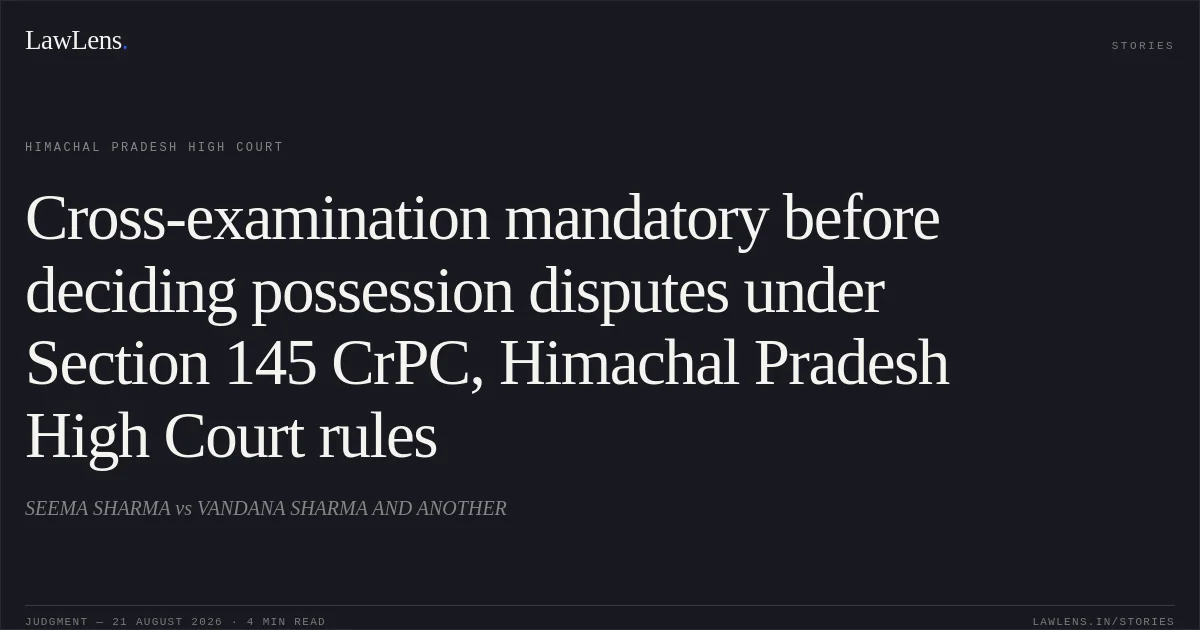
The High Court answered the legal issue against the petitioner and held that the Magistrate could not rely upon affidavits in a Section 145 inquiry without following Section 274 Cr.P.C. and affording the affected party an opportunity of cross-examination.
The Sessions Judge’s order dated 12.06.2023, setting aside the Magistrate’s order dated 01.02.2023 and remanding the matter for fresh decision, was upheld.
Source reference: paras. 29–30The petition under Section 482 Cr.P.C. was dismissed.
Source reference: no citationThe parties were directed to appear before the Sub-Divisional Magistrate on 09.09.2026, and the Magistrate was requested to conclude the proceedings expeditiously, preferably within one month.
Source reference: paras. 31–32Acts & Sections Cited
10 provisions across 1 statute referred to in this judgment. Each provision opens on LawLens.
Code of Criminal Procedure, 1973
Original Court PDF
SEEMA SHARMAvsVANDANA SHARMA AND ANOTHER
Click to open original judgment
Original judgment, available to read, download and summarize on LawLens.in