Facts
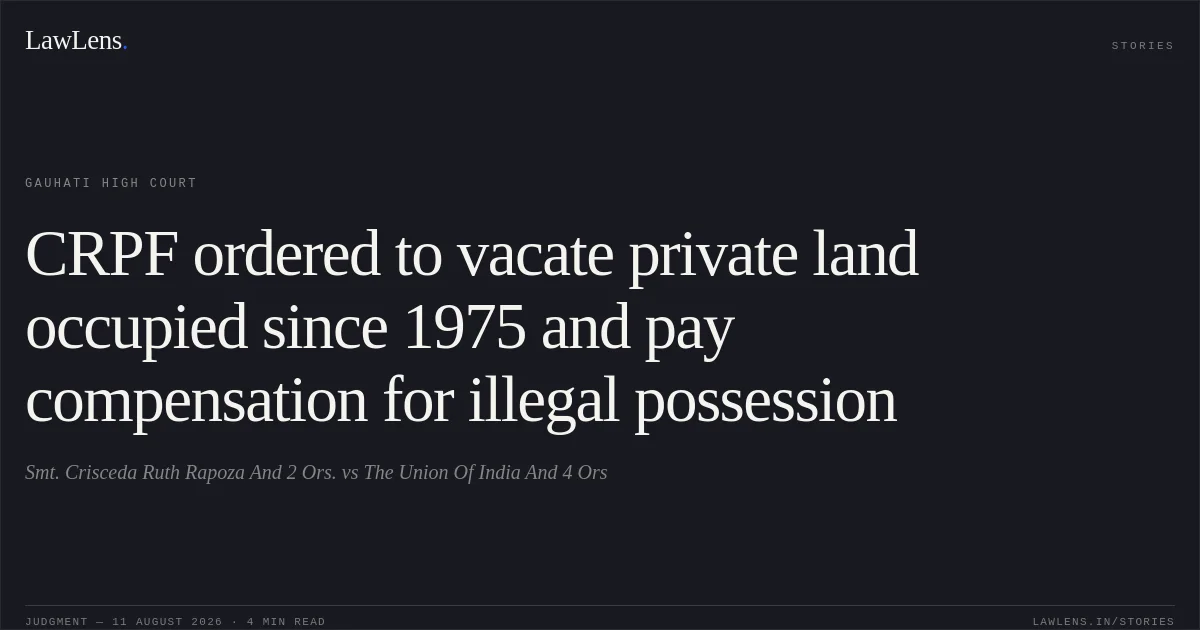
The petitioners, daughters of Late Vida Brumbach Nichols Roy, claimed ownership by inheritance over approximately 50 bighas of land under Patta No. 31, including land comprised in the original Dag No. 5 and subsequently created Dag No. 49 at Sarutari village, Sonapur, Kamrup (Metro), Assam.
Source reference: pp. 3–4; paras. 3–4The CRPF had occupied approximately 5 bighas 0 kathas 4 lechas of the petitioners’ land since 1975 and constructed a water pump house for the Group Centre, CRPF.
Source reference: p. 4; para. 4After the petitioners’ legal notice dated 27 December 2004 and subsequent representation to the Deputy Commissioner, revenue authorities conducted spot verifications and found the CRPF in occupation of land covered by Dag No. 5/49 of Patta No. 31.
Source reference: pp. 4–6; paras. 4–6The CRPF relied on a 1975 possession/land-handover certificate referring generally to acquisition of 14 bighas 1 katha 5 lechas, but no acquisition notification, award, compensation record, or other acquisition documents could be produced.
Source reference: pp. 6–8; paras. 7–10During the proceedings, revenue demarcation established that 1 bigha 2 kathas 15 lechas in original Dag No. 5 and 3 bighas 2 kathas 9 lechas in Dag No. 49—totalling 5 bighas 0 katha 4 lechas—were under CRPF occupation and belonged to the petitioners.
Source reference: pp. 9–12; paras. 16–19Although the Court gave the CRPF several opportunities either to acquire the land or relinquish it, the Union and CRPF ultimately stated that they were not willing to acquire the land.
Source reference: pp. 12–13; paras. 20–22Issues
Whether the CRPF’s continued occupation of the petitioners’ land, without proof of lawful acquisition or payment of compensation, violated the petitioners’ constitutional right to property under Article 300A of the Constitution.
Source reference: pp. 16–19; paras. 28–34Whether the CRPF could rely on a possession certificate, long possession, or adverse possession to justify its occupation of the petitioners’ land.
Source reference: pp. 17–19; paras. 30–34Whether the petitioners were entitled to restoration of possession and compensation for the period of the respondents’ unauthorised occupation.
Source reference: pp. 19–26; paras. 35–38Law Applied
Article 300A of the Constitution prohibits deprivation of property except by authority of law; the right to property, though no longer a fundamental right, remains a constitutional and human right, and the State must follow a lawful acquisition or requisition procedure and provide compensation, as held in Vidya Devi v. State of Himachal Pradesh, (2020) 2 SCC 569.
Source reference: pp. 19–22; para. 35The Court also relied on Tukaram Kana Joshi v. Maharashtra Industrial Development Corporation, (2013) 1 SCC 353, which holds that the State cannot dispossess citizens without following due process and must pay adequate compensation.
Source reference: pp. 22–24; para. 36Acquisition in Assam could have been undertaken under the Land Acquisition Act, 1894, the Assam Land (Requisition and Acquisition) Act, 1964, or, where applicable, the Defence of India Act, 1962; such proceedings require legally prescribed notifications, awards and compensation records.
Source reference: pp. 16–17; para. 28The Court further applied Section 11(4) of the Assam Land (Requisition and Acquisition) Act, 1964 for assessment of rental compensation for unauthorised occupation.
Source reference: pp. 25–27; para. 38(v)Reasoning
The revenue records and demarcation reports showed that the petitioners’ names continued to appear in the record of rights and that the disputed portions of Dag Nos. 5 and 49 were under CRPF occupation.
Source reference: pp. 16–17; paras. 28–29The CRPF failed, even after more than twelve years of litigation and repeated opportunities, to produce any acquisition notification, award, proof of compensation, or document identifying the disputed land as lawfully acquired.
Source reference: pp. 16–18; paras. 28–31The 1975 possession certificate was held insufficient because it was vague, did not identify the relevant patta or dag numbers, and merely recorded that possession had been handed over.
Source reference: p. 17; para. 30The Court rejected the respondents’ interpretation of the revenue remark “Chat,” holding that it indicated the retention of a portion of the original Dag No. 5 after subdivision and did not establish that the land was Government property.
Source reference: pp. 18–19; para. 33Applying Vidya Devi and Tukaram Kana Joshi, the Court held that prolonged possession could not cure the original absence of lawful authority, and that the State could not invoke adverse possession or delay to appropriate a citizen’s property.
Source reference: pp. 19–24; paras. 35–37Since the respondents declined to acquire the land, their continued occupation was unlawful and the appropriate relief was restoration of possession together with compensation for the period of illegal occupation.
Source reference: pp. 24–26; paras. 37–38Holding
The Court held that the Union and CRPF had no right to remain in possession of 1 bigha 2 kathas 15 lechas in Dag No. 5 and 3 bighas 2 kathas 9 lechas in Dag No. 49 of Patta No. 31, totalling 5 bighas 0 katha 4 lechas.
The CRPF was directed to vacate and hand over vacant possession to the petitioners or their authorised representative within 60 days, with the DIG, Group Centre, CRPF responsible for compliance.
Source reference: p. 25; paras. 38(i)–(ii)The CRPF was permitted to remove its movable and immovable assets, failing which the revenue authorities could remove them at the CRPF’s cost.
Source reference: pp. 25–26; para. 38(iii)The Deputy Commissioner, Kamrup (Metro), was directed to assess compensation under Section 11(4) of the Assam Land (Requisition and Acquisition) Act, 1964, from 11 April 2015, the date treated as the filing date of the writ petition, until delivery of possession.
Source reference: p. 26; para. 38(v)The assessed amount was to be paid by the CRPF to the petitioners within six months of communication of the assessment, subject to the parties’ liberty to challenge the assessment in accordance with law.
Source reference: pp. 26–27; para. 38(vi)No costs were awarded.
Source reference: p. 27; para. 38(vii)Acts & Sections Cited
1 provisions across 1 statute referred to in this judgment. Each provision opens on LawLens.
ASSAM LAND (REQUISITION AND ACQUISITION) ACT, 19641
Original Court PDF
Smt. Crisceda Ruth Rapoza And 2 Ors.vsThe Union Of India And 4 Ors
Click to open original judgment
Original judgment, available to read, download and summarize on LawLens.in