Facts
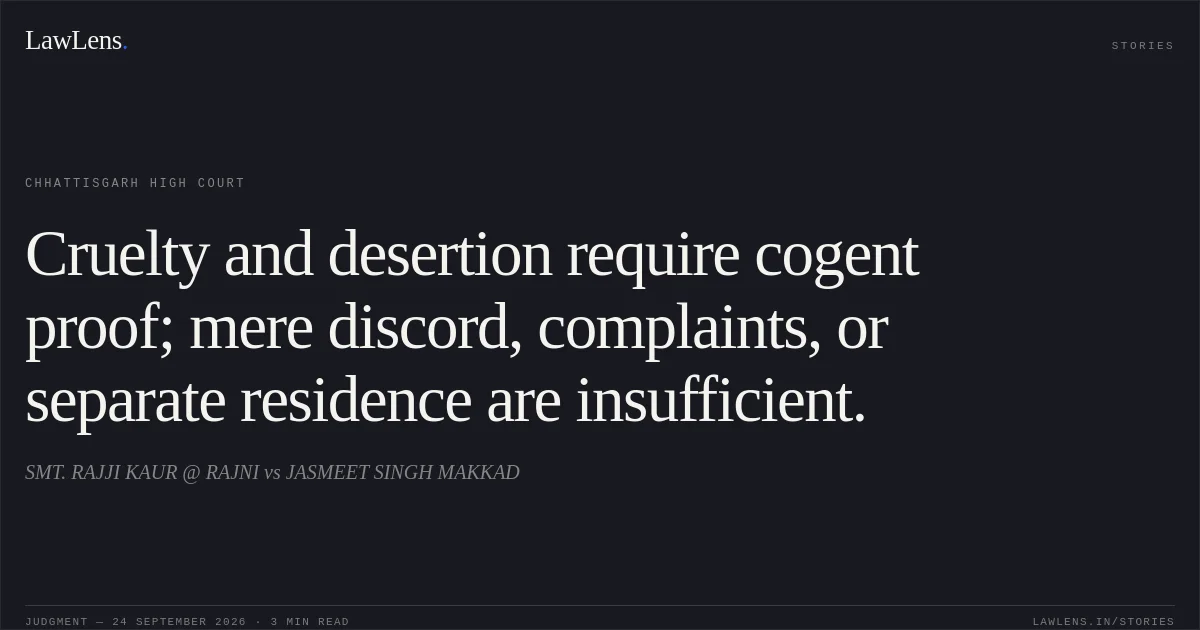
The parties married on 10 December 2011 according to Sikh/Hindu rites, and a son was born on 6 August 2013.
Source reference: paras. 2, 4, 9The husband alleged that the wife frequently quarrelled with him and his family, visited her parental home without justification, insisted that he live separately from his parents, disregarded family customs, threatened false criminal cases, and ultimately deserted him on 3 July 2018.
Source reference: paras. 2–3The wife denied these allegations and asserted that she had been subjected to dowry demands, physical assault, confinement, and mental cruelty, including an assault on 2 July 2018 that caused injury to her tooth.
Source reference: paras. 4–5The husband instituted proceedings for dissolution of marriage on the grounds of cruelty and desertion under Section 13(1)(ia) and (ib) of the Hindu Marriage Act, 1955.
Source reference: paras. 1, 6The Family Court, Mahasamund, decreed the suit and dissolved the marriage by judgment and decree dated 7 November 2023.
Source reference: paras. 1, 6Issues
Whether the wife’s alleged conduct—frequent quarrels, alleged disrespect towards the husband’s family, visits to her parental home, non-observance of family rituals, and institution of criminal and maintenance proceedings—constituted cruelty under Section 13(1)(ia) of the Hindu Marriage Act, 1955?
Source reference: paras. 10–12Whether the wife had deserted the husband within the meaning of Section 13(1)(ib) of the Hindu Marriage Act, 1955, by living separately from him since 3 July 2018?
Source reference: para. 13Whether the Family Court’s decree dissolving the marriage was sustainable on the evidence and circumstances of the case?
Source reference: para. 14Law Applied
The Court applied Sections 13(1)(ia) and 13(1)(ib) of the Hindu Marriage Act, 1955.
Source reference: no citationCruelty must be conduct of such gravity and intensity that the aggrieved spouse cannot reasonably be expected to continue matrimonial life; it must be assessed cumulatively in the context of the entire matrimonial relationship and not on the basis of isolated incidents.
Source reference: para. 10Mere quarrels, differences of opinion, incompatibility, visits to the parental home, or institution of criminal or maintenance proceedings do not, by themselves, establish cruelty; proceedings may amount to cruelty where they are demonstrably false, reckless, malicious, or deliberately fabricated.
Source reference: para. 11; Rani Narasimha Sastry v. Rani Suneela RaniDesertion requires both factum of separation and animus deserendi, namely, an intention to permanently terminate cohabitation, together with absence of consent and absence of reasonable cause for living separately.
Source reference: para. 13The principle in Narendra v. K. Meena—that a persistent effort to compel the husband to separate from his family may constitute cruelty—applies only where such conduct is satisfactorily proved.
Source reference: para. 12Reasoning
The Court held that the husband’s allegations, even if partially established, lacked cogent evidence showing the degree of gravity necessary to constitute matrimonial cruelty.
Source reference: paras. 10–12The wife’s repeated returns to the matrimonial home following the 2012 Gurudwara settlement and a later settlement in domestic-violence proceedings demonstrated that she had not treated the marriage as permanently terminated.
Source reference: para. 12Her allegations of assault, confinement, dowry harassment, and medical treatment provided a possible and reasonable cause for her separate residence; therefore, her living at her parental home could not automatically be treated as desertion.
Source reference: paras. 11, 13The husband also failed to prove that she persistently compelled him to live separately from his parents or that her criminal complaints were false, malicious, or fabricated.
Source reference: para. 12In the absence of proof of animus deserendi and in view of her consistent assertion that she was willing to resume cohabitation, neither cruelty nor desertion was established.
Source reference: paras. 12–14Holding
The appeal was allowed.
The High Court set aside the Family Court’s findings that the wife had treated the husband with cruelty or deserted him under Sections 13(1)(ia) and 13(1)(ib) of the Hindu Marriage Act, 1955, and consequently set aside the decree dissolving the marriage.
Source reference: para. 14The decree was directed to be drawn accordingly.
Source reference: para. 14No order as to costs.
Source reference: para. 15Acts & Sections Cited
1 provisions across 1 statute referred to in this judgment. Each provision opens on LawLens.
Hindu Marriage Act, 19551
Original Court PDF
SMT. RAJJI KAUR @ RAJNIvsJASMEET SINGH MAKKAD
Click to open original judgment
Original judgment, available to read, download and summarize on LawLens.in