Facts
Yaduveer Singh, proprietor of M/s Simen Tech, held service-tax registration but allegedly neither paid service tax nor filed returns.
Source reference: no citationBased on the appellant’s income-tax returns and other records, the Department alleged taxable receipts of ₹26,59,22,065 for 2014–15 to 2017–18 and issued a show-cause notice proposing service-tax demand of ₹3,62,51,923, along with interest and penalties under the Finance Act, 1994.
Source reference: p.4The Commissioner ultimately confirmed service-tax demand of ₹1,26,07,164, with interest and penalties.
Source reference: p.5The appellant did not appear at the hearings before the Tribunal despite repeated opportunities.
Source reference: no citationIssues
Whether the Tribunal could decide the appeal on merits despite the appellant’s repeated non-appearance.
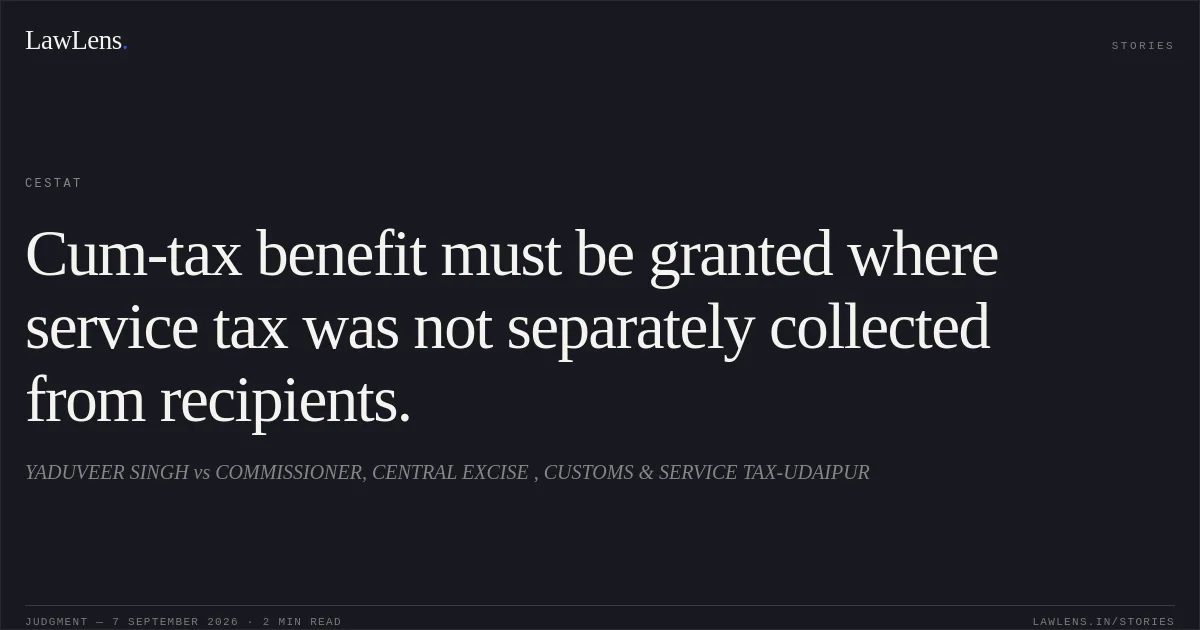
Source reference: pp.2–4Whether the appellant was entitled to cum-tax benefit where service tax had not been separately collected from service recipients.
Source reference: pp.5–6Whether the service-tax demand for 2017–18, based on contractual amounts in the absence of income-tax returns or balance sheets, was sustainable.
Source reference: p.6Law Applied
The Tribunal applied Sections 73(1), 75, 77 and 78 of the Finance Act, 1994, concerning recovery of service tax, interest and penalties.
Source reference: pp.4–5It relied on the principle that where the gross consideration received does not show separate collection of service tax, the amount must ordinarily be treated as cum-tax consideration, and the tax must be backed out from the gross receipts.
Source reference: p.6The Tribunal also followed the Supreme Court’s decision in Balaji Steel Re-rolling Mills v. Commissioner of Central Excise and Customs, 2014 (310) E.L.T. 209 (S.C.), which held that the Tribunal has a statutory duty to dispose of an appeal on merits and cannot dismiss it for default or want of prosecution.
Source reference: pp.2–4In the absence of reliable financial records, a tax liability may be determined on the basis of the best material available to the Department.
Source reference: p.6Reasoning
Applying Balaji Steel Re-rolling Mills, the Tribunal proceeded to examine the appeal notwithstanding the appellant’s absence.
Source reference: pp.2–4It accepted the appellant’s claim for cum-tax treatment for the relevant years because there was no evidence that service tax had been separately recovered from customers; consequently, the gross receipts had to be treated as inclusive of service tax.
Source reference: p.6For 2017–18, the Department lacked income-tax returns and balance sheets and therefore relied on the contractual amounts.
Source reference: p.6Although the appellant challenged that basis, it produced no alternative figures showing the services actually rendered or consideration received during the period.
Source reference: p.6The Tribunal accordingly upheld the use of the available contractual figures as the basis for best-judgment assessment, while holding that cum-tax benefit was nevertheless required for that year as well.
Source reference: p.6Holding
The appeal was partly allowed.
The Tribunal upheld the determination of liability for 2017–18 on the available contractual material but directed that cum-tax benefit be extended wherever service tax had not been separately collected.
Source reference: p.7The matter was remanded to the Commissioner for the limited purpose of recalculating the service tax, interest and mandatory penalty after granting cum-tax benefit for the years identified in the final order.
Source reference: p.7The judgment records those years as 2013–14, 2016–17 and 2017–18, although the preceding computation table concerns 2014–15, 2016–17 and 2017–18.
Source reference: pp.5–7Acts & Sections Cited
8 provisions across 2 statutes referred to in this judgment. Linked provisions open on LawLens.
Income-tax Act, 19224
Finance Act, 19944
Original Court PDF
YADUVEER SINGHvsCOMMISSIONER, CENTRAL EXCISE , CUSTOMS & SERVICE TAX-UDAIPUR
Click to open original judgment
Original judgment, available to read, download and summarize on LawLens.in