Facts
The petitioners, who were arrayed as accused in a prosecution under the Wildlife (Protection) Act, 1972, were convicted under Section 51 for offences involving the alleged killing of an elephant and removal and sale of its tusks.
Source reference: p. 2The Magistrate sentenced them to two years’ rigorous imprisonment and a fine; the Sessions Court affirmed the convictions and sentences.
Source reference: p. 2The prosecution relied principally on alleged confessions to Forest Officer PW1, the seizure of a gun and elephant skull, and tusks said to have been seized by Kerala Forest officials.
Source reference: pp. 5–7The officers who allegedly seized the tusks and the seizure records were not produced; no DNA testing linked the tusks to the recovered skull, and the gun was not connected to the offence.
Source reference: pp. 5–7The High Court considered the petitioners’ revision against the concurrent findings.
Source reference: pp. 1–2Issues
1. Whether the alleged confessions to Forest Officer PW1 were admissible and sufficient to sustain the convictions, particularly where some were recorded after the petitioners’ arrest.
Source reference: pp. 7–122. Whether the remaining evidence sufficiently corroborated the pre-arrest confession and proved the petitioners’ guilt beyond reasonable doubt.
Source reference: pp. 6–7, 12–13Law Applied
Under Section 50(8) of the Wildlife (Protection) Act, specified senior wildlife and forest officers are empowered to exercise listed investigative powers, including receiving and recording evidence; Section 50(9) makes evidence recorded under Section 50(8)(d) admissible in a subsequent trial if recorded in the accused’s presence, but the Act does not specifically empower those officers to record confessions.
Source reference: pp. 7–9A statement made to a Forest Officer may nevertheless be an extra-judicial confession; its probative value is governed by the principles in Sahadevan v. State of Tamil Nadu, including that such a confession must be voluntary, truthful, confidence-inspiring, and assessed with caution, with corroboration strengthening its value.
Source reference: pp. 9–10Applying Prem Prakash v. Union of India, the Court held that a statement made to the same investigating agency while the accused is in custody is inadmissible against its maker.
Source reference: pp. 10–12The Court also relied on E.C. Richard v. Forest Range Officer, Mettupalayam for the proposition that Forest Officers are not police officers merely by virtue of their statutory powers.
Source reference: p. 7Reasoning
The Court found that the alleged seizure of the tusks from A8 and A9 was not proved because the seizing officers were not examined and the relevant documents were not marked.
Source reference: pp. 6–7The veterinary evidence did not reliably link the tusks to the recovered skull, no DNA test was conducted, and the gun seizure did not connect the weapon to the alleged killing.
Source reference: pp. 6–7The confessions of A2 and A6 were recorded after arrest and were therefore inadmissible under Prem Prakash.
Source reference: pp. 11–13A3’s pre-arrest statement could be considered as an extra-judicial confession, but, given the circumstances and the absence of corroboration in material particulars, it was unsafe to base the convictions on that statement alone.
Source reference: pp. 11–13Holding
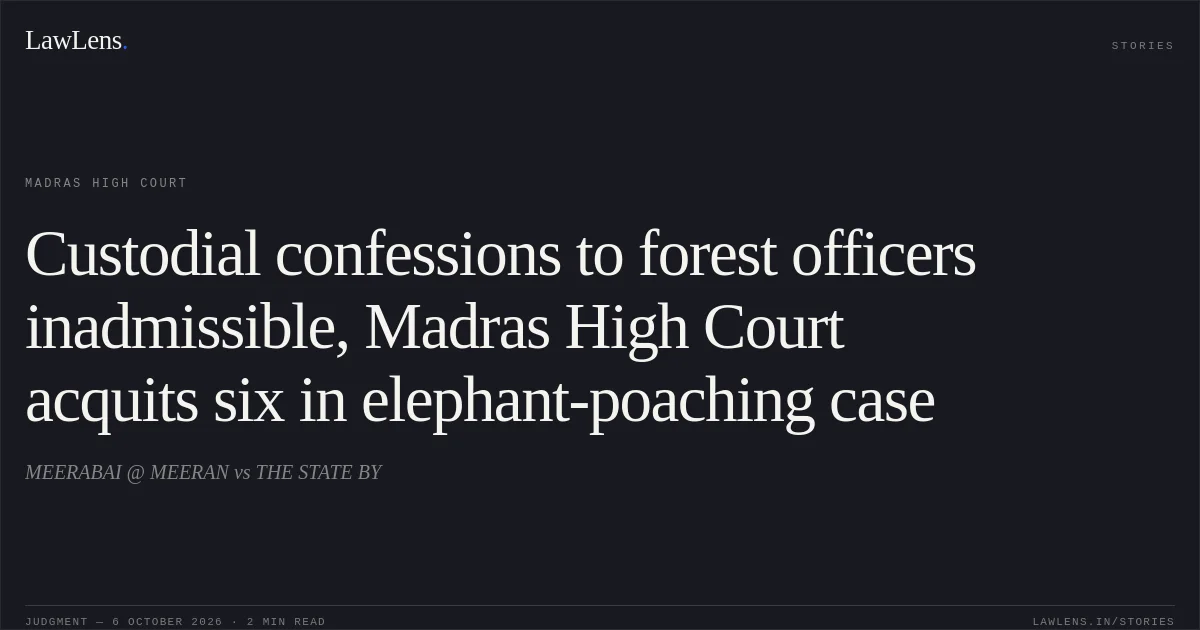
The High Court allowed the revision, set aside the judgments of the courts below, and acquitted the petitioners of the charges.
It directed that any fine paid be refunded and that any bail bonds executed stand discharged.
Source reference: p. 13Acts & Sections Cited
12 provisions across 3 statutes referred to in this judgment. Each provision opens on LawLens.
Code of Criminal Procedure, 19732
Wild Life (Protection) Act, 1972
Prevention of Money-Laundering Act, 20021
Original Court PDF
MEERABAI @ MEERANvsTHE STATE BY
Click to open original judgment
Original judgment, available to read, download and summarize on LawLens.in