Facts
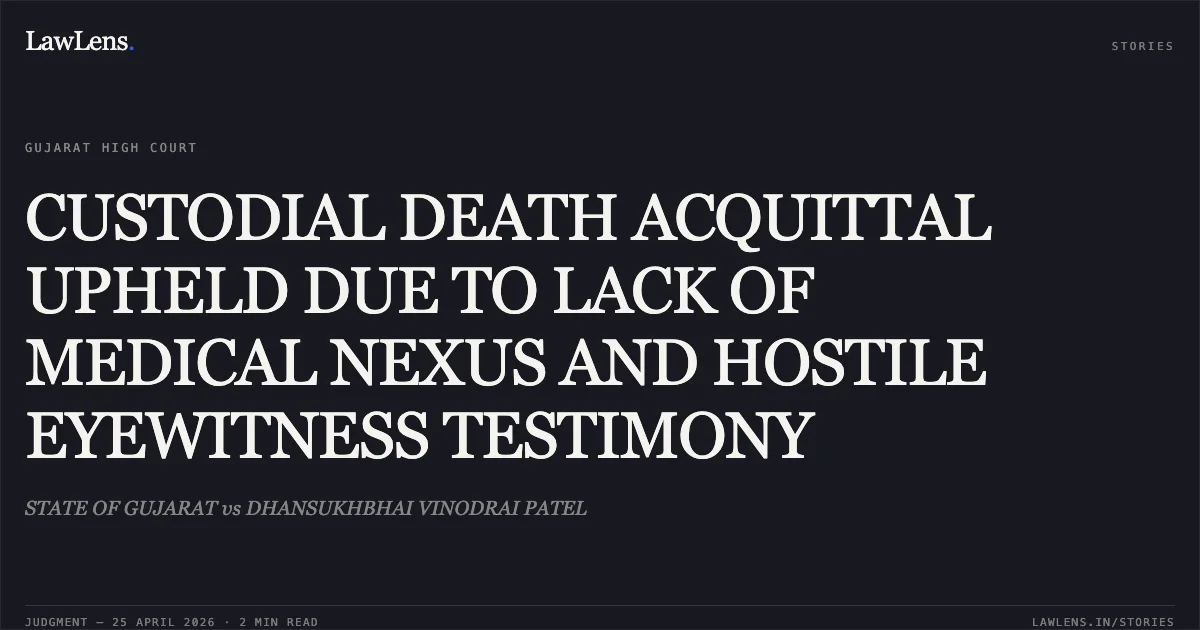
The State of Gujarat appealed an acquittal order dated 12.08.1998 passed by the Additional Sessions Judge, Bhavnagar, in a case involving the alleged custodial death of Jethabhai.
Source reference: p. 1-2The prosecution alleged that on the night of 10.05.1991, the respondents (police personnel) apprehended Jethabhai near Taleti Road, publicly assaulted him with sticks, and continued the assault inside the Palitana police station, resulting in his death.
Source reference: p. 2The defense contended the deceased was a habitual drinker with health issues.
Source reference: p. 13, 17The trial court acquitted the accused, holding that the prosecution failed to prove the charges under Sections 302, 34, and 114 of the IPC beyond a reasonable doubt.
Source reference: p. 6Issues
1. Whether the prosecution established a direct nexus between the injuries found on the deceased and the alleged assault by the accused police personnel.
Source reference: p. 112. Whether the medical evidence supported the claim that death was caused by custodial violence.
Source reference: p. 9-103. Whether the High Court should interfere with a trial court’s order of acquittal when a reasonable alternative view of the evidence exists.
Source reference: p. 23, 27Law Applied
The court primarily applied Section 302 (Murder) and Sections 34/114 (Common intention/Abetment) of the Indian Penal Code.
Source reference: p. 1Procedurally, it followed Section 378 of the Code of Criminal Procedure regarding appeals against acquittal.
Source reference: p. 2The court relied on the "Double Presumption of Innocence" principle, noting that an acquittal reinforces the initial presumption of innocence.
Source reference: p. 27It cited Chandrappa v. State of Karnataka, establishing that an appellate court should not disturb an acquittal if two reasonable conclusions are possible.
Source reference: p. 25-27It cited Ramesh Babulal Doshi v. State of Gujarat, emphasizing that interference is only warranted if the trial court's findings are "perverse" or "manifestly erroneous".
Source reference: p. 23Reasoning
Medical testimony from PW-1 indicated that the thirteen external injuries were "simple in nature" and not sufficient to cause death, with X-rays showing no fractures.
Source reference: p. 9-10PW-1 further noted that the deceased might have died of neurogenic shock possibly linked to a drop in blood sugar levels due to alcohol habituation and lack of food, rather than physical trauma.
Source reference: p. 10-11Crucially, the estimated time of injury (per PW-1) predated the time the deceased was taken into police custody.
Source reference: p. 11, 21Furthermore, key eyewitnesses (PW-6, PW-11, and PW-12) turned hostile, denying they saw any assault.
Source reference: p. 15, 19, 20PW-3 (Medical Officer) testified that the deceased sat and walked on his own and made no complaints of assault when brought for a blood test at 1:00 AM.
Source reference: p. 12-13The court reasoned that since the trial court's view was plausible and supported by the lack of direct or consistent medical evidence, there was no "patent perversity" to justify reversing the acquittal.
Source reference: p. 28Holding
The High Court answered the issues in the negative, holding that the prosecution failed to prove its case beyond reasonable doubt.
The court affirmed that as long as the trial court's view is a possible one, the appellate court must not substitute it with its own.
Source reference: p. 25The appeal was dismissed, and the judgment of acquittal passed by the Additional Sessions Judge, Bhavnagar, was confirmed.
Source reference: p. 29Acts & Sections Cited
5 provisions across 2 statutes referred to in this judgment. Each provision opens on LawLens.
Indian Penal Code, 18603
Code of Criminal Procedure, 19732
Original Court PDF
STATE OF GUJARATvsDHANSUKHBHAI VINODRAI PATEL
Click to open original judgment
Original judgment, available to read, download and summarize on LawLens.in