Facts
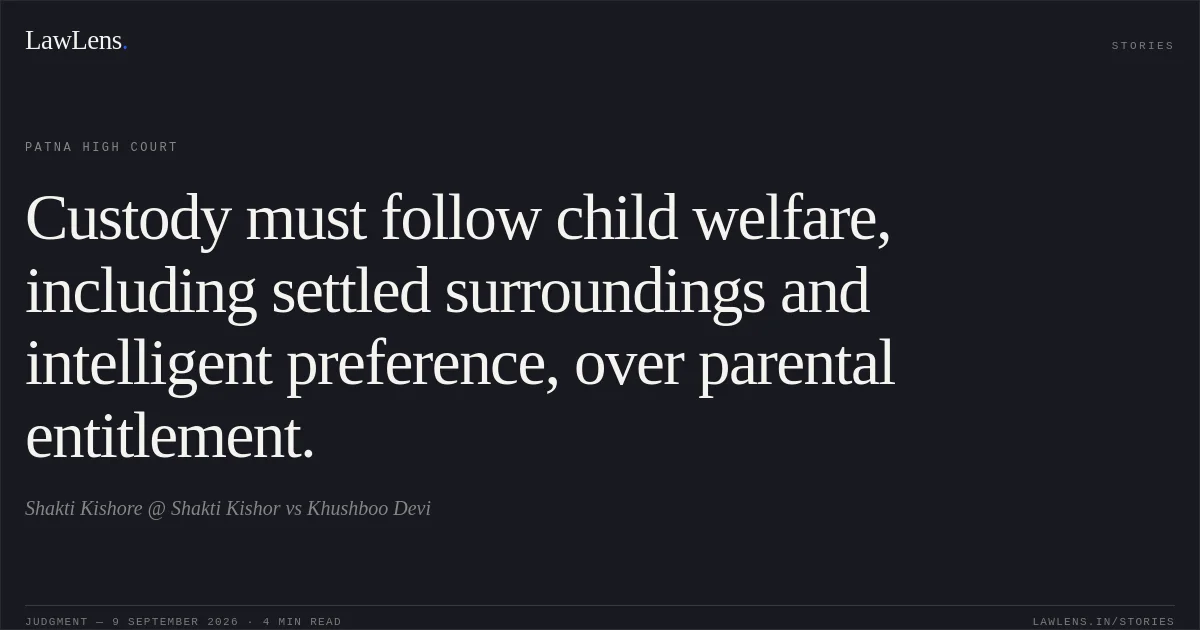
The parties married in 2011 and have two children, Shivani Kumari @ Aradhya Kumari and Aryan Kumar @ Advik.
Source reference: p. 2, para. 3They began living separately in August 2018, when the children were approximately two-and-a-half years and eight months old, respectively.
Source reference: p. 2, para. 3Since the separation, the children had continuously resided with the appellant-father and his family.
Source reference: p. 2, para. 3In Guardian & Wards Case No. 1 of 2019, the Principal Judge, Family Court, Jehanabad directed that custody be handed over to the respondent-mother while granting visitation rights to the appellant-father, relying principally on the importance of the mother’s role and the welfare of the children.
Source reference: p. 2, para. 4The father challenged that decision under Section 19 of the Family Courts Act, 1984, contending that the children had become settled in his care, education and familial environment and had expressed a preference to remain with him.
Source reference: p. 2, para. 5The mother supported the Family Court’s order, relying on her status as the children’s natural mother and her right to maintain a relationship with them.
Source reference: p. 3, para. 6Issues
1. Whether, in light of the children’s prolonged residence with the appellant, their settled educational and familial environment, and their expressed preference, transferring custody to the respondent-mother would be conducive to their welfare?
Source reference: pp. 8–9, paras. 11–152. Whether the appellant-father’s present custody should continue while preserving the respondent-mother’s right to meaningful visitation and interaction with the children?
Source reference: pp. 9–10, paras. 16–193. Whether the Family Court’s custody order required interference under Section 19 of the Family Courts Act, 1984, on account of subsequent developments affecting the children’s welfare?
Source reference: p. 2, para. 2; p. 10, para. 17Law Applied
The Court applied Section 13 of the Hindu Minority and Guardianship Act, 1956, under which the welfare of the minor is the paramount consideration and no person is entitled to guardianship merely by statutory entitlement if such guardianship is not conducive to the child’s welfare.
Source reference: p. 3, para. 7Relying on Gaurav Nagpal v. Sumedha Nagpal, (2009) 1 SCC 42, the Court held that “welfare” must be construed broadly to include the child’s physical, moral, emotional and overall well-being, rather than the competing legal rights of the parents.
Source reference: p. 4, para. 8Under Nil Ratan Kundu v. Abhijit Kundu, (2008) 9 SCC 413, custody matters are human problems requiring a child-centred approach, with due consideration to comfort, contentment, health, education, intellectual development, favourable surroundings, moral values and, where the child is sufficiently mature, an intelligent preference.
Source reference: pp. 5–6, para. 9The Court also relied on Col. Ramneesh Pal Singh v. Sugandhi Aggarwal, 2024 INSC 397, which requires a holistic assessment of socioeconomic and educational opportunities, healthcare, overall well-being, physical surroundings, stability and the child’s preference; it further cautions courts against attributing parental alienation without identifying specific instances of alienating conduct.
Source reference: pp. 6–7, para. 10The appeal was maintainable under Section 19 of the Family Courts Act, 1984, against the Family Court’s judgment on facts and law.
Source reference: p. 2, para. 2Reasoning
The High Court found that the circumstances at the appellate stage were materially different from those existing when the guardianship proceedings commenced.
Source reference: p. 8, para. 11The children had spent several formative years with the appellant, were settled in his educational and familial environment, and had expressed their unwillingness to leave him.
Source reference: p. 8, para. 11Although the children’s preference was not treated as determinative, the Court considered it significant because they possessed sufficient age and maturity to express an intelligent preference, particularly when assessed alongside their continuous residence, education and emotional stability.
Source reference: pp. 8–9, paras. 12–15The Court therefore concluded that an abrupt transfer of custody would not advance their welfare.
Source reference: pp. 8–9, paras. 11–15At the same time, applying the welfare principle holistically, it held that the children should retain a meaningful relationship with their mother.
Source reference: p. 9, para. 16; p. 10, para. 19The father was consequently required to facilitate reasonable and dignified communication and visitation, and both parents were directed not to make adverse statements about each other in the children’s presence or hearing.
Source reference: p. 9, para. 16; p. 10, para. 19Holding
The appeal was allowed.
The Family Court’s judgment dated 6 September 2024 was set aside insofar as it directed that custody of the children be handed over to the respondent-mother.
Source reference: p. 10, para. 18The children’s existing custody with the appellant-father was permitted to continue, while the respondent-mother was granted reasonable visitation and interaction rights, with the father directed to cooperate fully.
Source reference: p. 10, para. 19Both parties were restrained from exposing the children to their matrimonial dispute or allegations against the other parent.
Source reference: p. 10, para. 19The Court clarified that the arrangement was based on the prevailing circumstances and could be reconsidered by the competent court upon a substantial change in circumstances or if the children’s welfare so required.
Source reference: p. 10, para. 20Pending interlocutory applications were disposed of and there was no order as to costs.
Source reference: p. 11, paras. 21–22Acts & Sections Cited
3 provisions across 3 statutes referred to in this judgment. Each provision opens on LawLens.
Family Courts Act, 19841
Hindu Minority and Guardianship Act, 19561
Guardians and Wards Act, 18901
Original Court PDF
Shakti Kishore @ Shakti KishorvsKhushboo Devi
Click to open original judgment
Original judgment, available to read, download and summarize on LawLens.in