Facts
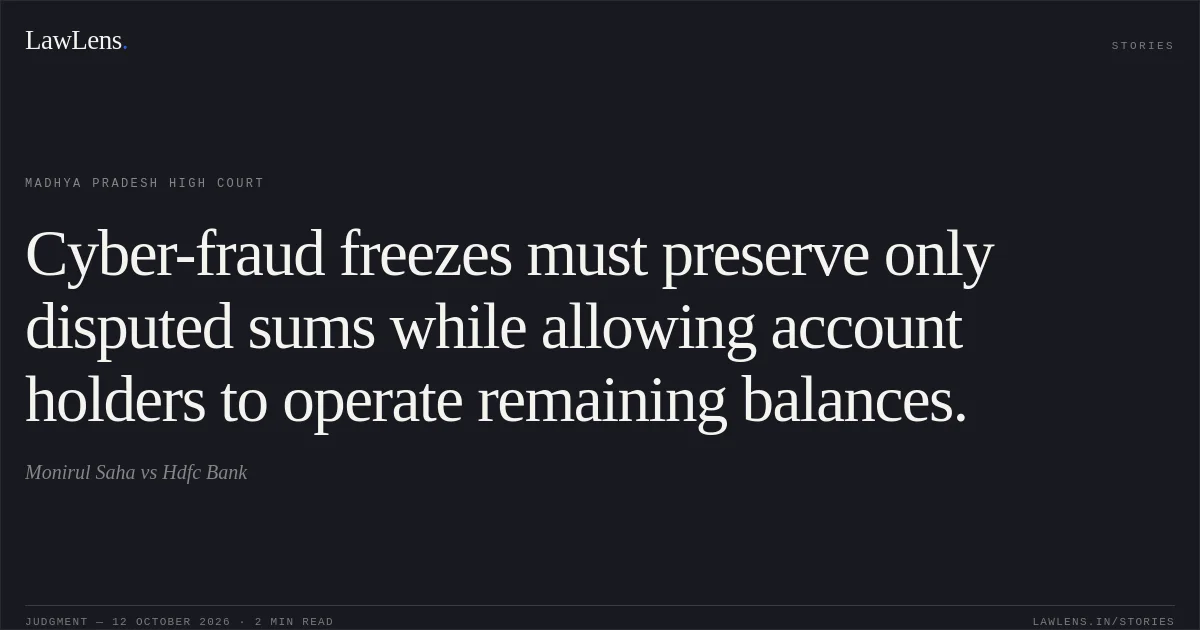
The petitioner sought relief under Article 226 of the Constitution after HDFC Bank froze his savings account.
Source reference: para. 1He asked the Court either to direct immediate unfreezing or, alternatively, to restrict the hold to two disputed credits of Rs. 49,750 and Rs. 49,751, received on 20 September 2026, while allowing him to operate the rest of the account.
Source reference: para. 1Relying on Malcolm Murayis v. State Bank of India and Archana v. State of Madhya Pradesh, the petitioner argued that only the disputed sums should remain secured.
Source reference: paras. 2–4The Court considered those decisions applicable to the case.
Source reference: para. 5Issues
1. Whether the entire bank account should remain frozen when the identified disputed amounts can be secured separately.
Source reference: paras. 1, 5–62. Whether the disputed amounts should be retained in fixed deposits pending action by the competent Judicial Magistrate, while the petitioner is permitted to operate the account.
Source reference: para. 6Law Applied
Under Article 226, the Court may grant appropriate relief where a bank-account freeze is disproportionate to the suspected proceeds of crime.
Source reference: no citationIn Malcolm Murayis v. State Bank of India, the Court directed that disputed amounts be placed in fixed deposits and permitted their withdrawal if the competent Magistrate did not pass an order within the specified period.
Source reference: para. 3In Archana v. State of Madhya Pradesh, the Court relied on the Ministry of Home Affairs’ Standard Operating Procedure dated 10 April 2026 and emphasized proportionality: where practicable, only the suspected amount should be subject to a lien or debit freeze, while continuation of a full-account freeze requires recorded reasons.
Source reference: para. 4, reproducing Archana, paras. 11–18The present Court held that these decisions applied mutatis mutandis.
Source reference: para. 5Reasoning
The Court applied the proportionality approach in Malcolm Murayis and Archana to the two identified credits.
Source reference: paras. 5–6It directed that those sums be secured in fixed deposits rather than maintaining a freeze on the entire account.
Source reference: paras. 5–6This preserved the disputed funds while allowing the petitioner to access the remainder of the account.
Source reference: paras. 5–6The Court also left open the Bank’s ability to act lawfully if it received a complaint concerning another transaction, having regard to the SOP.
Source reference: paras. 5–6Holding
The petition was disposed of with a direction to place Rs. 49,750 and Rs. 49,751 in fixed deposits.
Those deposits may be liquidated only after an order by the competent Judicial Magistrate within three months; if no such order is passed within that period, the petitioner may withdraw the amounts after informing the Police agency.
Source reference: paras. 6–7The Bank was directed to unfreeze the account and permit the petitioner to operate it, without prejudice to lawful action concerning any other reported transaction.
Source reference: paras. 6–7Acts & Sections Cited
1 provisions across 1 statute referred to in this judgment. Each provision opens on LawLens.
Code of Criminal Procedure, 19731
Original Court PDF
Monirul SahavsHdfc Bank
Click to open original judgment
Original judgment, available to read, download and summarize on LawLens.in