Facts
The appellant was appointed as a daily-wage watchman on 26 August 1992 after his name was sponsored by the local Employment Exchange and after he successfully underwent the selection process. He continued in service without blemish
Source reference: para. 3Government Order No. 22 dated 28 February 2006 directed regularisation of daily-wage employees in Government departments who had completed ten years of service as on 1 January 2006, subject to their possessing the requisite qualifications.
Source reference: para. 4Although the appellant had completed ten years of service by 26 August 2002, his service was regularised only prospectively from 17 September 2010 under G.O. No. 187, after approximately eighteen years of service.
Source reference: para. 5The appellant challenged the refusal to regularise him from completion of ten years of service. The Single Judge allowed the writ petition and directed retrospective regularisation from the date of completion of ten years, with consequential salary arrears.
Source reference: para. 6The Division Bench reversed that decision, holding that the effective date of regularisation was within the Government’s policy discretion and that G.O. No. 187 operated prospectively.
Source reference: paras. 8–9Issues
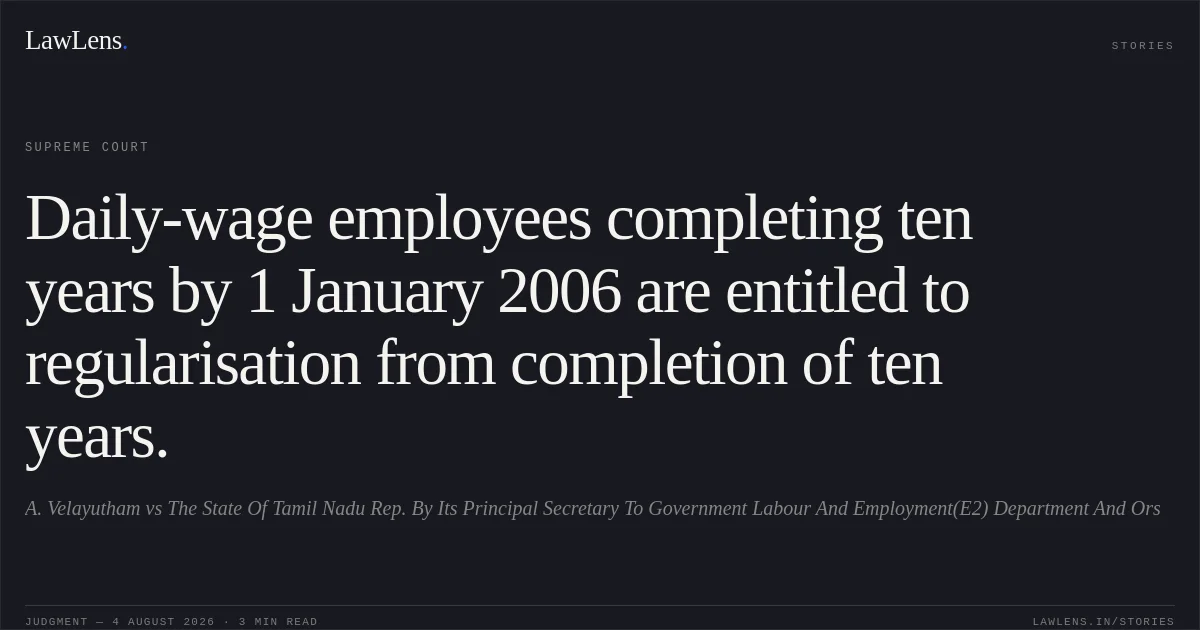
Whether the appellant, having completed ten years of qualifying daily-wage service before 1 January 2006, was entitled to regularisation from the date of completion of ten years rather than from the date of G.O. No. 187.
Source reference: paras. 4–6, 18–19Whether G.O. No. 74 dated 27 June 2013 or the Full Bench decision in S. Dhanasekaran v. Government of Tamil Nadu justified restricting the appellant’s regularisation to a prospective date.
Source reference: paras. 9–17Whether denying the appellant retrospective regularisation, while granting similar relief to other similarly situated employees, violated the principle of equality under Article 14 of the Constitution.
Source reference: para. 17Law Applied
G.O. No. 22 dated 28 February 2006 required regularisation of daily-wage employees working in Government departments who had completed ten years of service as on 1 January 2006, provided they were otherwise qualified for the relevant post.
Source reference: para. 4The Court applied the principle that a party’s rights are ordinarily determined by the facts existing when the proceedings are instituted, unless a statute or considerations of equity require otherwise.
Source reference: para. 13It further applied Article 14’s prohibition against arbitrary and discriminatory treatment, holding that the State cannot selectively grant retrospective regularisation to similarly situated employees while denying it to an employee recruited through a substantially regular process.
Source reference: para. 17The Court distinguished State of Tamil Nadu v. A. Singamuthu, which concerned part-time employees, because the appellant was not engaged in voluntary part-time work.
Source reference: para. 16It also distinguished S. Dhanasekaran v. Government of Tamil Nadu, which dealt with appointments lacking statutory sanction or involving “backdoor entry”; the appellant’s appointment had been routed through the Employment Exchange and a selection process against a sanctioned post.
Source reference: para. 17G.O. No. 74 was held inapplicable because it was issued after the appellant’s regularisation and concerned daily-wage employees yet to be regularised.
Source reference: paras. 12–15Reasoning
The Supreme Court found the language of G.O. No. 22 unambiguous: 1 January 2006 was the cut-off date for determining whether an employee had completed ten years of service, not the date from which the benefit could necessarily be postponed.
Source reference: para. 18The appellant had completed ten years of continuous service well before that cut-off and satisfied the essential factual conditions for regularisation.
Source reference: para. 18His appointment was not a clandestine or wholly irregular entry; it followed Employment Exchange sponsorship and a selection process.
Source reference: paras. 3, 16–17Consequently, the restrictive reasoning applicable to illegal or backdoor appointments in Dhanasekaran could not govern his case.
Source reference: paras. 16–17G.O. No. 74 was irrelevant because it post-dated both the appellant’s regularisation and institution of the writ proceedings and was intended to regulate employees who had not yet been regularised.
Source reference: paras. 13–15In light of the treatment accorded to similarly placed employees, denying the appellant regularisation from completion of ten years would be arbitrary and inconsistent with Article 14.
Source reference: para. 17The Division Bench therefore erred in treating G.O. No. 187 as conclusively requiring prospective regularisation.
Source reference: paras. 18–20Holding
The Court held that the appellant was entitled to regularisation from the date on which he completed ten years of service, rather than from 17 September 2010, the date of G.O. No. 187.
The Division Bench’s judgment was set aside, and the Single Judge’s order was restored.
Source reference: para. 20The respondents were directed to issue a revised order granting regularisation with the applicable time-scale of pay and to release all consequential benefits, including salary arrears, within three months.
Source reference: para. 20The appeal was allowed without costs.
Source reference: para. 21Original Court PDF
A. VelayuthamvsThe State Of Tamil Nadu Rep. By Its Principal Secretary To Government Labour And Employment(E2) Department And Ors
Click to open original judgment
Original judgment, available to read, download and summarize on LawLens.in