Facts
The petitioner, who operated a private gas agency, sought to quash Crime No. 64 of 2026, registered under Clause 4(1)(b) of the Liquefied Petroleum Gas (Regulation of Supply and Distribution) Order, 2000 (“the Order”), read with Section 7(1)(a)(ii) of the Essential Commodities Act, 1955.
Source reference: para. 2The complaint alleged that 107 empty LPG cylinders were found at his premises without a licence or proof that he was a distributor.
Source reference: para. 2The petitioner relied on subsisting distributorships with Star Gas and Total Gas for 39 cylinders, and said the remaining 68 Go Gas cylinders had been left with him after that distributorship expired in 2022 because Go Gas would not take back the damaged cylinders.
Source reference: paras. 3, 8–9The police had sought Go Gas’s response about disposal of the damaged cylinders but had received no reply.
Source reference: para. 9The petitioner invoked the Court’s quashing jurisdiction; the petition was allowed.
Source reference: paras. 1, 12Issues
Whether possession of the seized empty cylinders attracted Clause 4(1)(b) or Clause 7(1)(c) of the Order.
Source reference: para. 6Whether continuation of the criminal proceedings would amount to an abuse of the process of law.
Source reference: para. 6Law Applied
Clause 4(1)(b) of the Order prohibits transporting or storing a cylinder filled with LPG in a position other than upright.
Source reference: para. 7Clause 7(1)(c) prohibits a person who is neither a distributor nor a consumer from possessing a filled or empty cylinder, a gas-cylinder valve, or a pressure regulator.
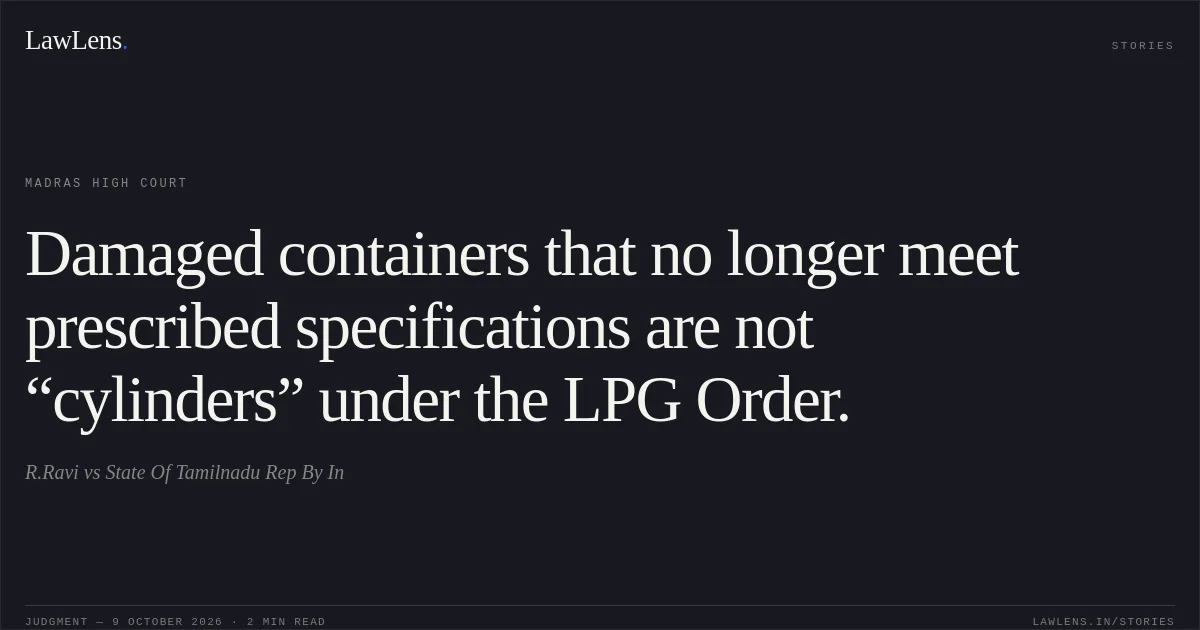
Source reference: para. 8Under Clause 2(c), a “cylinder” is a metal container used to store LPG that conforms to the specifications in Schedules II and III; the Court held that a damaged container that no longer conforms to those specifications and cannot store LPG falls outside that definition.
Source reference: para. 10The Court also applied the quashing principle that proceedings should not continue where the allegations, taken at face value, disclose no offence and their continuation would amount to abuse of process.
Source reference: para. 11Reasoning
The seized cylinders were alleged to be empty, so Clause 4(1)(b), which concerns filled cylinders, did not apply.
Source reference: para. 7The 39 Star Gas and Total Gas cylinders were in the petitioner’s possession under subsisting distributorship agreements; he therefore fell within the distributor exception in Clause 7(1)(c).
Source reference: para. 8As to the 68 Go Gas cylinders, the distributorship had expired, but the company’s failure to reclaim them for nearly four years, together with its lack of response to the investigating agency’s inquiry, lent support to the petitioner’s claim that they were damaged.
Source reference: para. 9The Court concluded that such non-conforming, unusable containers were not “cylinders” within Clause 2(c), and thus their possession did not attract Clause 7(1)(c).
Source reference: paras. 10–11Holding
The Court held that neither Clause 4(1)(b) nor Clause 7(1)(c) was attracted on the facts alleged and that no offence was made out even if the FIR allegations were taken at face value.
It quashed the FIR in Crime No. 64 of 2026 and allowed the Criminal Original Petition; the connected miscellaneous petition was closed.
Source reference: para. 12Acts & Sections Cited
2 provisions across 2 statutes referred to in this judgment. Each provision opens on LawLens.
Bharatiya Nagarik Suraksha Sanhita, 20231
Essential Commodities Act, 19551
Original Court PDF
R.RavivsState Of Tamilnadu Rep By In
Click to open original judgment
Original judgment, available to read, download and summarize on LawLens.in