Facts
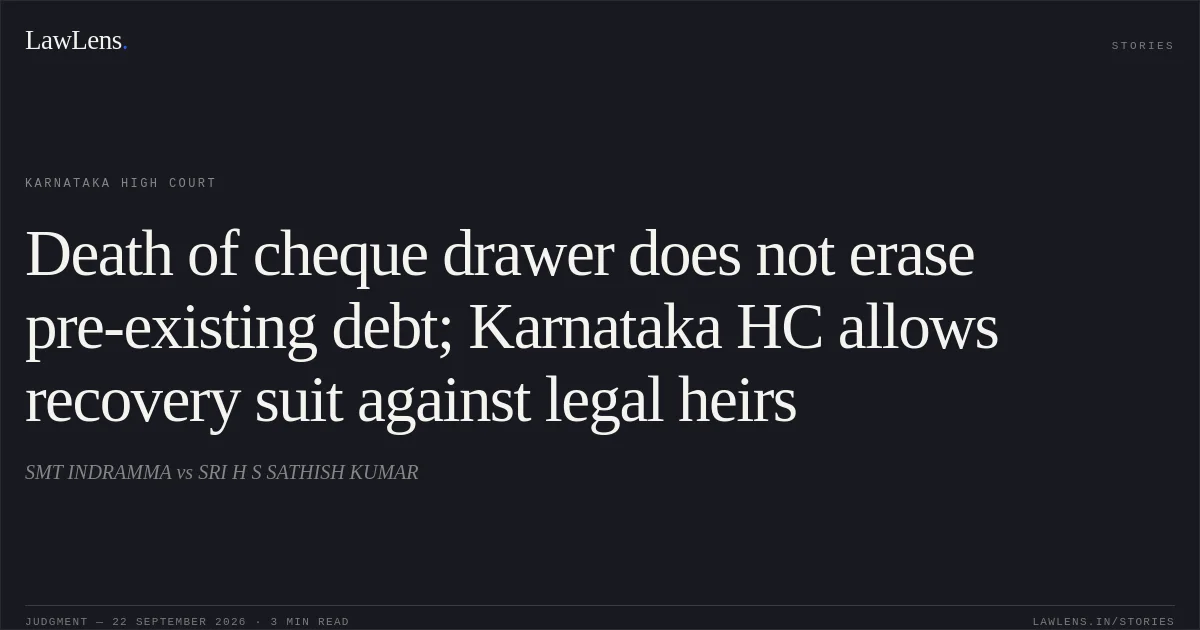
The respondent-plaintiff instituted O.S. No. 101/2023 before the Principal Senior Civil Judge and CJM, Mandya, seeking recovery of ₹8,00,000 allegedly advanced to the deceased husband of petitioner No. 2. A post-dated cheque was issued towards repayment and was dishonoured for “funds insufficient” after the drawer’s death. The petitioners, who were the defendants/legal representatives, filed I.A. No. 6 under Order VII Rule 11(a) and (d) of the Code of Civil Procedure, 1908, contending that the plaint disclosed no cause of action because the cheque had been presented after the drawer’s death and had therefore lost legal efficacy.
Source reference: p. 2–3The trial court dismissed the application, holding that the plaintiff could pursue the deceased’s legal representatives, to the extent of the estate inherited by them, and that the existence of a cause of action had to be determined from the plaint averments alone. The defendants challenged that order under Section 115 CPC before the High Court.
Source reference: p. 4–5; p. 2Issues
1. Whether a plaint seeking recovery of an alleged pre-existing debt from the legal representatives of a deceased drawer is liable to be rejected under Order VII Rule 11(a) CPC merely because the cheque issued towards the debt was presented and dishonoured after the drawer’s death?
Source reference: p. 7–102. Whether the death of the cheque drawer extinguishes the underlying civil liability or deprives the plaintiff of a cause of action against the deceased’s estate?
Source reference: p. 8–9Law Applied
The Court applied Order VII Rule 11(a) and (d) CPC, under which a plaint may be rejected where it does not disclose a cause of action or where the suit appears from the plaint to be barred by law.
Source reference: p. 4–5At this stage, the Court must ordinarily examine the plaint averments and cannot adjudicate the truth or merits of the pleaded transaction. A cheque operates as a mandate by the drawer to the bank, and that mandate cannot ordinarily continue after the drawer’s death; accordingly, presentation and dishonour after death cannot independently create a cheque-based or penal liability against the deceased or the legal representatives. However, the death of the drawer does not extinguish an antecedent, enforceable civil debt incurred during his lifetime. Such liability may be enforced against the deceased’s estate through the legal representatives, subject to the extent of the estate inherited by them.
Source reference: p. 4–5, 7–9Reasoning
The High Court distinguished between the post-death cheque presentation and the alleged underlying loan liability. Although the cheque could not operate as a continuing banking mandate after the drawer’s death, the plaintiff’s pleaded case was that the loan had been advanced and the cheque issued during the drawer’s lifetime.
Source reference: p. 8Therefore, the alleged debt was not a liability arising solely from the subsequent dishonour; it was an independent civil liability said to have already arisen before death. The cheque could be considered as evidence of the transaction and the subsisting liability, while the questions concerning the loan, consideration, issuance of the cheque, and the amount due were matters for trial on the merits. Since the plaint disclosed an alleged pre-existing debt and a basis for proceeding against the deceased’s estate, it could not be rejected under Order VII Rule 11 CPC merely on the basis of the drawer’s death before presentation of the cheque.
Source reference: p. 9–10Holding
The Court held that the death of the cheque drawer before presentation and dishonour prevented the cheque from creating an independent post-death mandate or dishonour-based liability, but it did not extinguish a civil debt allegedly incurred during the drawer’s lifetime. The suit for recovery against the legal representatives, limited to the estate inherited from the deceased, therefore disclosed a cause of action.
The trial court’s refusal to reject the plaint was upheld, and the Civil Revision Petition was dismissed; all pending interlocutory applications were closed.
Source reference: p. 10Acts & Sections Cited
1 provisions across 1 statute referred to in this judgment. Each provision opens on LawLens.
Code of Civil Procedure, 19081
Original Court PDF
SMT INDRAMMAvsSRI H S SATHISH KUMAR
Click to open original judgment
Original judgment, available to read, download and summarize on LawLens.in