Facts
The Plaintiff No. 1 (an NRI) and his wife, Ramaben (Plaintiff No. 2), purchased the "suit property" in Vadodara in 1999
Source reference: p. 2The plaintiffs executed two General Powers of Attorney (GPA) in favor of Defendant No. 1 (a family friend) in 1998 and 1999 to manage their Indian affairs
Source reference: p. 2, 21-25Ramaben (donor of the second GPA) died in London on July 21, 2010
Source reference: p. 2Despite her death, Defendant No. 1, acting as attorney, executed a registered Gift Deed of the suit property on January 5, 2011, in favor of his own son and daughter-in-law (Defendants No. 2 and 3)
Source reference: p. 3, 14The defendants claimed the gift was a settlement for unpaid loans owed by the plaintiff
Source reference: p. 3-4The Trial Court dismissed the plaintiffs' suit for cancellation of the Gift Deed; the plaintiffs subsequently appealed
Source reference: p. 4Issues
1. Whether a Power of Attorney remains valid and legally binding after the death of the principal/donor
Source reference: p. 122. Whether an agent can execute a Gift Deed of the principal's property when the Power of Attorney instrument does not specifically grant the authority to gift
Source reference: p. 12, 203. Whether the termination of agency under Section 201 of the Contract Act is mitigated by the agent's alleged lack of knowledge of the principal's death under Section 208
Source reference: p. 15-16Law Applied
The Court applied Section 201 of the Indian Contract Act, 1872, which mandates that an agency is terminated by the principal's death
Source reference: p. 13Section 208, which dictates when termination takes effect for agents and third parties
Source reference: p. 14Section 3 of the Powers-of-Attorney Act, 1882, which protects acts done in good faith without notice of the donor's death
Source reference: p. 17Principle of strict construction of Power of Attorney, holding that general words cannot enlarge specific restricted powers
Source reference: p. 20Section 32(c) of the Registration Act, requiring a valid character of agency at the time of presentation for registration
Source reference: p. 19Reasoning
The High Court reasoned that under Section 201 of the Contract Act, the death of Ramaben (Plaintiff No. 2) immediately terminated the agency by operation of law; thus, Defendant No. 1 had no authority to represent a "dead person"
Source reference: p. 14-15, 19The Court rejected the defense of "ignorance of death" under Section 208, noting that the fiduciary family relationship between the parties made the plea of ignorance implausible and lacked good faith
Source reference: p. 15, 17Upon a strict construction of the GPA instruments, the Court found no express or implied power to "gift" the property; the documents only authorized transfers for consideration, such as sales or mortgages
Source reference: p. 21-25, 26The execution of a Gift Deed in favor of the agent's own relatives was an unauthorized act that exceeded the scope of the instrument
Source reference: p. 26-27Holding
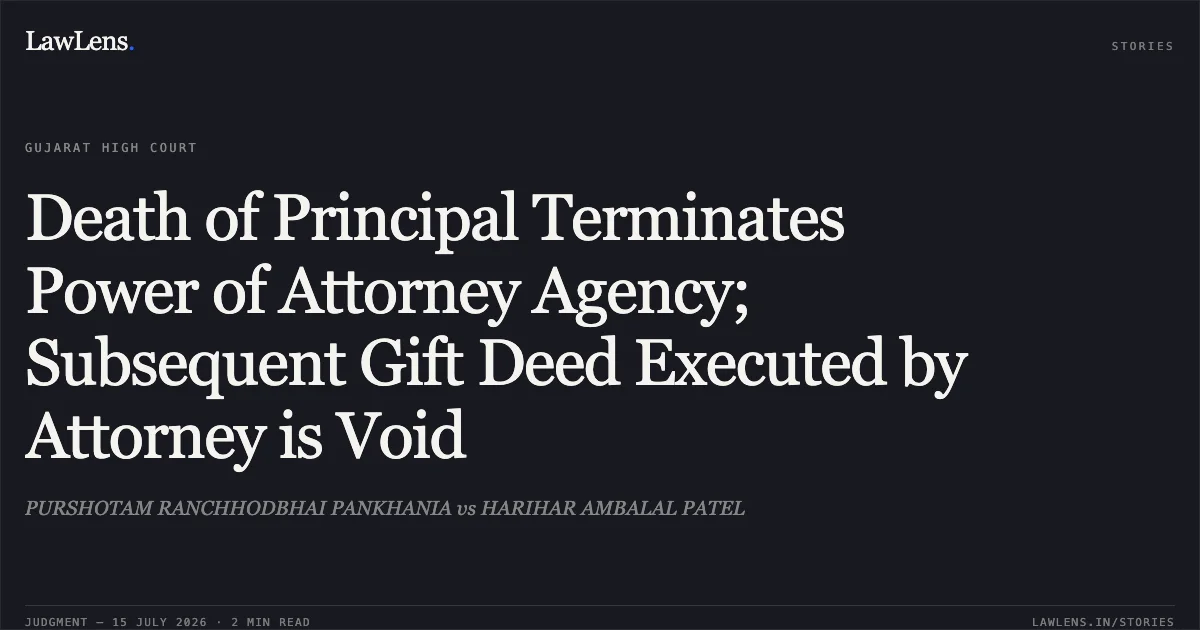
The Court held that the registered Gift Deed dated January 5, 2011, was void ab initio because the Power of Attorney had ceased upon the donor's death and the agent lacked the specific authority to gift the suit property
The Court allowed the appeal, set aside the Trial Court's judgment, and granted the relief for cancellation of the Gift Deed and permanent injunction as prayed for in the original suit
Source reference: p. 31, 32Acts & Sections Cited
6 provisions across 3 statutes referred to in this judgment. Each provision opens on LawLens.
Indian Contract Act, 18724
Powers-of Attorney Act, 18821
Registration Act, 19081
Original Court PDF
PURSHOTAM RANCHHODBHAI PANKHANIAvsHARIHAR AMBALAL PATEL
Click to open original judgment
Original judgment, available to read, download and summarize on LawLens.in