Facts
On 21 August 2021, after an examination at Moridhol College, Nandita Saikia was travelling towards Dhemaji with PW-2 Kasmina Dutta as a pillion rider on a motorcycle driven by PW-1 Deba Dutta. The accused allegedly followed them on a red scooty and, near Drug House Pharmacy in Dhemaji town, assaulted PW-1 with a Khamti dao. When PW-2 intervened, she was also assaulted. The accused then repeatedly struck Nandita, particularly on the head, and fled with the weapon. He was apprehended shortly thereafter near Pasoni Goli with the dao in his possession. Nandita later died from her injuries at Dibrugarh
Source reference: p. 3, para. 3The FIR initially led to registration of Dhemaji P.S. Case No. 397/2021 under Sections 341/326 IPC, with Section 302 IPC subsequently added. After investigation, the accused was charged under Sections 341, 302, 324 and 307 IPC. The prosecution examined 41 witnesses and produced 27 documents and 11 material objects. The Sessions Court convicted the accused under all four provisions and imposed the death penalty under Section 302 IPC, treating the case as one of the “rarest of the rare” cases. The present reference was made under Section 366 Cr.P.C., while the accused preferred a criminal appeal against his conviction and sentences
Source reference: p. 4, paras. 4–9Issues
Whether the prosecution proved beyond reasonable doubt that Rintu Sarmah committed offences under Sections 302, 307, 324 and 341 IPC?
Source reference: pp. 7–13, paras. 18–46Whether the conviction was sustainable despite alleged omissions, inconsistencies, investigative lapses, and challenges to the recovery and electronic evidence?
Source reference: pp. 5–6, paras. 10–14; pp. 11–13, paras. 37–43Whether the death sentence imposed under Section 302 IPC satisfied the “rarest of the rare” standard, such that the alternative of life imprisonment was unquestionably foreclosed?
Source reference: pp. 13–16, paras. 47–56Law Applied
The Court applied Sections 302, 307, 324 and 341 IPC concerning murder, attempt to murder, voluntarily causing hurt by dangerous weapons, and wrongful restraint, respectively.
Source reference: p. 4, paras. 5–8It considered Section 366 Cr.P.C., which requires a death sentence imposed by a Sessions Court to be referred to the High Court for confirmation.
Source reference: p. 4, para. 9The Court relied on the evidentiary principle that credible testimony of injured eyewitnesses carries special weight because their presence at the scene is ordinarily assured by their injuries.
Source reference: p. 8, para. 25Recovery of the weapon and the accused’s immediate post-occurrence conduct were treated as corroborative circumstances under Section 8 of the Evidence Act.
Source reference: p. 11, para. 36For sentencing, the Court applied Bachan Singh v. State of Punjab, (1982) 3 SCC 24, requiring death penalty to be reserved for the “rarest of the rare” cases where life imprisonment is unquestionably foreclosed; Machhi Singh v. State of Punjab, (1993) 3 SCC 470; and Vasanta Sampat Dupare v. Union of India, 2025 SCC OnLine SC 1823, requiring consideration of the crime, the offender, the possibility of reform and rehabilitation, and whether life imprisonment would be inadequate.
Source reference: p. 14, paras. 48–50The Court further held that mere denial of the offence under Section 313 Cr.P.C. cannot, by itself, establish absence of remorse or impossibility of reformation.
Source reference: p. 15, para. 53Reasoning
The Court found PW-1 and PW-2 to be injured eyewitnesses whose evidence was consistent regarding the identity of the accused, the dao used, and the sequence of assault. Their testimony was corroborated by independent witnesses, medical evidence, and the immediate recovery of the weapon and red scooty.
Source reference: pp. 7–13, paras. 19–36, 43The medical evidence established sharp-cut injuries, extensive head injuries, and homicidal death caused by coma resulting from cranial damage; it was consistent with the ocular account and ruled out the defence theory of accidental injuries.
Source reference: pp. 9–10, paras. 30–33The alleged omissions concerned peripheral details and did not affect the core prosecution case. Accordingly, the Court affirmed the convictions under Sections 302, 307, 324 and 341 IPC.
Source reference: p. 13, paras. 38–46On sentence, the Court accepted that the planned pursuit, use of a sharp weapon, assault on two intervening witnesses, and repeated blows to the deceased’s head constituted substantial aggravating circumstances.
Source reference: pp. 14–15, paras. 51–52However, the Sessions Court had focused predominantly on the brutality of the crime and had not adequately examined the offender’s circumstances, prospects of rehabilitation, or whether he was beyond reform. The Court held that the prosecution had not established that life imprisonment would be wholly inadequate or that reformation was impossible. The accused’s denial of the offence could not legitimately be treated as proof of incorrigibility.
Source reference: p. 15, paras. 52–54Therefore, the stringent “rarest of the rare” threshold was not met.
Source reference: p. 16, para. 55Holding
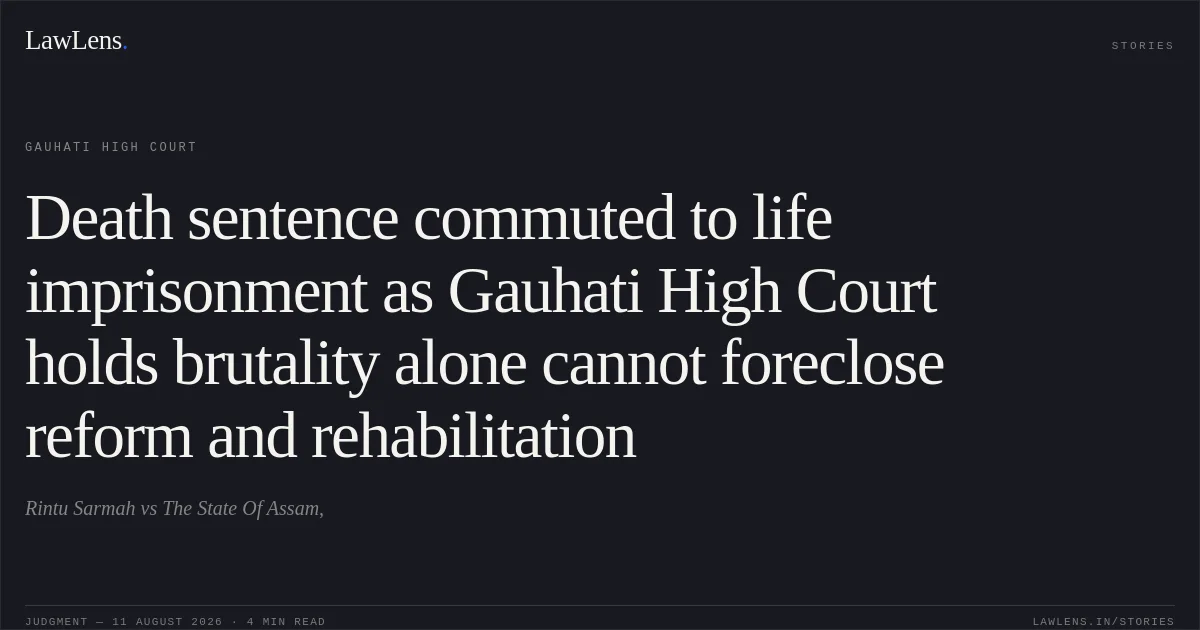
The High Court affirmed the convictions of Rintu Sarmah under Sections 302, 307, 324 and 341 IPC.
It declined to confirm the death sentence because the alternative of life imprisonment was not unquestionably foreclosed, and commuted the death sentence to imprisonment for life.
Source reference: p. 16, paras. 55–56The sentences for the offences under Sections 307, 324 and 341 IPC were also affirmed and directed to run concurrently. The death sentence reference was answered accordingly, and the trial court record was directed to be returned.
Source reference: p. 16, paras. 57–58Acts & Sections Cited
8 provisions across 2 statutes referred to in this judgment. Each provision opens on LawLens.
Indian Penal Code, 18605
Code of Criminal Procedure, 19733
Original Court PDF
Rintu SarmahvsThe State Of Assam,
Click to open original judgment
Original judgment, available to read, download and summarize on LawLens.in