Facts
The deceased, Jyotsnaben, was married to respondent No. 1, Ashokkumar, for approximately six years.
Source reference: no citationThe prosecution alleged that, after the death of her first child and the birth of a daughter, the deceased was subjected to physical and mental cruelty by her husband and in-laws, including abusive language and allegations that she was a “witch.”
Source reference: no citationIt was alleged that on 6 September 2008 she poured kerosene on herself and set herself on fire at the matrimonial home.
Source reference: p.9, para.12The deceased’s brother lodged the complaint, following which the respondents were prosecuted under Sections 498A, 306, 107 and 114 of the Indian Penal Code, along with the presumptions under Sections 113A and 113B of the Indian Evidence Act.
Source reference: pp.1–2, paras.1–2.3The Additional Sessions Judge, Fast Track Court, Palanpur, acquitted all the accused by judgment dated 11 September 2009 in Sessions Case Nos. 15 and 32 of 2009.
Source reference: no citationThe State preferred an appeal under Section 378(1)(3) of the Code of Criminal Procedure, 1973.
Source reference: p.1, para.1Issues
1. Whether the trial court was justified in acquitting the respondents of the offences under Sections 498A, 306, 107 and 114 of the IPC?
Source reference: p.8, para.11(1)2. Whether the trial court had correctly appreciated the oral and documentary evidence while recording the acquittal?
Source reference: p.8, para.11(2)3. Whether the impugned judgment suffered from any illegality, irregularity or perversity warranting appellate interference?
Source reference: p.8, para.11(3)Law Applied
The Court applied Sections 498A and 306 of the IPC, requiring proof of legally established cruelty and abetment of suicide, respectively, together with Sections 107 and 114 concerning abetment and liability for acts done in furtherance of common intention or abetment.
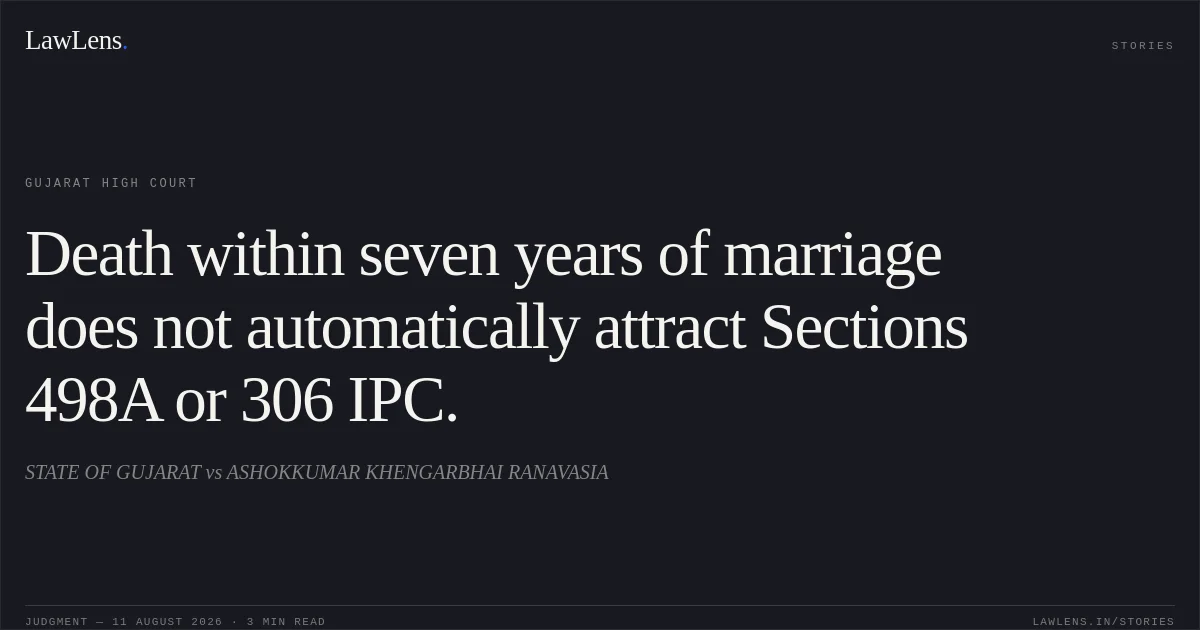
Source reference: no citationThe presumptions under Sections 113A and 113B of the Indian Evidence Act could arise only after the prosecution established the foundational facts of cruelty or dowry-related harassment; death within seven years of marriage, by itself, does not automatically attract Sections 498A or 306.
Source reference: p.13, para.16In an appeal against acquittal under Section 378 CrPC, the appellate court has power to reappreciate the evidence, but must account for the double presumption of innocence in favour of the accused.
Source reference: pp.14–16, paras.17–20Where two reasonable views are possible, the acquittal should not be disturbed; interference is justified only where the trial court’s view is manifestly illegal, perverse, or unreasonable.
Source reference: pp.14–16, paras.17–20The Court relied principally on Chandrappa v. State of Karnataka, (2007) 4 SCC 415, reaffirmed in Rajesh Prasad v. State of Bihar, (2022) 3 SCC 471, Babu Sahebagouda Rudragoudar v. State of Karnataka, (2024) 8 SCC 149, and Ramesh v. State of Karnataka, (2024) 9 SCC 169.
Source reference: pp.14–16, paras.19–20Reasoning
The Court found that the prosecution failed to establish the foundational facts necessary to prove cruelty or abetment.
Source reference: no citationThe complainant’s evidence showed that respondent No. 1 was away from the matrimonial home with the deceased’s family when the incident occurred and returned immediately after receiving information about the burns.
Source reference: pp.9–10, para.13The panch witnesses found no trace of kerosene or other hydrocarbon at the scene, and the post-mortem doctor detected no smell of kerosene on the body or clothes; the medical evidence also could not determine whether the death was accidental or homicidal.
Source reference: pp.10–12, para.14Independent witnesses did not support the allegations of harassment or cruelty, and the Investigating Officer admitted that no evidence of physical or mental cruelty had emerged during investigation.
Source reference: p.12, para.15The prosecution also failed to prove any dowry demand or specific conduct amounting to cruelty, and the statutory presumptions under Sections 113A and 113B were therefore unavailable.
Source reference: pp.12–16, paras.15–20Since the trial court had given cogent reasons for acquittal and its conclusions were at least reasonably possible on the evidence, the enhanced appellate scrutiny applicable to an acquittal did not justify interference.
Source reference: pp.12–16, paras.15–20Holding
The High Court answered all the issues against the State.
It held that the prosecution had failed to prove beyond reasonable doubt that the respondents subjected the deceased to cruelty, abetted her suicide, or were otherwise liable under Sections 498A, 306, 107 and 114 of the IPC.
Source reference: pp.16–17, paras.21–22The State’s appeal was dismissed, the trial court’s judgment of acquittal dated 11 September 2009 was confirmed, the bail bonds were cancelled, and the record and proceedings were directed to be returned to the trial court.
Source reference: p.17, para.23Acts & Sections Cited
6 provisions across 2 statutes referred to in this judgment. Each provision opens on LawLens.
Code of Criminal Procedure, 19733
Indian Penal Code, 18603
Original Court PDF
STATE OF GUJARATvsASHOKKUMAR KHENGARBHAI RANAVASIA
Click to open original judgment
Original judgment, available to read, download and summarize on LawLens.in