Facts
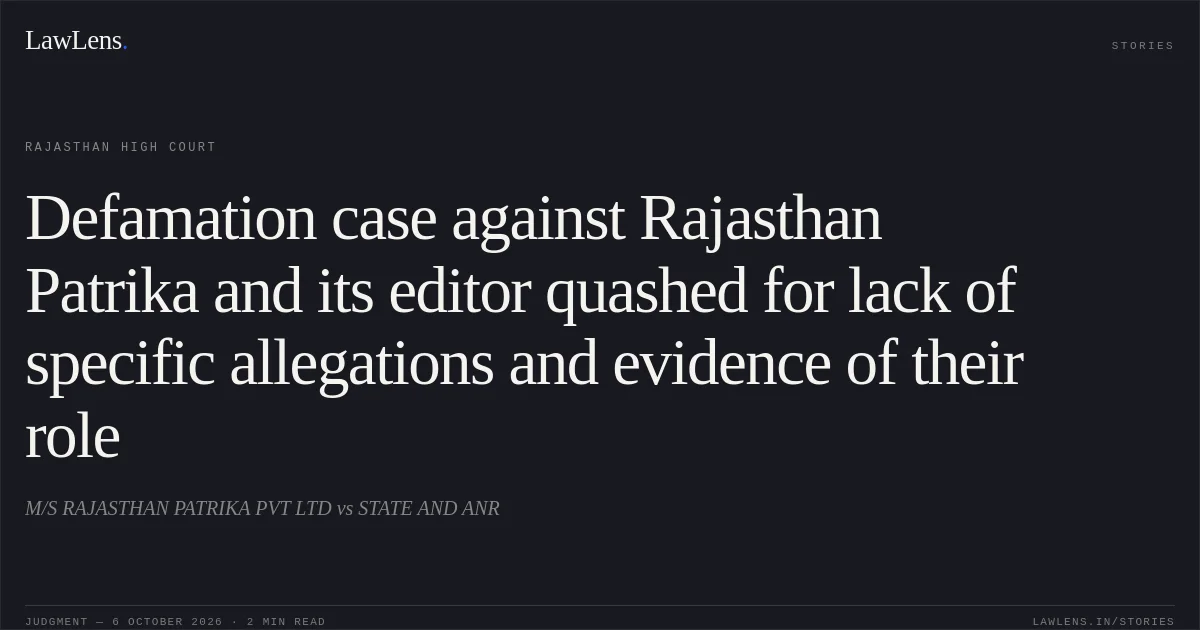
The complainant filed a private complaint alleging that ten accused had defamed him through pamphlets, a demonstration and a news article published in Rajasthan Patrika.
Source reference: para. 1, 12–13The Magistrate took cognizance against the accused, including the newspaper company and its Editor-in-Chief, under Sections 500, 501 and 502 of the IPC; the Sessions Court dismissed their revision.
Source reference: para. 1, 12–13The company and Editor-in-Chief then sought relief under Section 482 CrPC, contending that the complaint and preliminary evidence did not attribute to them a specific role, knowledge, intent or participation in the alleged publication or demonstration.
Source reference: para. 3–6Issues
Whether the complaint and material recorded under Sections 200 and 202 CrPC disclosed a prima facie case of defamation against the newspaper company and its Editor-in-Chief
Source reference: para. 28, 33–38Whether the orders taking cognizance and dismissing the revision should be quashed under Section 482 CrPC for lack of specific allegations and material connecting the petitioners to the alleged offences
Source reference: para. 40–42, 45–50Law Applied
Section 499 IPC requires an imputation concerning a person, made or published with the intention, knowledge or reason to believe that it will harm that person’s reputation; Sections 500, 501 and 502 address, respectively, punishment for defamation, printing or engraving defamatory matter, and offering such matter for sale.
Source reference: para. 19–20, 34At the process stage, the Magistrate must find sufficient ground to proceed, not sufficient ground for conviction; however, process should not issue in the absence of material disclosing the offence and the accused’s role.
Source reference: para. 21–22, 28The Court relied on Subramanian Swamy v. Union of India concerning the balance between free expression and reputation, and Pepsi Foods Ltd. v. Special Judicial Magistrate on the need for judicial application of mind before issuing process.
Source reference: para. 15, 45It also applied the principle in Muhammad Abdulla Khan v. Prakash K. distinguishing the offences under Sections 500, 501 and 502 IPC.
Source reference: para. 19–20In exercising Section 482 CrPC jurisdiction, the High Court may quash proceedings where the allegations and material, taken as presented, do not prima facie constitute an offence against the accused.
Source reference: para. 23, 28, 32Reasoning
The complaint referred to the petitioners in connection with publication of the article, but did not specifically allege their involvement in the pamphlet distribution, demonstration or any conspiracy with the other accused.
Source reference: para. 36–38, 42The complainant’s statement and the supporting witnesses’ evidence likewise did not attribute to either petitioner a deliberate or malicious role in publishing the article; nor did the record identify the company’s management or establish its knowledge or intent.
Source reference: para. 36–38, 42The Magistrate’s order nevertheless connected the petitioners to the pamphlets and demonstration without supporting material, and the revisional court did not meaningfully examine the legality of that order.
Source reference: para. 39–41, 46On the material before the Court, the essential elements of defamation and the petitioners’ individual involvement were not prima facie established.
Source reference: para. 34–35, 45–49Holding
The High Court held that the cognizance and summoning process against the petitioners lacked a sufficient basis and amounted to an abuse of process.
It allowed the Section 482 CrPC petition, set aside the Magistrate’s order dated 7 April 2004 and the revisional order dated 11
Acts & Sections Cited
11 provisions across 2 statutes referred to in this judgment. Each provision opens on LawLens.
Code of Criminal Procedure, 19736
Indian Penal Code, 18605
Original Court PDF
M/S RAJASTHAN PATRIKA PVT LTDvsSTATE AND ANR
Click to open original judgment
Original judgment, available to read, download and summarize on LawLens.in