Facts
Respondent No. 2 filed a private complaint alleging that the petitioners published newspaper notices accusing her of creating false documents, cheating officials and attempting to alienate disputed properties, thereby harming her reputation.
Source reference: p. 3–4The allegations arose amid pending civil litigation concerning the properties.
Source reference: p. 3–4The Magistrate referred the complaint to police under Section 156(3) Cr.P.C.; the police investigated and filed a charge-sheet for offences under Sections 426, 427 and 500 read with Section 34 IPC.
Source reference: p. 4–5, 8The Magistrate took cognizance under Section 190(1)(b) Cr.P.C.
Source reference: p. 4–5, 8The petitioners sought to quash the proceedings, contending, among other things, that a defamation complaint should not have been referred for police investigation.
Source reference: p. 5–7Issues
1. Whether the Magistrate erred in referring the private complaint, which included an offence of defamation, to the police under Section 156(3) Cr.P.C.
Source reference: p. 7–82. Whether the subsequent police investigation, charge-sheet and taking of cognizance were sustainable in the circumstances.
Source reference: p. 8–9Law Applied
The Court considered Sections 156(3), 190(1)(b) and 200 Cr.P.C., and offences under Sections 426, 427 and 500 read with Section 34 IPC.
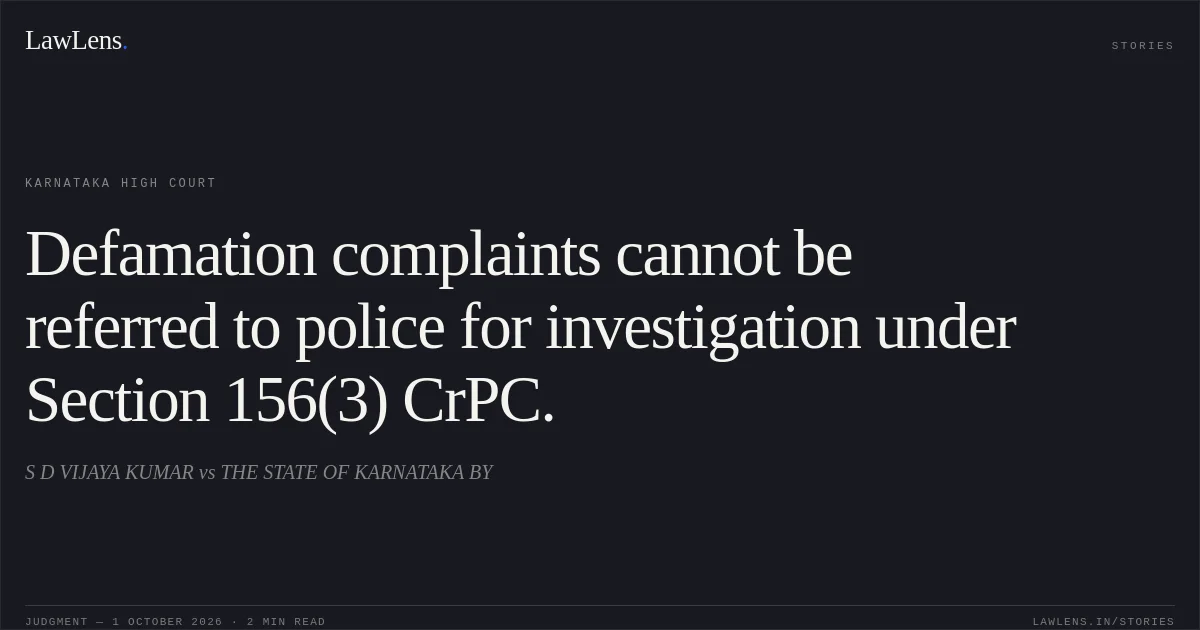
Source reference: p. 5, 8It held that, in a defamation complaint, the Magistrate should consider the complaint and, if proceeding, take cognizance and record the complainant’s sworn statement under Section 200 Cr.P.C., rather than refer the matter to police for investigation under Section 156(3) Cr.P.C.
Source reference: p. 8The Court also relied on Subramanian Swamy v. Union of India, (2016) 7 SCC 221, and Suresh v. Sub-Inspector of Police, (2019) 4 KLT 106, as well as its decision in Crl.P. No. 675/2020.
Source reference: p. 6–7Reasoning
The complaint alleged defamation through newspaper publications, but the Magistrate referred it to the police without first following the complaint procedure under Section 200 Cr.P.C.
Source reference: p. 7–8The police then investigated and filed a charge-sheet despite the nature of the offences alleged.
Source reference: p. 7–8The Magistrate’s later order merely recorded that the charge-sheet had been perused and took cognizance, without addressing whether its material disclosed a prima facie case against the petitioners.
Source reference: p. 8The Court treated these defects as fundamental and held that the referral and ensuing cognizance could not stand.
Source reference: p. 8–9Holding
The petition was allowed.
The order referring the complaint under Section 156(3) Cr.P.C. and the taking of cognizance on the investigation report in C.C. No. 449/2019 were quashed.
Source reference: p. 9The Magistrate was directed to resume proceedings from the stage of registration of the complaint and proceed in accordance with law.
Source reference: p. 9Acts & Sections Cited
8 provisions across 2 statutes referred to in this judgment. Each provision opens on LawLens.
Code of Criminal Procedure, 19734
Indian Penal Code, 18604
Original Court PDF
S D VIJAYA KUMARvsTHE STATE OF KARNATAKA BY
Click to open original judgment
Original judgment, available to read, download and summarize on LawLens.in