Facts
The Petitioner, a finance company, extended loans to the Respondent for vehicle purchases in 2008.
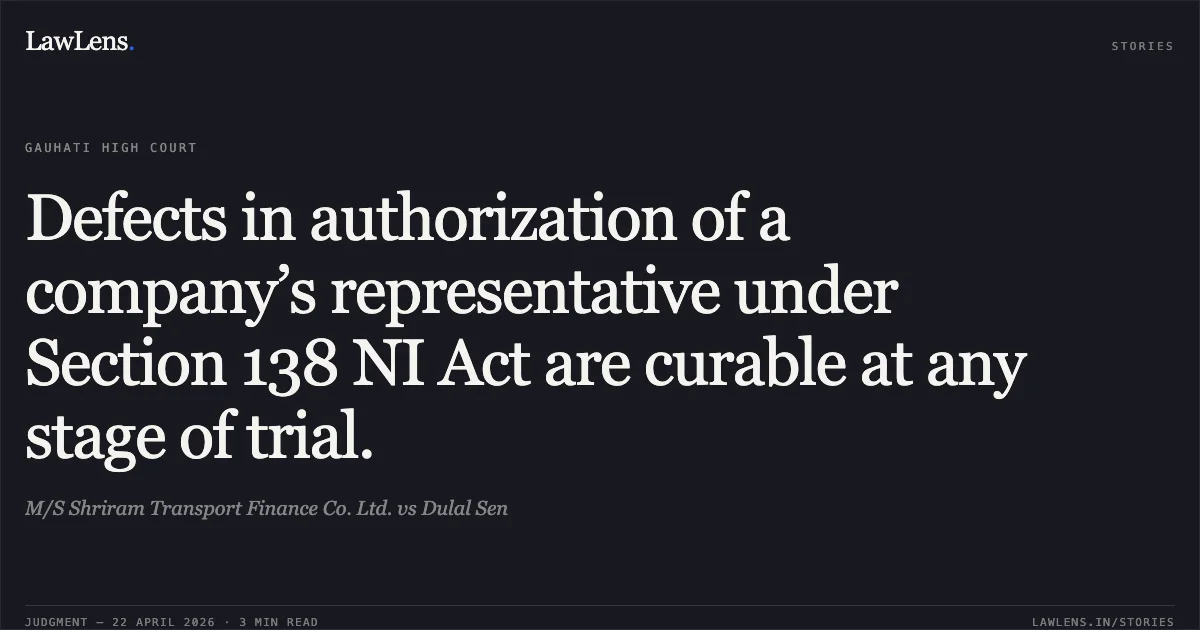
Source reference: p.2The Respondent defaulted and subsequently issued two cheques totaling Rs. 4,46,537, which were dishonoured for "Funds Insufficient" on 18.10.2010.
Source reference: p.3After serving a demand notice that went unheeded, the Petitioner, through its Area Recovery Manager, Sri Ashraful Hussain, filed a complaint under Section 138 of the Negotiable Instruments (NI) Act.
Source reference: p.3The Trial Court convicted the Respondent, sentencing him to 10 months of simple imprisonment and Rs. 6,00,000 in compensation.
Source reference: p.4On appeal, the Sessions Judge affirmed the findings on the merits of the offence but set aside the conviction on the technical ground that the complaint was not maintainable, as it was not filed by a person with a proved Board Resolution or proper authorization under Section 142(a) of the NI Act.
Source reference: p.4, 11The Petitioner challenged this reversal in the present revision.
Source reference: p.4Issues
1. Whether the complaint filed by a juristic person is maintainable if the initial authorization of the representing officer is not produced at the time of filing.
Source reference: p.82. Whether a defect in the authorization of the person representing the company can be rectified at a later stage of the proceedings.
Source reference: p.133. Whether the non-production of a specific Board Resolution authorizing the Company Secretary to issue a Power of Attorney (POA) vitiates the authority of the POA holder.
Source reference: p.11Law Applied
Section 138 (dishonour of cheque) and Section 142(a) (cognizance of offences) of the Negotiable Instruments Act, 1881.
Source reference: p.2, 4Section 305 of the CrPC regarding the representation of corporations.
Source reference: p.9Doctrine from MMTC Ltd. v. Medchl Chemicals and Pharma (P) Ltd., which established that a defect in authorization is a curable irregularity and does not bar cognizance if the complaint is in the name of the payee.
Source reference: p.13-14Principle from Associated Cement Co. Ltd. v. Keshvanand, which held that while a company is the de jure complainant, it can be represented by different de facto natural persons at different stages.
Source reference: p.14, 16Precedent in TRL Krosaki Refractories Ltd. v. SMS Asia Pvt. Ltd., affirming that an authorized employee with knowledge of the transaction can maintain the complaint.
Source reference: p.17-20Reasoning
The High Court found that the Appellate Court misdirected itself by ignoring settled law and evidence on record.
Source reference: p.13Although the initial filing officer, Ashraful Hussain, did not produce a formal authorization letter, he was an Area Recovery Manager conversant with the transaction, satisfying the requirements for setting the criminal law in motion.
Source reference: p.13, 20During the trial, the company substituted its representative with Sri Champak Kumar Talukdar (PW-1), who produced a valid Power of Attorney (Ext-1) executed by the Company Secretary.
Source reference: p.13The High Court held that under Section 142 of the NI Act, the "payee" (the company) is the complainant, and the identity of the natural person representing it can change.
Source reference: p.14, 19The Appellate Court's insistence on the production of the underlying Board Resolution—despite the POA's explicit recital of such authority—was deemed unnecessary since the Respondent failed to prove the document was non-genuine.
Source reference: p.11, 20Consequently, the initial defect, if any, was rectified during the trial, and the complaint remained maintainable.
Source reference: p.20Holding
The High Court allowed the revision petition and set aside the Appellate Court’s judgment regarding maintainability, affirming that the Respondent committed the offence under Section 138 of the NI Act.
The Trial Court’s conviction was restored; however, the Court modified the sentence by setting aside the term of imprisonment and ordered a consolidated compensation of Rs. 6,00,000 within four months, failing which the Respondent must undergo three months of simple imprisonment.
Source reference: p.21-22Acts & Sections Cited
10 provisions across 2 statutes referred to in this judgment. Each provision opens on LawLens.
Negotiable Instruments Act, 18813
Code of Criminal Procedure, 19737
Original Court PDF
M/S Shriram Transport Finance Co. Ltd.vsDulal Sen
Click to open original judgment
Original judgment, available to read, download and summarize on LawLens.in