Facts
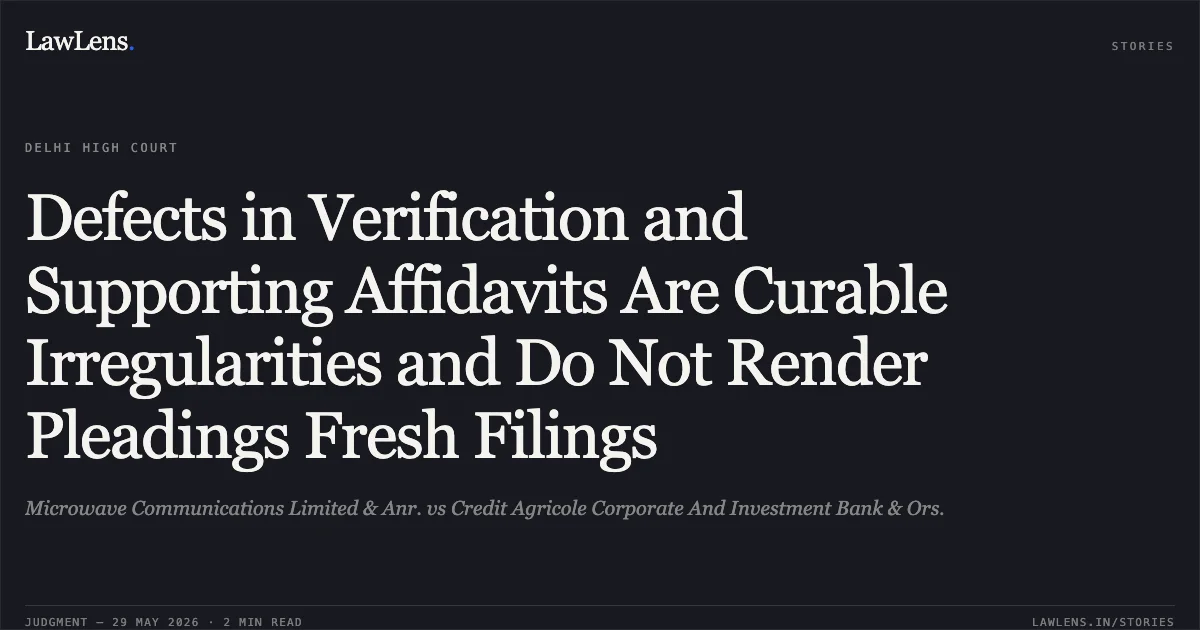
The Petitioners (Defendants 1 and 2 below) filed a joint Written Statement in March 2017 contesting a recovery action (O.A. No. 753 of 2016) initiated by Respondent No. 1
Source reference: para. 3While the pleading was filed on time, it contained procedural defects: the verification clause did not specify the authoree's name/capacity, and the supporting affidavit, though intended to be by Mr. Anil Kumar Jain, was mistakenly signed by Mr. B.B. Chugh
Source reference: para. 4In 2022, the Petitioners moved I.A. No. 400 of 2022 to rectify these defects without changing the contents or defenses of the Written Statement
Source reference: para. 5The Debt Recovery Tribunal (DRT) initially allowed the application but, after a remand from the Appellate Tribunal (DRAT), eventually dismissed it on 11.09.2025. The DRAT affirmed this dismissal on 27.01.2026, holding that rectification would be equivalent to filing a fresh Written Statement
Source reference: para. 6Issues
1. Whether the rectification of defects in the verification and supporting affidavit of a Written Statement already on record amounts to filing a fresh Written Statement.
Source reference: para. 92. Whether procedural technicalities regarding the signing and verification of pleadings can override substantive adjudication on merits under Order VI Rules 14 and 15 of the CPC.
Source reference: para. 14Law Applied
The Court applied Order VI Rules 14 and 15 of the Code of Civil Procedure (CPC) regarding the signing and verification of pleadings
Source reference: para. 14United Bank of India v. Naresh Kumar (1996), which established that procedural defects in signatures or verifications by corporate entities are curable and can be ratified expressly or impliedly
Source reference: para. 16Uday Shankar Triyar v. Ram Kalewar Prasad Singh (2006), which dictates that non-compliance with procedural requirements should not entail automatic dismissal of a claim as procedure is a "hand-maiden to justice" and should not be used to deny substantive rights
Source reference: para. 17Reasoning
The Court reasoned that the Written Statement had remained unchanged since 2017, and the Petitioners were not seeking to introduce new facts, withdraw admissions, or amend defenses under Order VI Rule 17
Source reference: paras. 11, 13The Court found that the DRT and DRAT erred by conflating substantive pleadings with the procedural act of authentication
Source reference: para. 19Since the respondent bank had contested the proceedings for years based on the existing Written Statement, no prejudice was caused by allowing the correction of an "inadvertent procedural lapse"
Source reference: para. 15The High Court emphasized that the trial court's role is to ensure justice is not defeated by technicalities, especially when the defect pertains only to the manner of execution and not the merits of the defense
Source reference: paras. 20-21Holding
The Court answered the issue in the negative, holding that rectification is not a substitution of the pleading
It set aside the orders of the DRAT (27.01.2026) and DRT (11.09.2025). The Petitioners were permitted to file duly executed verifications and affidavits within two weeks, strictly prohibited from altering or supplementing the contents of the original Written Statement. The writ petition was allowed with no order as to costs
Source reference: paras. 22-25Acts & Sections Cited
3 provisions across 1 statute referred to in this judgment. Each provision opens on LawLens.
Code of Civil Procedure, 19083
Original Court PDF
Microwave Communications Limited & Anr.vsCredit Agricole Corporate And Investment Bank & Ors.
Click to open original judgment
Original judgment, available to read, download and summarize on LawLens.in