Facts
The Bihar State Warehousing Corporation and its Managing Director challenged an arbitral award dated 7 August 2024, rendered in favour of M/s Pushpheera Infrastructure Pvt. Ltd., by filing an application under Section 34 of the Arbitration and Conciliation Act, 1996 (“Arbitration Act”) before the Principal District Judge-cum-Commercial Court, Patna, on 19 October 2024.
Source reference: paras. 1, 5(i)–(ii)The application was admittedly filed within the limitation period under Section 34(3).
Source reference: paras. 1, 5(i)–(ii)Upon scrutiny, a deficit court fee of Rs. 245 was reported.
Source reference: para. 5(iii)The Commercial Court granted successive dates for payment of the deficit fee—initially until 19 December 2024, then until 18 January 2025.
Source reference: para. 5(iii)–(iv)On 7 February 2025, the appellants deposited the deficit court fee, which was taken on record.
Source reference: para. 5(v)The respondent initially did not object to the extension of time or deposit of the deficit fee, raising the objection only during the admission hearing.
Source reference: paras. 5(vi)–(vii), 24The Commercial Court dismissed the Section 34 application as barred by limitation, holding that the deficit court fee had not been paid within the three-month period plus the further thirty-day period under Section 34(3), and that Section 149 CPC could not be invoked thereafter.
Source reference: para. 6Issues
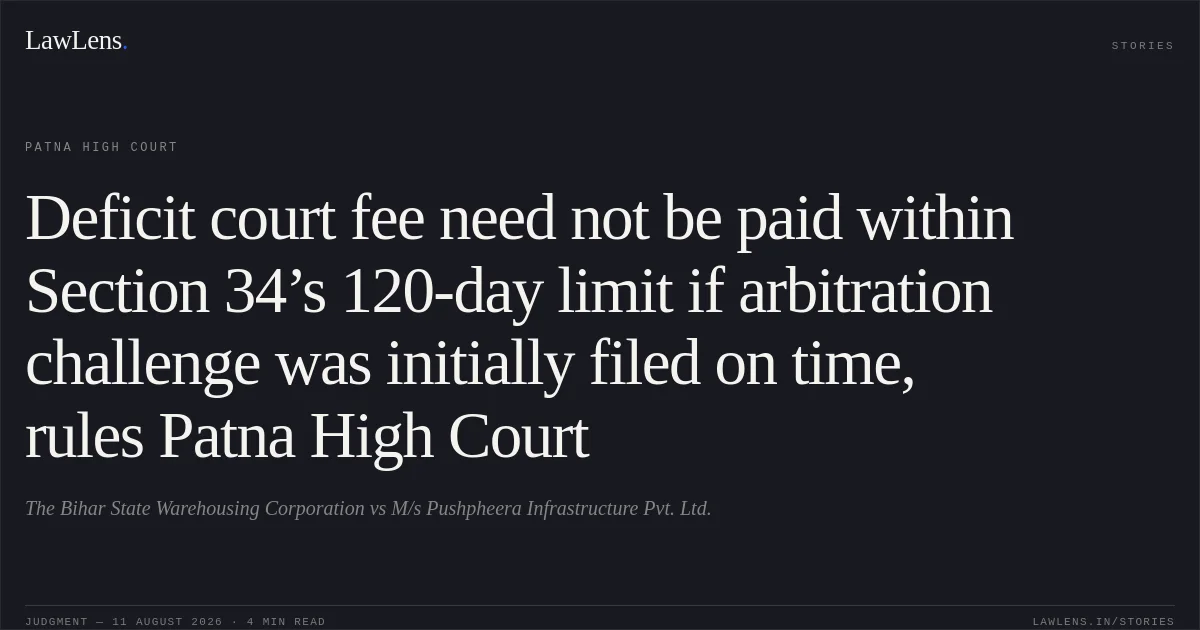
Whether an application under Section 34 of the Arbitration Act, initially presented within the statutory limitation period but accompanied by a deficit court fee, becomes time-barred merely because the deficit fee is paid after expiry of the period under Section 34(3)?
Source reference: paras. 23–24, 35Whether the court can exercise its power under Section 149 CPC to permit payment of deficit court fee after expiry of the three-month period and the further thirty-day period prescribed under Section 34(3) of the Arbitration Act?
Source reference: paras. 27–29, 34–36Whether the Commercial Court erred in dismissing the Section 34 application without examining the merits of the challenge to the arbitral award?
Source reference: paras. 45–47Law Applied
The Court applied Section 34(3) of the Arbitration and Conciliation Act, 1996, holding that its strict limitation period, including the proviso permitting a further thirty days but “not thereafter,” governs the initial filing of an application for setting aside an arbitral award.
Source reference: paras. 20–22It relied on Union of India v. Popular Construction Co., (2001) 8 SCC 470, Ramjee Power Construction Ltd. v. Jharkhand Urja Vikas Nigam Ltd., decided on 19 September 2018, and Simplex Infrastructure Ltd. v. Union of India, (2019) 2 SCC 455, for the rule that delay in the initial filing beyond the statutory outer limit cannot be condoned.
Source reference: paras. 20–22Section 149 CPC empowers a court, in its discretion and “at any stage,” to permit payment of deficient court fee, upon which the document has the same force and effect as if the fee had been paid initially.
Source reference: paras. 27, 34Section 19 of the Arbitration Act excludes the CPC only in proceedings before the arbitral tribunal, not in court proceedings under Section 34.
Source reference: paras. 26, 28Relying on Mannan Lal v. Chhotaka Bibi, (1970) 1 SCC 769, Sri Rathnavarmaraja v. Smt. Vimla, AIR 1961 SC 1299, and Northern Railway v. M/s Pioneer Publicity Corporation Pvt. Ltd., (2017) 11 SCC 234, the Court held that a duly presented proceeding remains pending from the date of initial presentation and that Section 34(3) does not prescribe a separate limitation period for curing a deficit court-fee defect.
Source reference: paras. 29–36, 45Reasoning
The Court treated the appellants’ filing on 19 October 2024 as the relevant initial presentation and noted that it was admittedly within the period prescribed by Section 34(3).
Source reference: paras. 5(i)–(ii), 24The deficit of Rs. 245 was a curable court-fee defect, not a delayed initial filing.
Source reference: paras. 24, 34The Commercial Court itself repeatedly granted time for payment and ultimately accepted the deficit fee on 7 February 2025.
Source reference: paras. 24, 34Since Section 149 CPC operates in a distinct field from Section 34(3), permitting the court to cure a court-fee deficiency does not extend the statutory limitation for filing the Section 34 application.
Source reference: paras. 35–36The words “but not thereafter” in Section 34(3) restrict only the time for presenting the application, and cannot be interpreted as impliedly repealing or restricting Section 149 CPC.
Source reference: para. 35The Court also considered it significant that the respondent raised no objection when the Commercial Court granted time or when the deficit fee was deposited, and raised the objection only at a later stage.
Source reference: paras. 24, 45The contrary authorities of the Madras High Court were distinguished because they did not adequately consider Section 149 CPC and the applicable court-fee principles.
Source reference: paras. 37–41Holding
The Court held that the Section 34 application was initially filed within limitation and that the subsequent payment of the deficit court fee did not render it time-barred.
Section 34(3) does not prescribe a limitation period for curing a deficit court-fee defect, and the Commercial Court was competent to permit such payment under Section 149 CPC.
Source reference: paras. 34–36, 45The impugned order dated 2 April 2026 was set aside, and the matter was remitted to the Principal District Judge-cum-Commercial Court, Patna, for consideration of the Section 34 application on merits, preferably within three months from receipt or production of the judgment.
Source reference: paras. 46–48Acts & Sections Cited
14 provisions across 4 statutes referred to in this judgment. Each provision opens on LawLens.
Arbitration and Conciliation Act, 19966
Code of Civil Procedure, 19082
Court-Fees Act, 18704
Limitation Act, 19632
Original Court PDF
The Bihar State Warehousing CorporationvsM/s Pushpheera Infrastructure Pvt. Ltd.
Click to open original judgment
Original judgment, available to read, download and summarize on LawLens.in