Facts
The respondents’ lands in Silgur-II, Nunsuri, Bindasora, Tablabagh, Malsury and Devasora villages of Lunglei District were acquired for construction of the Indo-Bangladesh border fencing for the benefit of the appellant, Engineering Projects India Ltd.
Source reference: para. 2A notification under Section 4 of the Land Acquisition Act, 1894 was issued on 06.11.2006, and the Collector prepared Draft Award No. 1/2009 determining compensation. The award was approved by the Government of Mizoram on 08.05.2009 under the first proviso to Section 11(1) of the 1894 Act and forwarded to the acquiring agency for payment.
Source reference: para. 3As the compensation and statutory benefits remained unpaid, the landowners pursued reference proceedings. Those proceedings were ultimately dismissed after remand on the ground that the Reference Court lacked authority to determine the dispute.
Source reference: para. 4The respondents thereafter filed WP(C) No. 87/2018 seeking payment of the awarded compensation, solatium and statutory interest under Sections 23(1A), 23(2), 28 and 34 of the Land Acquisition Act, 1894.
Source reference: para. 5The learned Single Judge directed the Deputy Commissioner to calculate and forward the statutory benefits for release of the compensation.
Source reference: paras. 8–12Issues
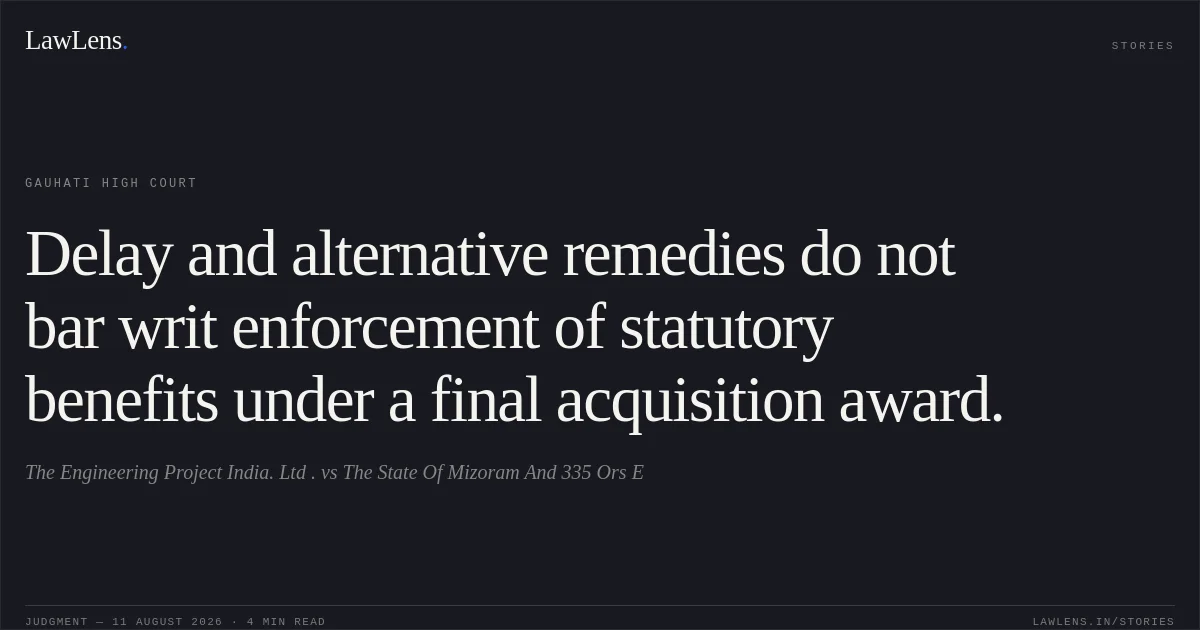
Whether a writ petition under Article 226 is maintainable for enforcement of compensation and statutory benefits under a final land-acquisition award, despite delay and the availability of an execution remedy?
Source reference: paras. 16, 22–27Whether the acquiring agency or beneficiary can collaterally challenge the legality, correctness or procedural validity of a land-acquisition award while resisting payment of the compensation and statutory benefits flowing from it?
Source reference: paras. 18–21, 28Whether statutory interest and other benefits can be denied or restricted solely on the ground of delay attributable to the landowners in approaching the Court?
Source reference: paras. 29–30Law Applied
The Court applied the Land Acquisition Act, 1894, particularly Sections 11(1), 23(1A), 23(2), 28 and 34, holding that a duly approved and unchallenged award creates an enforceable obligation to pay the determined compensation together with its statutory incidents, including solatium and applicable interest.
Source reference: paras. 18, 23–24It applied Article 226 of the Constitution, reiterating that the existence of an alternative remedy is not an inflexible bar where an undisputed statutory obligation is sought to be enforced.
Source reference: paras. 26–27Article 300A was relied upon to hold that lawful deprivation of property carries a corresponding obligation to pay lawful compensation and statutory benefits.
Source reference: para. 25The Court distinguished the principles on delay and laches in State of M.P. v. Nandlal Jaiswal, (1986) 4 SCC 566, and Chennai Metropolitan Water Supply & Sewerage Board v. T.T. Murali Babu, (2014) 4 SCC 108, because the present claim concerned a continuing failure to discharge a statutory liability.
Source reference: para. 22It also relied on Union of India v. Pushpavathi, (2018) 3 SCC 28, Santosh Kumar v. Central Warehousing Corporation, (1986) 2 SCC 343, Young Lai Association v. State of Mizoram, 2017 (3) GLT 382, Vidya Devi v. State of Himachal Pradesh, (2020) 2 SCC 569, and Ultra-Tech Cement Ltd. v. Mast Ram, (2025) 1 SCC 798.
Source reference: paras. 6, 15, 25, 27Although interest may, in an appropriate case, be regulated for a period attributable solely to the claimant’s conduct, such consideration does not extinguish the substantive statutory entitlement.
Source reference: para. 30Reasoning
The Court held that Award No. 1/2009 had received the requisite Government approval, had attained finality, and had never been challenged by the appellant before a competent forum.
Source reference: paras. 18–19The respondents did not seek enhancement of compensation or question the acquisition; they sought only enforcement of the compensation and statutory benefits already attached to the final award.
Source reference: paras. 13–14, 23Consequently, the appellant could not accept the acquisition and selectively resist the statutory liabilities arising from the same award.
Source reference: para. 21The alleged lack of knowledge was rejected because the acquisition was undertaken for the appellant’s benefit, the award required governmental approval, and no contemporaneous material or subsequent legal challenge supported the assertion.
Source reference: para. 20The delay did not defeat the claim because non-payment of statutory compensation and benefits constituted a continuing cause of action, and mere lapse of time could not extinguish a statutory liability in the absence of a statutory limitation period.
Source reference: paras. 22–24The alternative execution remedy likewise did not bar writ relief where the entitlement was based on an undisputed final statutory award rather than disputed private rights.
Source reference: paras. 26–27Allegations of excess acquisition or procedural irregularities were held to be impermissible collateral challenges that ought to have been raised in proceedings directly assailing the award.
Source reference: para. 28Any issue concerning computation of interest for a period specifically attributable to the landowners could be considered during implementation, but it did not justify interference with the Single Judge’s order.
Source reference: para. 30Holding
The Division Bench answered the issues against the appellant.
It held that the respondents were entitled to enforcement of the final Land Acquisition Award No. 1/2009, including the compensation, admissible solatium and statutory interest.
Source reference: paras. 31–32Delay, availability of an execution remedy, alleged lack of knowledge, and collateral objections to the award did not justify refusal of writ relief.
Source reference: paras. 31–32Finding no legal or factual error in the Single Judge’s judgment, the Court dismissed the writ appeal and directed that the parties bear their own costs.
Source reference: para. 32Acts & Sections Cited
5 provisions across 1 statute referred to in this judgment. Linked provisions open on LawLens.
Land Acquisition Act, 18945
Original Court PDF
The Engineering Project India. Ltd .vsThe State Of Mizoram And 335 Ors E
Click to open original judgment
Original judgment, available to read, download and summarize on LawLens.in