Facts
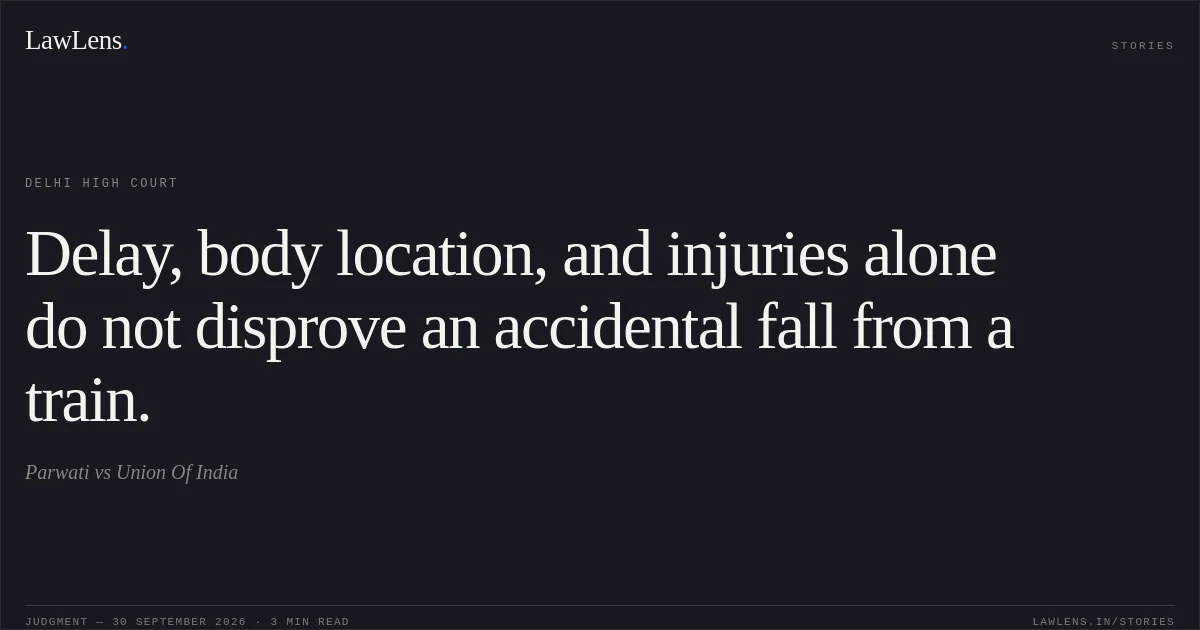
The appellant sought compensation for the death of her son, Pritam Singh, who was travelling from Mahbubabad to New Delhi on the Andaman Express on 8 September 2019. His body was found near Faridabad at about 4:30 a.m. on 10 September 2019, and a valid railway ticket was recovered and verified.
Source reference: pp. 1–2, paras. 1–3The Railway Claims Tribunal dismissed the claim, reasoning principally that the body was discovered about seven hours after the train left Faridabad, that other trains had passed in the meantime, and that the body’s location and injuries suggested a subsequent run-over.
Source reference: pp. 3–4, paras. 5–6, 8–9The appellant appealed under Section 23 of the Railway Claims Tribunal Act, 1987.
Source reference: p. 1, para. 1Issues
1. Whether the deceased’s death resulted from an accidental fall from the train and therefore constituted an “untoward incident” under Section 123(c)(2) of the Railways Act, 1989.
Source reference: p. 2, para. 32. Whether the delay in discovery of the body, its location, and the nature of the injuries established that the deceased had alighted at Faridabad and was subsequently run over.
Source reference: pp. 3–5, paras. 6–10Law Applied
Section 123(c)(2) of the Railways Act, 1989 defines an “untoward incident” to include an accidental falling of a passenger from a train; Section 124-A provides for compensation on a strict-liability basis, subject to the statutory exceptions.
Source reference: p. 5, para. 11The applicable evidentiary standard is preponderance of probabilities.
Source reference: p. 5, para. 11In Union of India v. Prabhakaran Vijaya Kumar, (2008) 9 SCC 527, the Supreme Court emphasized that the beneficial nature of the statutory scheme must inform the consideration of claims for untoward incidents.
Source reference: p. 5, para. 11The Court also relied on Surendra Prasad Verma v. Union of India, Maya Devi v. Union of India, and Moola Ram v. Union of India; in particular, Surendra Prasad Verma held that delay in discovering a body is not, by itself, sufficient to reject an accidental-fall claim, while Maya Devi recognized that the body’s eventual location does not alone rule out a fall from a train.
Source reference: pp. 3–4, paras. 4, 7–8Reasoning
The deceased’s bona fide passenger status was undisputed, but the Tribunal’s circumstantial reasons did not establish the respondent’s alternative theory of a subsequent run-over.
Source reference: p. 3, para. 7The time the body was found did not establish the time of death or injury, and no driver or guard of the trains said to have passed was examined; nor was any particular train identified as having run over the deceased.
Source reference: p. 3, para. 7The body’s eventual location did not, without further evidence, prove that the deceased could not have fallen from the Andaman Express, and no medical opinion established that the recorded injuries were incompatible with such a fall.
Source reference: pp. 4–5, paras. 8–9There was also no evidence that the deceased had alighted at Faridabad, or that a later train had run him over.
Source reference: p. 5, para. 10Applying the preponderance standard and the beneficial statutory scheme, the Court held that the uncertainty about the precise sequence of events did not justify rejecting the claim.
Source reference: p. 5, para. 11Holding
The Court set aside the Tribunal’s judgment and allowed the appeal, holding that the evidence did not justify rejecting the claim on the basis of the delay, location of the body, or injuries.
It remanded the matter to the Tribunal to assess the compensation payable and directed that the authorities disburse it within two months of receiving the order; the matter was to be listed before the Tribunal on 30 October 2026.
Source reference: pp. 5–6, para. 12Acts & Sections Cited
2 provisions across 2 statutes referred to in this judgment. Each provision opens on LawLens.
Railway Claims Tribunal Act, 19871
Railways Act, 19891
Original Court PDF
ParwativsUnion Of India
Click to open original judgment
Original judgment, available to read, download and summarize on LawLens.in