Facts
The petitioner, an employee of the State of Madhya Pradesh, sought the benefit of the second time scale of pay effective from 31.07.2007
Source reference: para 1Although the benefit was eventually granted from 01.01.2012, the Departemental Promotion Committee (DPC) had initially denied it from the 2007 date due to an adverse Annual Confidential Report (ACR) for the year 2006
Source reference: paras 2, 5The petitioner contended that as per a government circular dated 29.11.1984, adverse ACRs not communicated within three months become "non-est" and cannot be used to deny benefits
Source reference: para 2Procedurally, the petitioner had challenged the adverse ACR through a representation and a subsequent review, both of which were rejected in 2008 and 2015 respectively, but he did not challenge those rejection orders in the present writ petition
Source reference: paras 2, 7Issues
1. Whether an adverse ACR communicated beyond the prescribed three-month limit is legally void if the employee has already exhausted administrative remedies against it without success.
Source reference: para 5/72. Whether the petitioner is entitled to the second time scale of pay effective from 31.07.2007 despite having an adverse ACR that attained finality.
Source reference: para 7/8Law Applied
the State Government Circular dated 29.11.1984, which mandates the communication of adverse ACRs within three months
Source reference: para 5Jagat Narayan Tiwari v. State of MP (1988 MPLJ 745), which established that uncommunicated or inordinately delayed adverse entries lose efficacy and should be ignored during promotion or grade-scale considerations
Source reference: para 6principle of "finality of administrative orders," noting that once an ACR is challenged and the challenge is rejected, the entry attains finality unless specifically set aside by a competent court
Source reference: para 7/8Reasoning
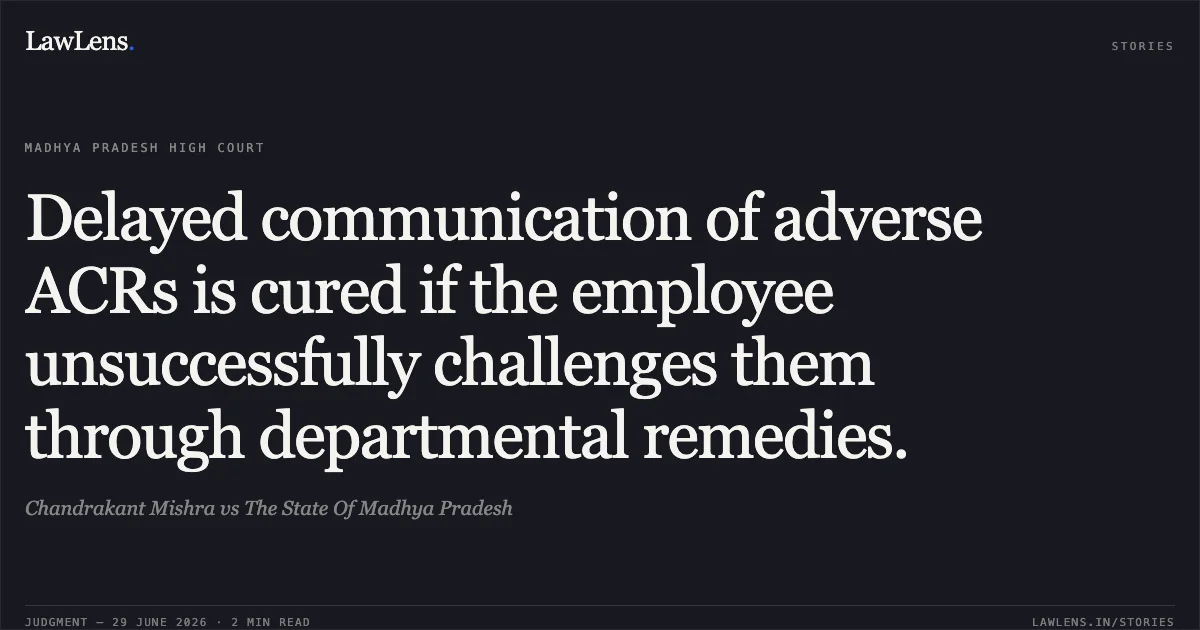
The court distinguished the present case from Jagat Narayan Tiwari. While the 1984 circular suggests that delayed ACRs have no effect, the court reasoned that the petitioner had actually received the communication (albeit late) and actively exercised his right to represent and review against it
Source reference: para 8Because the petitioner's representation was rejected in 2008 and his review was rejected in 2015—and notably, because he did not challenge these specific rejection orders in the current petition—the adverse ACR for 2006 remained valid and "final"
Source reference: para 7Since the criteria for granting a time scale of pay are identical to those for promotion (requiring a review of the previous 5 years of ACRs), the DPC was justified in finding the petitioner ineligible in 2007 due to the adverse entry
Source reference: paras 3, 5Holding
The court answered the issues in the negative, holding that the petitioner could not claim the benefit from 2007 because the adverse ACR had attained finality through the rejection of his administrative appeals
In the absence of a direct challenge to the orders rejecting his representations against the ACR, no relief could be granted. The petition was dismissed as being without merit
Source reference: para 7/10Original Court PDF
Chandrakant MishravsThe State Of Madhya Pradesh
Click to open original judgment
Original judgment, available to read, download and summarize on LawLens.in