Facts
On 23 July 2019, Harvesh @ Harvesh Kumar was allegedly travelling from New Delhi to Ludhiana Junction by a superfast passenger train on railway ticket No. UAB-90628860. It was alleged that, owing to heavy rush and a sudden jerk, he accidentally fell from the moving train and sustained fatal injuries. His body was subsequently found beside the railway track near Km. No. 348/13–15 between Chawapayal and Doraha, and a post-mortem examination was conducted at Civil Hospital, Khanna.
Source reference: p. 1–2, paras. 1–2, 8The Railway Claims Tribunal dismissed the claim application, holding that the appellants had failed to prove that the deceased was a bona fide passenger or that his death resulted from an “untoward incident” under Sections 123(c) and 124-A of the Railways Act, 1989. The appellants challenged that decision under Section 23 of the Railway Claims Tribunal Act, 1987, contending that the journey ticket had been recovered from the deceased during jamatalashi and verified from Railway records. They also relied on the post-mortem report, which noted black greasy material on the injuries, described by the doctor as characteristic of a railway accident. The Union of India disputed the deceased’s bona fide passenger status and argued that the delayed discovery of the body and the absence of an eyewitness rendered the alleged accidental fall doubtful.
Source reference: p. 2–3, paras. 3–5Issues
Whether the deceased was a bona fide passenger holding a valid railway ticket for the relevant journey.
Source reference: p. 3–4, paras. 6–7Whether the deceased’s death resulted from an “untoward incident” within the meaning of Sections 123(c) and 124-A of the Railways Act, 1989.
Source reference: p. 4–5, paras. 8–11Whether the Tribunal was justified in dismissing the claim application on the grounds of the alleged discrepancy in the recovery records, delayed discovery of the body, absence of eyewitnesses, and passage of other trains.
Source reference: p. 3–5, paras. 7–10Law Applied
The Court considered the appellate jurisdiction under Section 23 of the Railway Claims Tribunal Act, 1987, and applied Sections 123(c) and 124-A of the Railways Act, 1989, under which an accidental fall from a train may constitute an “untoward incident” attracting the Railways’ statutory no-fault liability, subject to the statutory exceptions.
Source reference: p. 1, para. 1; p. 4–5, paras. 8–11Relying on Union of India v. Rina Devi, (2019) 3 SCC 572, and Lata v. Union of India, 2026 SCC OnLine SC 1350, the Court held that bona fide passenger status may be established through reliable evidence of a valid railway ticket, including a ticket recovered from the deceased and independently verified by Railway records.
Source reference: p. 3–4, para. 6Under Sh. Surendra Prasad Verma v. Union of India, 2014 SCC OnLine Del 2917, mere delay in discovering or recovering a body is not by itself determinative against a claim of accidental fall, particularly absent cogent contrary evidence.
Source reference: p. 4–5, para. 9Union of India v. Prabhakaran Vijaya Kumar, (2008) 9 SCC 527, was applied for the principle that the expression “untoward incident” must be construed in the context of the beneficial statutory scheme and that Section 124-A imposes statutory no-fault liability, subject to its exceptions.
Source reference: p. 5, para. 11Reasoning
The Court found that the deceased’s bona fide passenger status was established because the Fard-Jamatalashi expressly recorded recovery of ticket No. UAB-90628860 from his person, and the ticket particulars were subsequently verified in the Railway records as a ticket issued from New Delhi to Ludhiana for one adult passenger for 23 July 2019.
Source reference: p. 3–4, para. 6The discrepancy in the Rapat-Roznamcha, which recorded an alleged communication regarding non-recovery of the ticket, could not override the contemporaneous physical-search record and subsequent Railway verification.
Source reference: p. 3–4, para. 7As to the occurrence, the body was found beside the railway track at the relevant railway section, and the post-mortem report recorded injuries smeared with black greasy material, which the doctor associated with a railway accident, with head injury stated as the cause of death.
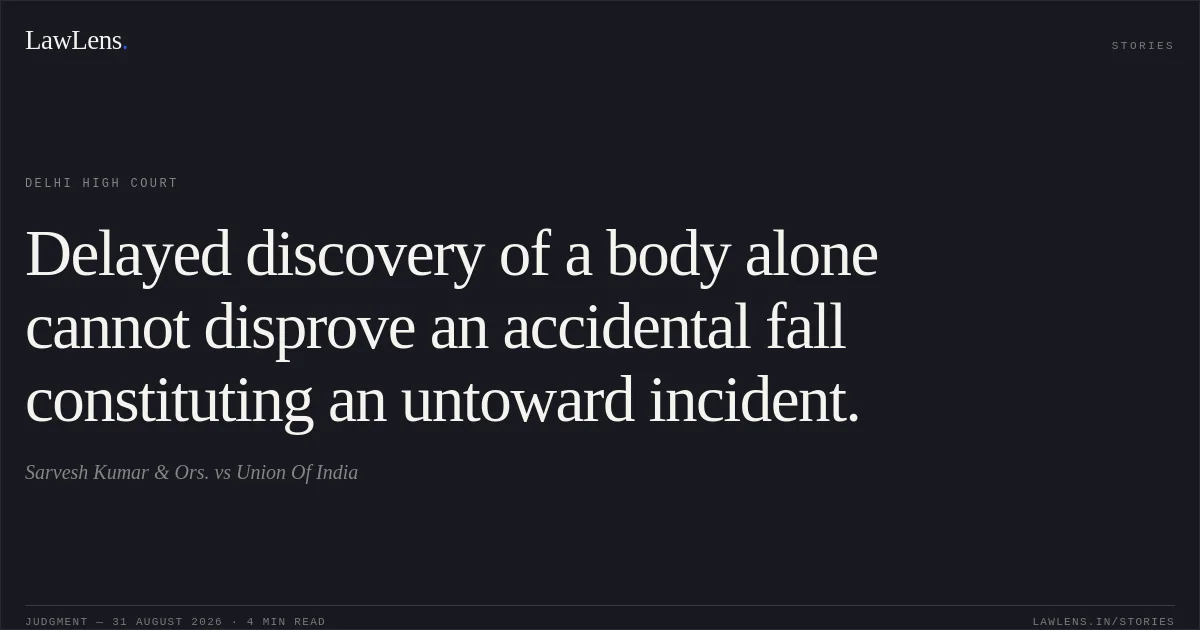
Source reference: p. 4, para. 8The delayed discovery of the body and the fact that other trains passed through the section created, at most, uncertainty; they did not positively establish that the deceased was run over by another train or disprove a fall from the train.
Source reference: p. 4–5, para. 9The absence of an eyewitness was not fatal, particularly since neither the DRM enquiry nor the post-mortem report supplied cogent evidence inconsistent with an accidental fall. On a cumulative assessment and applying the standard of preponderance of probabilities, the Court held that the deceased was a bona fide passenger and that his death was attributable to an untoward incident.
Source reference: p. 5, paras. 10–11Holding
The Court allowed the appeal, set aside the Tribunal’s judgment dated 16 May 2023, and held that the evidence sufficiently established both the deceased’s bona fide passenger status and the occurrence of an untoward incident under the Railways Act, 1989.
The matter was remanded to the Tribunal to assess the compensation payable in accordance with law and to direct its disbursement within two months of receipt of the High Court’s order. The matter was directed to be listed before the Tribunal on 18 September 2026.
Source reference: p. 5–6, paras. 12–14Acts & Sections Cited
2 provisions across 2 statutes referred to in this judgment. Each provision opens on LawLens.
Railway Claims Tribunal Act, 19871
Railways Act, 19891
Original Court PDF
Sarvesh Kumar & Ors.vsUnion Of India
Click to open original judgment
Original judgment, available to read, download and summarize on LawLens.in