Facts
On 24.06.2019, Jagveer @ Jagbeer purchased a railway journey ticket from Bijwasan to Jataula and was allegedly travelling by train during the intervening night of 24/25.06.2019. The appellants alleged that he fell from the train near Tajnagar Railway Halt due to a sudden jerk or jolt and died from the resulting injuries.
Source reference: p.2His journey ticket, bearing No. UAC-39161344, was recovered from his person and its recovery was also reflected in the respondent’s written statement and the DRM report.
Source reference: p.3; para. 7The deceased’s body was noticed by a Gangman at approximately 06:15 hours on 25.06.2019.
Source reference: p.3; para. 9The Railway Claims Tribunal dismissed the compensation claim, reasoning that the ticket had been purchased at 12:38 hours, was valid for three hours, and that the deceased would likely have completed his journey by approximately 16:40 hours on 24.06.2019.
Source reference: p.2; para. 3The appellants challenged that decision under Section 23 of the Railway Claims Tribunal Act, 1987.
Source reference: p.1; para. 1Issues
1. Whether the deceased was proved to be a bona fide passenger for the purpose of claiming railway compensation?
Source reference: p.3; paras. 7–82. Whether the circumstances established that the deceased’s death resulted from an “untoward incident”, notwithstanding the absence of eyewitness evidence and the delayed discovery of the body?
Source reference: p.4; paras. 9–12Law Applied
The Court applied Section 23 of the Railway Claims Tribunal Act, 1987, governing appeals against orders of the Railway Claims Tribunal.
Source reference: p.1; para. 1It considered the statutory concept of an “untoward incident” under the Railways Act, 1989 and the beneficial nature of railway compensation legislation.
Source reference: p.4; paras. 9–12The Court held that possession of a journey ticket recovered from the deceased, corroborated by railway records, constituted cogent material establishing bona fide passenger status; the precise train or timing of travel need not necessarily be established where the ticket itself was recovered from the deceased.
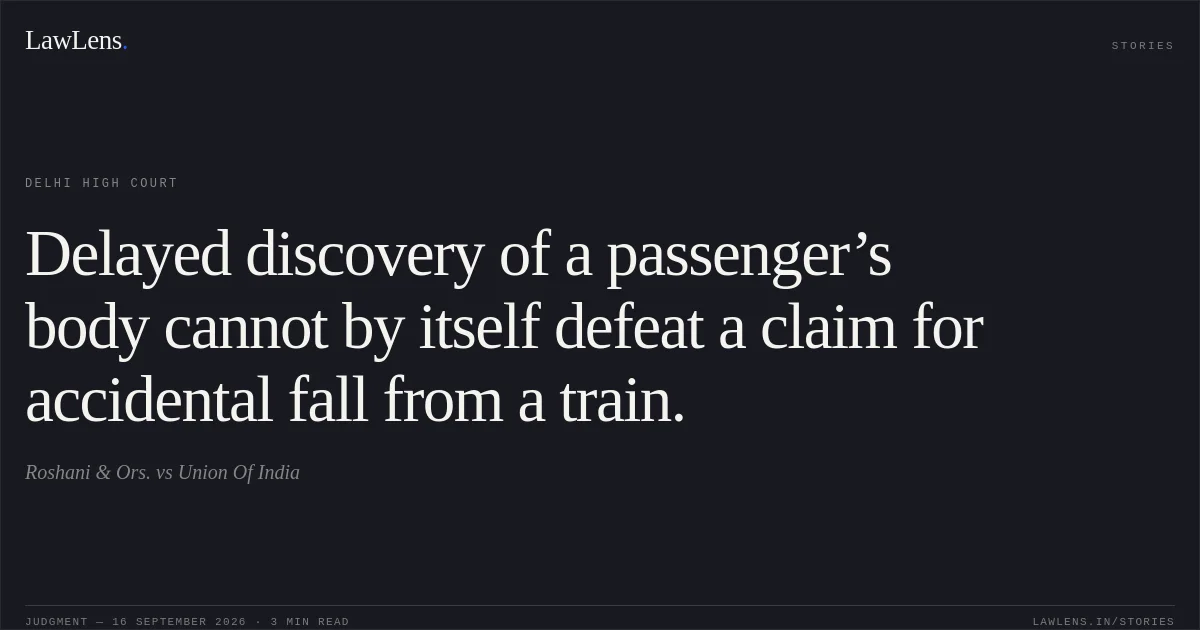
Source reference: p.3; para. 8Relying on Sh. Surendra Prasad Verma & Anr. v. Union of India , 2014 SCC OnLine Del 2917, the Court held that delayed discovery of a body, by itself, is insufficient to reject a claim based on an accidental fall from a train.
Source reference: p.4; para. 10Reasoning
The Court distinguished the deceased’s status as a bona fide passenger from the separate question of the precise circumstances of his fall. The recovered ticket was issued for the relevant route and had been verified in the DRM proceedings; therefore, the absence of proof identifying the exact train did not negate bona fide passenger status.
Source reference: p.3; paras. 7–8The Tribunal’s calculation that the journey would have ended by 16:40 hours was treated as an assumption rather than evidence establishing when the deceased fell or proving that the body was present and visible at that time.
Source reference: p.4; para. 9Similarly, the fact that the Gangman discovered the body only at 06:15 hours did not establish that it must necessarily have been noticed earlier.
Source reference: p.4; para. 10The statements of the driver and guard that they had not seen anyone fall from Train No. 54413 merely failed to establish a fall from that particular train; they did not disprove a fall from any train.
Source reference: p.4; para. 11In the absence of positive material indicating suicide, trespass, or another cause of death, and keeping in view the beneficial character of the legislation, the claim could not be rejected on the basis of speculative assumptions or minor discrepancies.
Source reference: p.5; paras. 11–12Holding
The Court answered both issues in favour of the appellants. It held that the deceased was a bona fide passenger and that the available circumstances were sufficient to prevent rejection of the claim on the ground that the accidental fall had not been proved by direct evidence.
The Tribunal’s judgment dated 24.03.2021 was set aside, and the matter was remanded to the Tribunal to assess the compensation payable in accordance with law and direct its disbursement within two months of receiving the order.
Source reference: p.5; para. 13The appeal was accordingly allowed and disposed of, with the matter directed to be listed before the Tribunal on 12.10.2026.
Source reference: p.5; paras. 13–15Acts & Sections Cited
1 provisions across 1 statute referred to in this judgment. Each provision opens on LawLens.
Railway Claims Tribunal Act, 19871
Original Court PDF
Roshani & Ors.vsUnion Of India
Click to open original judgment
Original judgment, available to read, download and summarize on LawLens.in