01Facts
The petitioner, an NBFC registered in Kerala, held a Certificate of Registration (CoR) issued by the Reserve Bank of India.
pp. 2–3 · ¶ 2–8, 11Following a show-cause notice issued by the RBI’s Thiruvananthapuram Regional Office, the CoR was cancelled by a Designated Authority in Mumbai on 11 September 2025.
pp. 2–3 · ¶ 2–8, 11The petitioner challenged the cancellation before the Kerala High Court, which stayed its operation; that petition was later disposed of after the petitioner pursued a statutory appeal.
pp. 2–3 · ¶ 2–8, 11The Appellate Authority, situated in Delhi, dismissed the appeal on 8 June 2026.
pp. 2–3 · ¶ 2–8, 11The petitioner then challenged both the cancellation and appellate orders before the Delhi High Court. The respondents objected that Delhi was not the appropriate forum under the doctrine of forum non conveniens.
pp. 2–3, 5–6 · ¶ 2–8, 1102Issues
i.1. Whether the Delhi High Court should decline to exercise its writ jurisdiction on the ground that it was not the forum conveniens, notwithstanding that the Appellate Authority and the appellate order were situated in Delhi.
pp. 3, 7–9 · ¶ 8, 15–21ii.2. Whether the petitioner’s substantive dispute and the material facts underlying the cancellation arose predominantly outside Delhi, such that the Delhi High Court should leave the petitioner to pursue relief before the appropriate High Court.
pp. 6–9 · ¶ 13–2203Law Applied
Article 226 permits a High Court to entertain a writ petition where the respondent’s office is situated within its territory or where the cause of action, wholly or in part, arises there; however, territorial jurisdiction does not by itself compel the Court to decide the matter on merits.
p. 7 · ¶ 17Under Kusum Ingots & Alloys Ltd. v. Union of India, even where a small part of the cause of action arises within a High Court’s territory, the Court may decline to exercise its discretionary jurisdiction by applying forum non conveniens.
p. 7 · ¶ 17The Court also considered Bakshi Ahmad v. Union of India, which cautions against misapplying forum non conveniens in Article 226 cases, particularly where jurisdiction is invoked by reference to Article 226(1); it distinguished that decision as involving statutory provisions specific to the service of a BSF member.
pp. 4–6 · ¶ 9–10, 13It further relied on ET Devassy and Sons Finance Private Limited v. Union of India & Ors. and John David Kusmode v. Union of India concerning the insufficiency of the appellate authority’s location, by itself, to make Delhi the convenient forum.
p. 6, 8 · ¶ 12, 18Provisions in the judgment · 3 · Linked ones open on LawLens
Reserve Bank of India Act, 1934 Section 58
04Reasoning
The Court treated the appellate authority’s location and the making of the appellate order in Delhi as part of the cause of action, but not as decisive of which forum was convenient for adjudicating the substantive dispute.
p. 7 · ¶ 16The CoR had been granted by the RBI’s Thiruvananthapuram office; the petitioner was registered in Kerala; the inspection and show-cause process concerned its affairs in Kerala; and the cancellation order was made in Mumbai.
pp. 5–6 · ¶ 11, 13–14The petitioner had also initially challenged that cancellation before the Kerala High Court.
pp. 5–6 · ¶ 11, 13–14In these circumstances, the material facts and core dispute were rooted outside Delhi.
pp. 6–9 · ¶ 13, 16–21The Court therefore held that the appellate authority’s presence in Delhi did not outweigh the connection of the substantive dispute to Kerala, and distinguished Bakshi Ahmad on its facts and statutory context.
pp. 6–9 · ¶ 13, 16–2105Holding
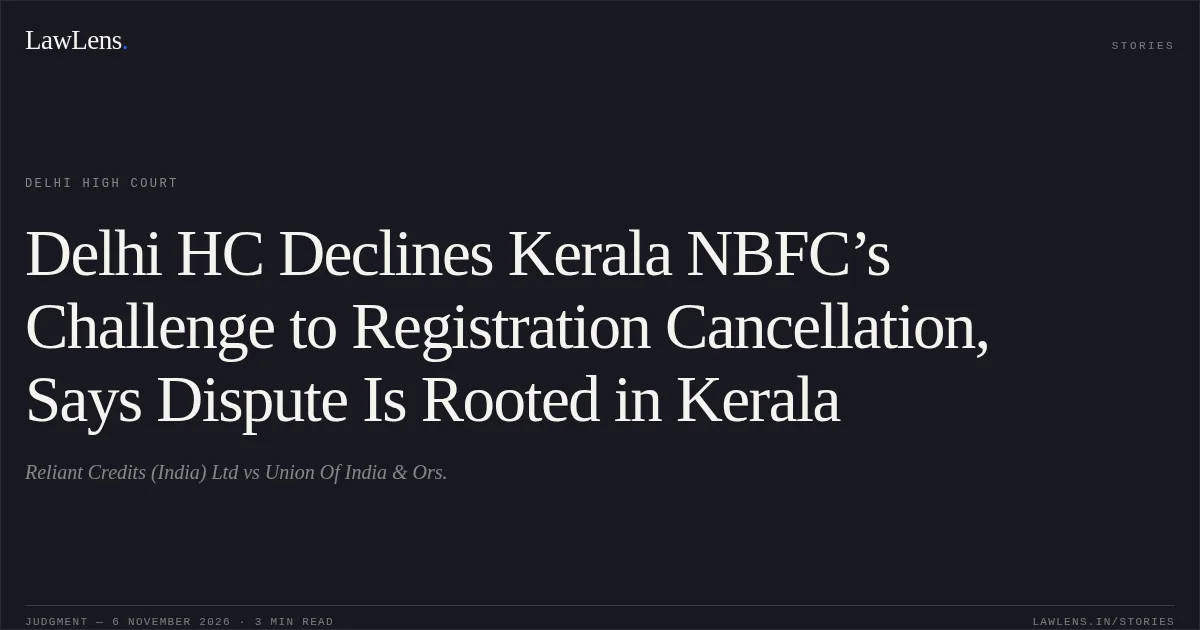
The Delhi High Court held that, although the appellate order’s connection to Delhi did not alone require dismissal for want of territorial jurisdiction, Delhi was not the forum conveniens for resolving the substantive dispute.
p. 9 · ¶ 21–23It disposed of the petition, leaving the petitioner at liberty to raise its grounds—including any request for interim relief—before the appropriate High Court.
p. 9 · ¶ 21–23Original Court PDF
Reliant Credits (India) LtdvsUnion Of India & Ors.
Click to open original judgment
Original judgment, available to read, download and summarize on LawLens.in